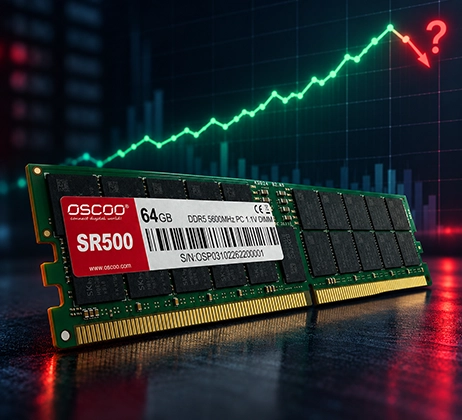
Server memory is more expensive than memory for regular computers for two main reasons. First, server memory uses technologies such as ECC and Register, which place higher demands on hardware design, manufacturing processes, and quality control. This makes the products more expensive to produce. Second, the rapid growth of AI data centers has greatly increased demand for server memory, while DRAM production capacity can only expand at a limited pace. This has tightened market supply.
In addition, demand for HBM (High Bandwidth Memory) from AI chips is affecting how production capacity is allocated across traditional DRAM products, putting further pressure on supply and demand. In simple terms, server memory is expensive both because of its own product costs and because of market conditions driven by the growth of the AI industry.
Higher Production Costs for Server Memory
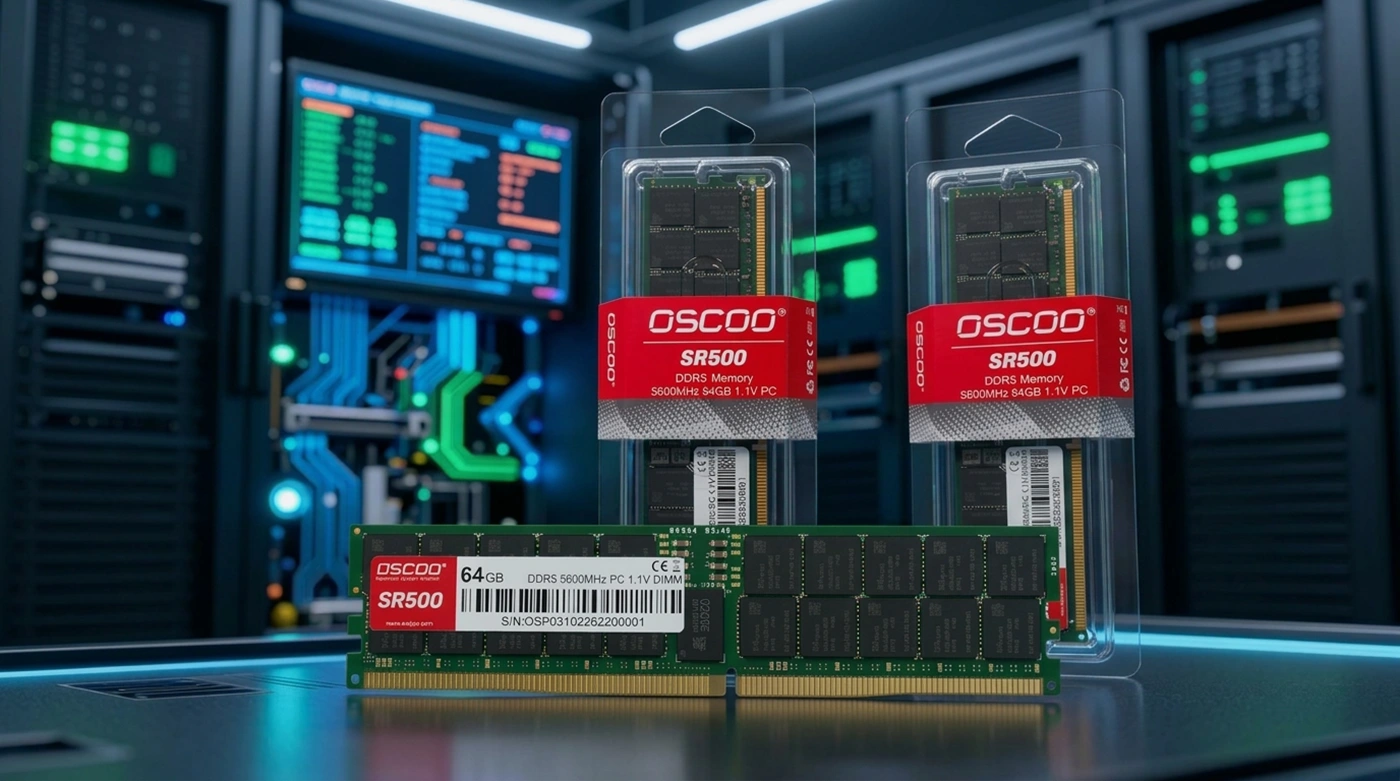
Compared with regular desktop memory, server memory must do more than store data. It also needs to meet enterprise requirements for data integrity, stable operation, and support for large memory capacities. These requirements affect hardware design, manufacturing processes, and quality testing, all of which increase the final product cost.
ECC Technology Increases Hardware Design Costs
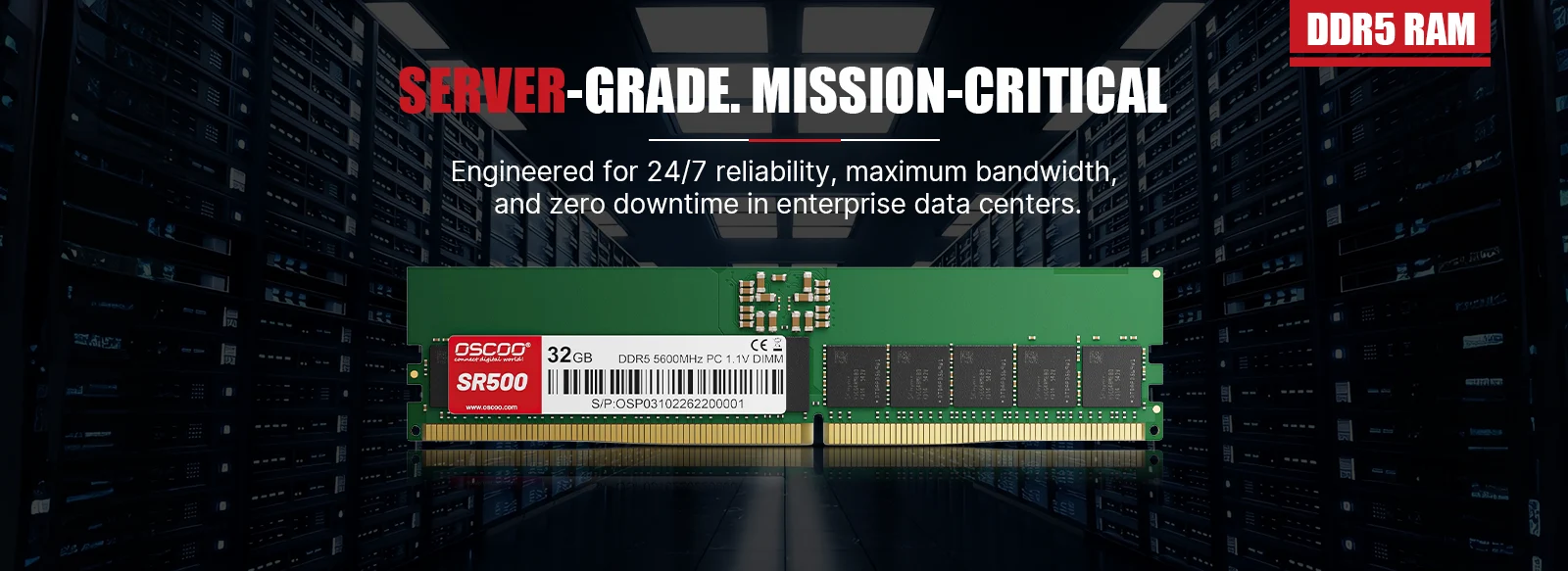
ECC (Error-Correcting Code) is a common technology used in server memory. It is designed to detect and correct memory data errors. During operation, electrical noise, hardware faults, or other factors may cause individual bits of data to change. For example, a bit that should be stored as 0 may become 1. If this error is not detected, it may affect program execution or even cause errors in databases or calculation results. Regular non-ECC memory usually cannot correct these errors. ECC memory, on the other hand, stores additional check information and works with the memory controller to detect and correct errors. The added cost of ECC mainly comes from the extra check bits, the related control logic, and the platform support and validation required.
RCD Register Chips Add to the Cost
An RCD (Register Clock Driver) is a dedicated interface chip on server RDIMM memory modules. Its main purpose is to buffer and resend the command, address, and clock signals from the memory controller. In a server, a memory channel often has two or three memory modules installed, and each module may contain more than a dozen DRAM chips. If the memory controller had to drive all these chips directly, high-frequency signals could be reflected or distorted as they travel through the circuit traces and between chips. At best, this could cause data-sampling errors. At worst, it could cause a system crash or other difficult-to-diagnose problems.
A regular desktop memory channel usually has only one or two modules installed, so the load is lighter and the system can operate reliably without this chip. RDIMM places an RCD between the memory controller and the DRAM chips. The RCD receives the signals, holds them for one clock cycle, reshapes them, and then distributes them to each chip. This means the controller only has to drive the load of a single chip. As a result, the system can support higher capacities per module and more memory slots. The cost of an RCD mainly comes from the dedicated interface chip itself, the selection of components with the wider temperature range required by servers, and joint signal validation with different server platforms.
PMIC Power Management Chips Add to the Cost
A PMIC (Power Management IC) is a voltage-regulation chip that has been mounted directly on memory modules in the DDR5 era. It provides stable, clean power to the DRAM chips and other components on the module. In the DDR4 era and earlier, the voltage-regulation circuits for memory were located on the motherboard. Power traveled from the motherboard to the memory module through long circuit traces and the gold contact fingers. As memory frequencies increased and module capacities grew, this long-distance power delivery method caused problems such as greater voltage ripple, interference from motherboard noise, and voltage drops at the end of the power path. These issues could lead to instability under heavy loads.
Regular desktop memory has fewer chips and lower overall power consumption, so its power-delivery requirements are less demanding. Server memory modules contain more chips and draw higher transient currents. For this reason, the DDR5 standard requires the PMIC to be placed directly on the memory module, with a higher-power, multi-output design that brings the power supply closer to the DRAM chips. The added cost mainly comes from the PMIC itself and its surrounding inductors and capacitors, as well as the higher power specifications and stricter output testing required for server versions.
Multilayer PCBs Increase Manufacturing Costs
The circuit boards used in server memory modules are also thicker and more complex than those used in desktop memory. In addition to DRAM chips, a server memory module contains an RCD, a PMIC, temperature sensors, and many decoupling capacitors. Its component density is much higher than that of a regular memory module. With the high-frequency signals used in DDR5, every circuit trace needs strict impedance control. The power and signal layers must also be kept separate to prevent interference. Regular desktop memory usually works well with a 4- to 6-layer PCB that is about 1.0 to 1.2 mm thick. Server RDIMMs generally need an 8- to 12-layer PCB that is at least 1.6 mm thick.
They also use thicker copper foil and hard-gold-plated contact fingers to meet heat-dissipation needs and withstand repeated insertion and removal. More layers mean more lamination steps and greater use of board materials. Strict impedance tolerances also increase manufacturing and batch-testing costs. These costs are reflected in more expensive board materials, higher manufacturing precision, and more durable surface finishes.
Strict Quality Testing Adds to the Cost
Server memory is generally expected to run continuously, 24 hours a day, 7 days a week, in data center facilities. If a memory module fails, the system often needs to be shut down so the module can be replaced, resulting in high maintenance costs. For this reason, server memory must meet much higher quality standards before it leaves the factory than consumer products. Regular desktop memory usually undergoes only basic functional testing before shipment. Server memory modules, however, need to go through high-temperature burn-in testing one by one. These tests simulate months of heavy-load operation in a short period and identify chips that are likely to fail early, allowing them to be removed at the factory.
In addition, server memory must pass platform compatibility certification from server manufacturers such as Dell, HP, and Cisco. This ensures that the memory is recognized correctly and operates reliably with specific motherboards and firmware versions. These testing and certification processes do not appear directly on the bill of materials, but their labor, equipment, and time costs are spread across every finished product. They therefore become part of the selling price of server memory.
The AI Industry Is Driving Strong Demand for Server Memory
As the AI industry grows, AI data centers need large amounts of memory. However, DRAM manufacturers cannot expand production capacity quickly. At the same time, AI-specific memory products such as HBM are competing for limited DRAM manufacturing resources. As a result, demand in the server memory market is growing faster than supply.
AI Data Centers Are Increasing Demand for Server Memory
AI data centers have been an important driver of the recent growth in server memory demand. Traditional servers are mainly used for tasks such as website hosting, databases, file storage, and virtualization. AI servers must also handle model training, inference, and data processing. These tasks rely not only on GPU memory but also on large amounts of CPU system memory (System RAM). In particular, with the development of AI Agent and RAG applications, more and more companies are deploying AI systems on their own servers and in their own data centers. These applications need more than GPUs. They also require CPUs, memory, and storage devices to work together. Therefore, the expansion of AI infrastructure is driving demand for both HBM and server DDR5 RDIMMs.
According to a market analysis published by TrendForce in September 2026, global DRAM industry revenue reached approximately US$154.73 billion in the second quarter of 2026, up 59.5% from the previous quarter. Growing demand from AI servers for products such as HBM and high-capacity RDIMMs was one of the important factors driving the market.
Growing HBM Demand Affects the Supply of Traditional DRAM
HBM (High Bandwidth Memory) is high-performance memory designed specifically for GPUs and AI accelerators. It provides much higher bandwidth than regular DDR memory, so it is widely used in high-performance computing and AI accelerators. Although HBM and regular DDR memory are different types of products, both rely on DRAM wafer manufacturing capacity. Manufacturers must allocate wafer capacity, equipment, R&D resources, and capital across different products.
When demand for HBM grows rapidly in the AI market, major DRAM manufacturers such as Samsung, SK hynix, and Micron adjust their production resources based on market demand and product profitability. If more resources are allocated to HBM, the growth in supply of traditional DRAM products may be limited. Therefore, rising HBM demand does not only push up the price of memory designed for AI. It may also affect the supply of regular server DDR5 memory through the allocation of production capacity.
DRAM Manufacturers Cannot Expand Capacity Quickly
Even when demand in the memory market rises suddenly, DRAM manufacturers cannot increase supply significantly in a short period. This is because DRAM manufacturing is a capital-intensive industry. Building and operating advanced wafer fabs requires large amounts of funding, equipment, and specialized technology. A new semiconductor factory usually has to go through several stages before it can achieve stable mass production, and the entire process takes a long time. In addition, the DRAM industry must consider the manufacturing processes, packaging capacity, and customer certification requirements for different products. As a result, when AI data centers rapidly increase their memory purchases, suppliers find it difficult to meet the market’s needs immediately by expanding production.
Overall, the high price of server memory is the result of both product costs and market supply-and-demand conditions. The current high prices are not simply due to brand premiums or short-term speculation. They are shaped by technical specifications, quality requirements, and the industry’s production-capacity cycle. Until a large amount of new production capacity comes online, these high prices are likely to remain for some time.