In everyday computer use, many people have experienced programs crashing unexpectedly, files becoming corrupted for no obvious reason, or systems suddenly showing a blue screen and restarting. These failures are often blamed on software bugs or user errors. However, some of them are actually caused by silent bit flips occurring in memory. In critical business systems such as enterprise servers and databases, these random errors can cause serious data loss and business interruptions. ECC RAM is a key hardware solution designed to address this problem.
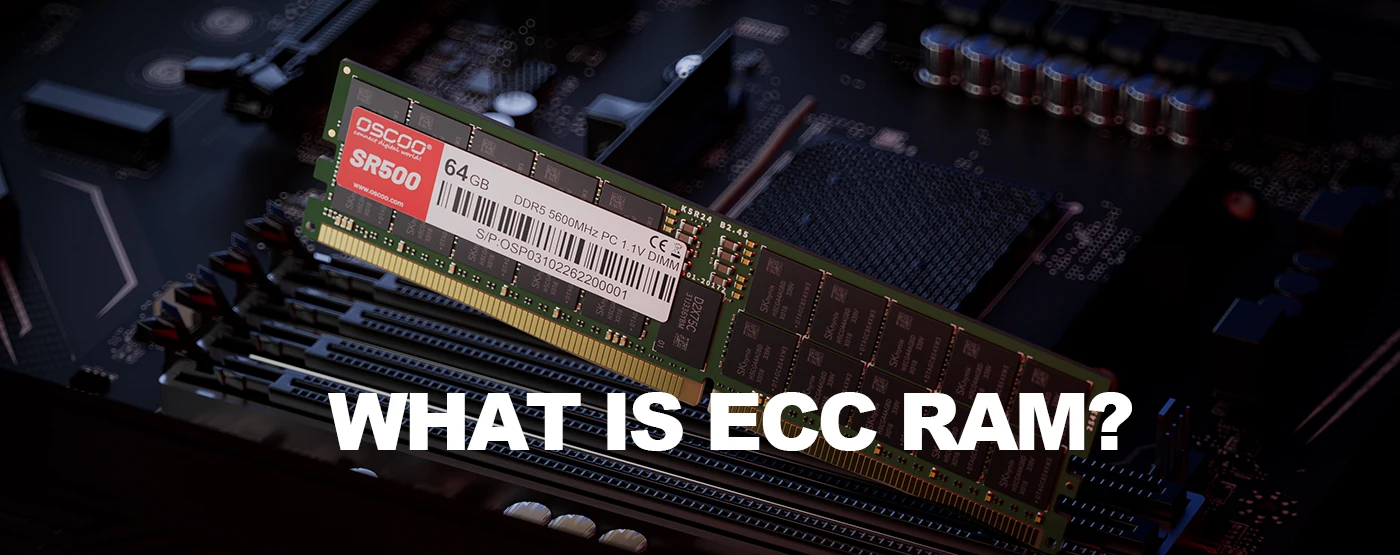
What is ECC RAM?
ECC RAM stands for Error-Correcting Code Random Access Memory. It is a specialized type of memory that can detect data errors and automatically correct them. Its core value is that it can repair common bit-flip errors in memory without interrupting system operation, protecting data integrity and system stability.
Before ECC technology became widely used, server systems mainly used parity memory, which could only detect errors. This type of memory could find errors but could not correct them. Once an error was detected, the system often had to shut down to prevent the corrupted data from spreading. As computing systems have placed greater demands on reliability, ECC memory, which can correct errors automatically, has gradually become mainstream and is now one of the standard configurations for all critical business computing systems.
Main Causes of Memory Bit-Flip Errors
ECC memory mainly protects against soft errors in memory. In other words, the memory hardware itself has not suffered physical damage; instead, external interference causes temporary bit-value changes. These errors do not cause permanent hardware damage, but they can change the stored data, and the process is completely invisible and difficult to diagnose afterward. Common causes can mainly be divided into three categories.
Cosmic rays and high-energy particles. High-energy particles such as neutrons and alpha particles in the atmosphere continuously strike semiconductor memory cells, causing changes in the charge within the cells and resulting in bit flips. This is the main source of soft errors in servers that run for long periods. Long-term monitoring of Google’s server clusters has shown that, on average, each server experiences 1 to 5 correctable memory errors per month, and the probability of a detectable error occurring in a single memory module exceeds 8% per year. At high altitudes or in space environments, these errors occur significantly more frequently.
Electrical interference. Electromagnetic interference from motherboard circuits, fluctuations in power-supply ripple, and crosstalk during high-speed signal transmission can all interfere with the electrical levels of memory chips and cause bit flips. In data centers with complex wiring and high equipment density, the impact of electrical interference can be more significant.
Environmental stress. Continuous changes in temperature and humidity can cause the electrical characteristics of semiconductor devices to drift, increasing the rate of charge leakage in memory cells and raising the probability of bit flips. In addition to accelerating charge leakage, high temperatures can also worsen electromigration, reducing the long-term reliability of semiconductor devices. This is also one of the reasons why server rooms have strict temperature and humidity control standards.
It should be noted that hard errors caused by physical damage to memory chips are outside the repair capabilities of ECC memory. However, the ECC mechanism can help locate memory chips with persistent errors, making hardware fault diagnosis easier.
The Operating Logic of ECC Error Correction
The core error-correction mechanism used by mainstream ECC memory is Single Error Correction, Double Error Detection, commonly known as SECDED. This mechanism is based on mature error-correcting code algorithms. It uses additional parity bits to locate and correct errors, and the entire process is completely transparent to the upper-layer system.
Simply put, every 64 bits of user data generates 8 bits of error-correction code through an algorithm, forming a 72-bit data unit that is stored in memory. When data is written, the memory controller calculates the corresponding error-correction code based on the original data and stores it in the memory chip together with the original data. When data is read, the controller recalculates the error-correction code based on the data currently being read and compares it with the previously stored error-correction code.
If the two error-correction codes are exactly the same, the data is complete and error-free and can be output normally. If a single-bit error occurs, the error-correction code will show a specific error pattern. The controller can accurately locate the incorrect bit and automatically flip it back to the correct value. The entire process is completed within nanoseconds and does not affect normal system operation. If a two-bit error occurs at the same time, the mechanism can detect that an error has occurred but cannot correct it. In this case, it triggers an uncorrectable error alert to the system, preventing the corrupted data from continuing to spread.
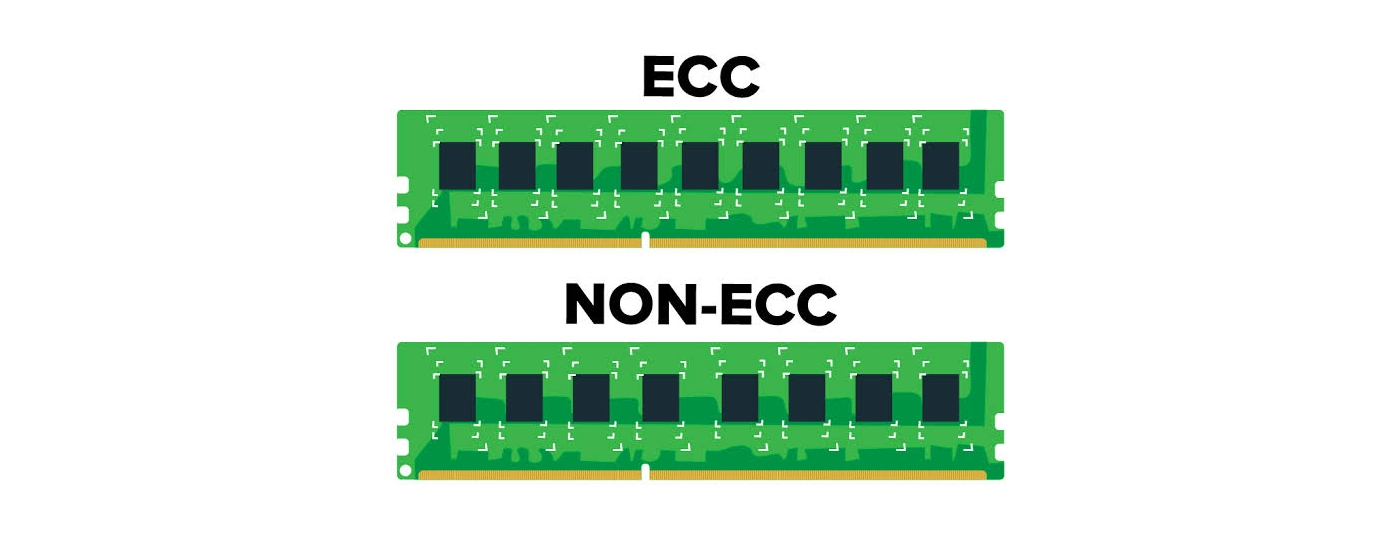
ECC memory can also be visually distinguished from ordinary memory by its hardware design. In the DDR2–DDR4 era, ordinary non-ECC memory modules typically had 8 memory chips in each row, corresponding to a 64-bit data width. Standard ECC memory modules added one dedicated chip, for a total of 9 chips, to store the 8-bit error-correction code.
Capabilities & Limitations of ECC Memory
Capabilities
ECC memory can automatically correct single-bit flip errors without interrupting the system, and the entire process is transparent to upper-layer applications. It can detect errors caused by two bits flipping at the same time and trigger a system alert, preventing silent data corruption from spreading. At the same time, it is a core part of the RAS architecture of computing systems—Reliability, Availability, and Serviceability—and is one of the basic safeguards for achieving 24×7 uninterrupted system operation.
Limitations
ECC memory has limits to its error-correction capabilities. The standard SECDED mechanism can correct 1-bit errors and detect 2-bit errors. More advanced error-correction mechanisms can correct more bit errors, but they require greater storage overhead and are only used in specialized scenarios requiring extremely high reliability.
ECC can only protect data stored in memory. Errors that occur after data has been loaded into the CPU cache are outside the protection range of memory ECC. However, caches in modern high-end CPUs also integrate independent ECC mechanisms, forming multiple layers of protection.
For system-level problems such as motherboard addressing errors, CPU execution logic errors, and data being written to the wrong address, memory ECC cannot provide protection. Similarly, for persistent hard errors caused by physical failure of memory chips, ECC cannot permanently repair the problem and can only identify the faulty location.
Hardware Support Requirements for Enabling ECC
ECC functionality cannot be implemented by memory alone. The entire computing platform must provide hardware support, and all three components are essential.
- CPU and memory controller. Server-grade CPUs, such as Intel Xeon and AMD EPYC series processors, natively support ECC. Most consumer CPUs do not support ECC. Some workstation-grade or commercial CPUs can provide ECC support, but they usually need to be paired with a compatible motherboard to enable it. As of 2026, AMD Ryzen PRO series processors fully support ECC. Some Intel consumer desktop processors, such as the Core Ultra 5 245K and Core Ultra 7 265, have also started to support ECC, but some models in the same series still do not support ECC, and ECC usually needs to be enabled with a workstation-grade motherboard.
- The motherboard. The motherboard must have dedicated ECC circuitry and provide a corresponding BIOS option. Consumer motherboards generally do not support ECC. Even when an ECC-supported CPU and ECC memory are used, the error-correction mechanism cannot be enabled without motherboard support.
- The memory module. A dedicated memory module with ECC functionality must be used. If ECC memory is mixed with non-ECC memory, most platforms will automatically disable ECC functionality, resulting in the loss of error-correction protection.
Enabling ECC is also affected by operating system configuration. Some platforms require ECC to be manually enabled in the BIOS, and some consumer operating systems have limited support for ECC error reporting.
The Actual Impact of ECC Memory on System Performance
Does the error-checking calculation of ECC memory affect system performance? The answer is that the impact is very small. The performance overhead introduced by ECC memory comes from the additional calculation and comparison of error-correction codes during read and write operations. For most enterprise workloads, such as databases, virtualization, and file services, the performance loss is usually in the range of 2% to 3%, which is almost unnoticeable in actual use.
Compared with the improvements in system stability and data integrity provided by ECC, as well as the business losses that can be avoided by preventing unexpected downtime, this performance overhead has much greater business value than its cost. In the DDR5 era, on-die ECC technology integrates error-correction logic inside the memory chips, further reducing the performance overhead caused by error checking while improving chip-level reliability.
Core Differences Between ECC Memory and Non-ECC Memoy
| Comparison | ECC Memory | Ordinary Non-ECC Memory |
|---|---|---|
| Core Function | Automatically corrects single-bit errors and detects double-bit errors | No error-correction capability; bit flips directly cause crashes or data corruption |
| Hardware Configuration | 9 chips, 72-bit width | 8 chips, 64-bit width |
| Cost Level | Usually 25% to 45% more expensive, with a higher premium for enterprise-grade specifications | Lower cost and mainstream in the consumer market |
| Performance | Approximately 1% to 2% of additional checking overhead | No additional error checking; slightly higher theoretical performance |
| Applicable Scenarios | Servers, databases, industrial control, scientific computing | Consumer PCs, gaming consoles, general office use |
| Stability | Greatly reduces the probability of downtime and supports 24×7 uninterrupted operation | Higher probability of errors under long-term high loads, with occasional blue screens or program crashes |
Main Application Scenarios of ECC Memory
ECC memory is the standard configuration for all critical business systems. Its main application scenarios are as follows.
- Enterprise servers. IDC data center servers, cloud servers, and business application servers commonly use ECC memory to ensure long-term error-free operation and reduce maintenance costs.
- Database systems. Relational databases and big data platforms have extremely high requirements for data consistency. ECC memory can prevent bit flips in memory from being written to disk and causing permanent data corruption.
- High-performance computing. Scenarios such as numerical simulation, weather forecasting, and scientific computing require large-scale calculations to run for long periods. A single bit flip may cause the entire calculation result to become invalid, making ECC memory a fundamental safeguard for result accuracy.
- Financial transaction systems. In securities and core banking systems, data errors can directly lead to financial losses and business incidents. ECC memory is a basic requirement for system reliability.
- Industrial control and embedded systems. PLCs and industrial computers operate in complex industrial environments and need to withstand electromagnetic interference and environmental stress. ECC memory can greatly improve system stability. In the automotive electronics field, the ISO 26262 functional safety standard has clear requirements for memory reliability, and ECC is one of the important methods for meeting those requirements.
- Storage and virtualization platforms. NAS and SAN storage devices, as well as virtualization hosts, need to ensure data consistency across multiple tenants and prevent a single-point error from affecting multiple business systems.
Upgrades and Changes in ECC Technology in the DDR5 Era
With the arrival of the DDR5 era, memory error-correction technology has undergone an important upgrade. On-die ECC has become a standard basic feature of DDR5 memory, but it has also caused some conceptual confusion. On-die ECC integrates error-correction logic inside each DRAM chip and performs real-time correction of errors in the storage cells inside the chip. As memory process technology continues to shrink, storage-cell density becomes increasingly high and the amount of charge held by each individual cell becomes smaller, making bit flips more likely.
On-die ECC mainly addresses reliability issues inside the memory chips, improving memory-chip yield and basic stability. It is important to understand that on-die ECC is not the same as traditional module-level ECC. On-die ECC only protects data inside the memory chips and cannot protect against errors that occur while data is being transferred between the memory module and the CPU. Consumer DDR5 memory generally only has on-die ECC and does not have complete module-level ECC functionality.
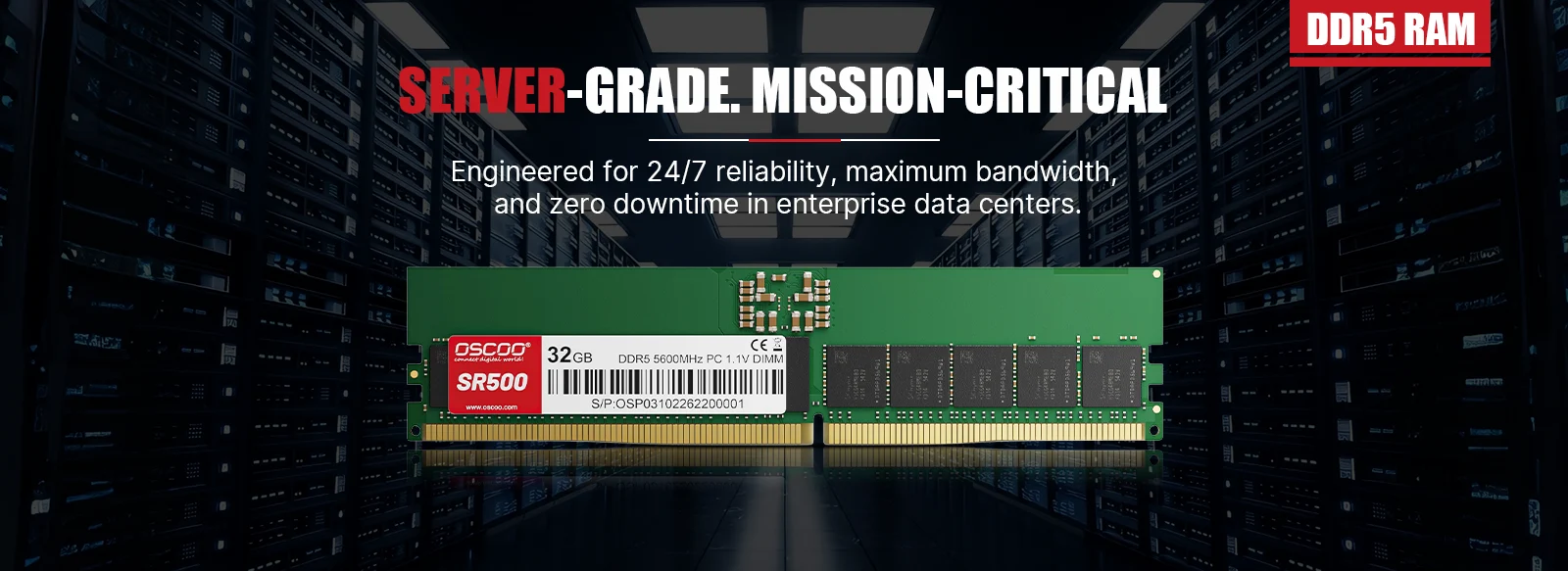
Server-grade DDR5 memory retains traditional module-level SECDED ECC while also using on-die ECC, providing dual protection through chip-level error correction and module-level error correction. Its reliability is further improved compared with the DDR4 era. At the same time, DDR5’s dual-channel DIMM architecture also makes the error-correction mechanism more efficient.
Do I Need ECC Memory?
If the system is used for critical business scenarios and needs to operate continuously 24×7, and data corruption or system downtime would cause significant financial losses—for example, in servers, databases, financial systems, or industrial control—then ECC memory is a necessary configuration. The stability benefits it provides are far greater than the additional hardware cost. If the system is a regular home computer, gaming console, or everyday office device, and occasional program crashes or file corruption would not cause serious consequences, then ordinary non-ECC memory is sufficient, and there is no need to pay the additional premium for ECC.