Server memory is high-speed dynamic random-access memory specifically designed for servers and data center equipment. It serves as a data exchange buffer between the CPU and persistent storage such as hard drives and solid-state drives. It temporarily stores CPU computing data, program instructions, and business interaction data, directly determining the server’s ability to handle multiple tasks, its concurrent response speed, and the stability of business operations.
Unlike memory used in consumer desktop computers, server memory is designed from the beginning for continuous 24/7 high-load operation. Through a series of enterprise-level technologies, it ensures data integrity and system reliability, making it one of the core hardware components that supports continuous business operations.
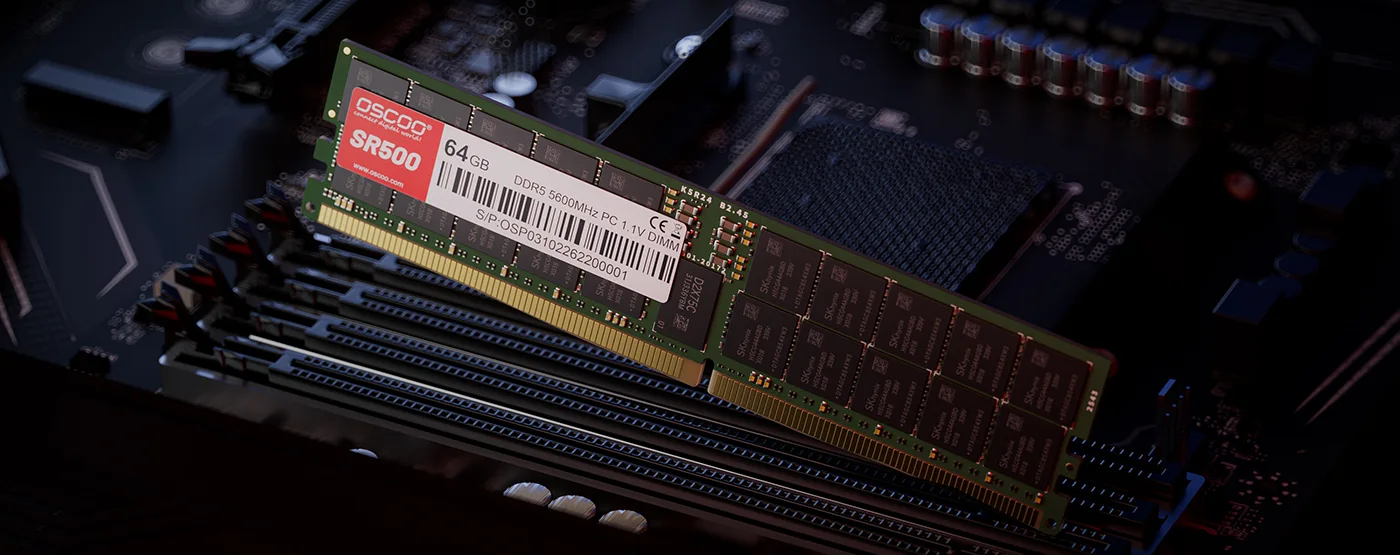
Key Differences Between Server Memory and Desktop Memory
The two are similar in appearance and interface design, but they have fundamental differences in design purpose, technical features, and application scenarios. The following comparison covers several dimensions:
| Comparison Dimension | Server Memory | Standard Desktop Memory |
|---|---|---|
| Error Correction | Standard system-level ECC technology, which can automatically correct single-bit data errors, detect multi-bit errors and issue warnings, avoiding silent data corruption | Most do not have system-level ECC. Consumer DDR5 memory only has on-die error correction, which repairs defects inside memory chips but cannot ensure business data integrity |
| Module Structure | Mainly RDIMM/LRDIMM, with register or buffer chips integrated to isolate electrical loads and improve signal integrity when multiple memory modules are installed | All are unbuffered DIMMs, with memory chips directly connected to the memory controller and no register design |
| Capacity Expansion | A single module can reach 32GB, 64GB, 128GB, or even 256GB. Dual-socket servers can support total capacity at the TB level | A single module is commonly 8GB to 48GB. The total capacity of consumer desktop platforms usually does not exceed 128GB |
| Fault Tolerance | Supports enterprise-level fault-tolerance features such as Chipkill, memory mirroring, and memory hot-plugging, allowing business operations to continue during a single-point failure | No advanced fault-tolerance features. Memory errors can easily cause system blue screens or program crashes |
| Validation Standards | Passes industrial-level validation for high temperatures, continuous loads, and multi-platform compatibility, making it suitable for demanding operating environments | Validated for everyday office and entertainment scenarios, with a focus on short-term performance and cost control |
Main Types of Server Memory
Based on module buffering structure and technical features, server memory is mainly divided into four types, each suited to different business scenarios and performance requirements.
ECC Unbuffered Memory (ECC UDIMM)
This type of memory retains ECC error correction but does not have integrated register or buffer chips. The memory chips are directly connected to the memory controller. It has lower latency and a lower cost than registered memory, and it can support some workstation and entry-level server platforms. Due to its limited electrical load capacity, it supports fewer memory modules, and its maximum capacity is also relatively low. It is mainly used in entry-level single-socket servers, small workstations, and lightweight office business systems.
Registered Memory (RDIMM)
Registered memory is the mainstream choice for current enterprise servers. A register chip is integrated in the center of the module to buffer and forward address, control, and clock signals. This design greatly reduces the electrical load on the memory controller, allowing more memory slots to operate stably at the same time and providing stronger signal integrity. The register introduces a very small increase in transmission latency, but for most enterprise businesses, it is almost negligible. This type of memory is widely used in general enterprise servers, virtualization platforms, conventional databases, and various business systems.
Load-Reduced Memory (LRDIMM)
Load-reduced memory upgrades registered memory to a fully buffered architecture. Buffer chips completely isolate the DRAM chips from the memory controller, resulting in a lower electrical load and supporting higher-density memory chips and more ranks. A single module can have a capacity of more than 128GB. Its cost is higher than registered memory, and its latency is also slightly higher. It is the preferred solution for large-capacity memory expansion and is mainly designed for high-density virtualization hosts, large in-memory databases, big data analysis, and hyper-converged infrastructure.
Multiplexed Rank Memory (MRDIMM)
Multiplexed rank memory is a new generation of high-performance server memory technology that emerged in the DDR5 era. By integrating multiplexers and buffers on the module, the two ranks on a single memory module can work in parallel, greatly increasing memory bandwidth without increasing the number of physical channels.
First-generation products have achieved a transfer rate of 8800MT/s, while the second generation can reach 12800MT/s. They are also compatible with standard DDR5 physical interfaces, so there is no need to replace the motherboard memory slots. This technology is particularly suitable for scenarios with extremely high memory bandwidth requirements, such as high-performance computing, AI training and inference, and high-throughput data processing. It is expected to see large-scale deployment over the next two to three years.
Core Reliability Technologies
The value of server memory lies not only in capacity and performance, but also in its comprehensive reliability design. These technologies are critical to ensuring continuous business operations.
ECC Error Checking and Correction
ECC is a basic standard technology for server memory. It uses additional check bits to verify transmitted data in real time. It can automatically correct 1-bit data-flip errors and detect multi-bit errors before sending an alert to the system. During years of continuous server operation, cosmic rays, electromagnetic interference, and chip aging can all cause memory bit flips. Ordinary memory may directly cause system crashes or silent data corruption. ECC technology can repair errors without interrupting business operations, making it a core protection mechanism for ensuring data integrity. It should be noted that on-die error correction in consumer DDR5 memory is only used to repair manufacturing defects inside memory chips. It is not the same as system-level ECC on servers and cannot replace enterprise-level error correction capabilities.
Chipkill Chip-Level Fault Tolerance
Chipkill technology is similar to RAID in hard drives. When one memory chip completely fails, the system can use the check information from the remaining chips to recover the data of the failed chip. This allows the server to continue operating even when a single memory chip is damaged, avoiding business interruption caused by a single-point failure. Traditional ECC can only handle individual bit errors, while Chipkill can tolerate the complete failure of an entire memory chip, greatly improving system availability. This technology usually requires x4-width memory chips and is a standard configuration for critical business servers.
Memory Mirroring
Memory mirroring writes data to two identical groups of memory modules at the same time. When the primary memory fails, the system automatically switches to the mirrored copy, ensuring that data is not lost and business operations are not interrupted. This is a common configuration for high-availability architectures. The cost is that the available memory capacity is reduced by half. It is mainly used in critical systems such as finance and telecommunications, where extremely high availability is required.
Memory Hot-Plugging
Some high-end fault-tolerant servers support memory hot-plugging technology. Faulty memory modules can be replaced while the system remains powered on and business operations continue, minimizing business downtime and meeting the high-availability requirements of critical systems.
Typical Application Scenarios
Different business scenarios have significantly different requirements for server memory. Proper selection can achieve the best balance between cost and performance.
- Enterprise virtualization platforms usually require large memory capacity to support more virtual machines and improve resource utilization. Registered memory and load-reduced memory are the mainstream choices.
- Large databases and in-memory computing scenarios, such as Oracle, SQL Server, and Redis clusters, rely on large memory capacity to reduce disk I/O and improve query response speed. Large-capacity load-reduced memory is usually preferred.
- Cloud computing and data center scenarios require high-density, highly stable memory configurations to support concurrent multi-tenant business and ensure service-level agreements.
- High-performance computing and AI scenarios have extremely high memory bandwidth requirements. Multiplexed rank memory is becoming a new choice for these scenarios.
- Storage and backup servers usually use large amounts of memory as data caches to improve file read/write and data backup efficiency.
Selection and Deployment Recommendations
The selection and deployment of server memory directly affect system stability and performance. The following points require particular attention.
- Platform compatibility should be the top priority. Different CPUs and motherboards support different memory types, frequencies, and maximum capacities. Before purchasing, the platform specifications need to be confirmed to avoid compatibility problems. For example, some entry-level platforms do not support load-reduced memory, and mixing incompatible modules may prevent the system from booting.
- Use symmetrical deployment with the same specifications. It is recommended to use memory from the same brand, with the same capacity, frequency, and rank, in the same server, and install it symmetrically by channel to avoid compatibility problems and performance loss.Different types of memory must not be mixed. In mild cases, the system may fail to boot; in severe cases, hardware may be damaged.
- Choose capacity and type according to actual needs. For conventional business, registered memory with a good cost-performance ratio should be preferred. For extremely large memory requirements, choose load-reduced memory. For high-bandwidth scenarios, the new generation of multiplexed rank memory can be considered. Capacity planning should reserve a certain amount of redundancy to meet future business growth requirements.
Server memory is one of the core components of enterprise IT infrastructure. It is not only a data bridge between the CPU and storage, but also an important guarantee for stable business operations. Compared with consumer memory, it provides fundamental improvements in error correction, reliability, and scalability, and can support high-load operation 24/7. With the widespread adoption of DDR5 technology and the gradual maturation of multiplexed rank memory, the performance and reliability of server memory will continue to improve, providing stronger support for emerging businesses such as AI and big data.