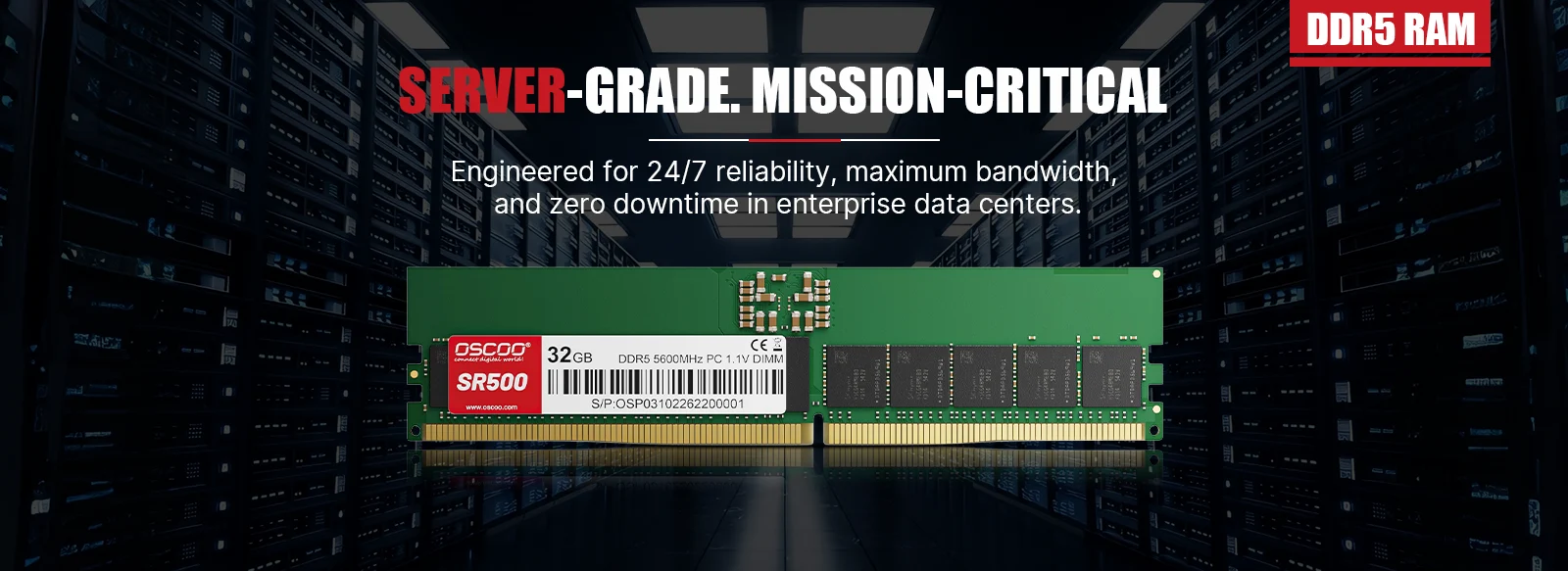
RDIMM stands for Registered Dual In-line Memory Module. It is also commonly called registered memory. It is a type of memory mainly used in servers and data centers that need large memory capacity and stable operation. It uses a Register Clock Driver (RCD) to buffer signals such as commands, addresses, and clocks, helping reduce the electrical load on the memory controller.
What Does RDIMM Mean?
The name RDIMM has two parts. The R in RDIMM refers to its registered design, which means that signals such as commands and addresses are buffered by registers. DIMM stands for Dual In-line Memory Module. A DIMM is a common type of memory module. It contains multiple DRAM chips and connects to the motherboard through gold-plated contacts. Compared with a traditional DIMM, an RDIMM adds registered signal-processing circuitry, allowing the memory system to manage command, address, and clock signals more effectively.
In a server, the CPU usually has an integrated memory controller that coordinates memory read and write operations. When multiple memory modules are installed, the controller must drive a greater signal load. An RDIMM uses a Register Clock Driver to buffer the relevant signals. This improves signal integrity and helps the server support more memory modules. Therefore, RDIMM describes the design type of a memory module, not its capacity, frequency, or DDR technology generation.
How RDIMM Works
In an RDIMM, relevant signals such as commands, addresses, and clocks pass through the Register Clock Driver on the module before reaching the DRAM chips. The data bus usually does not pass through this register. Instead, it connects the memory controller directly to the memory chips. This design reduces the electrical load that the memory controller would otherwise face when directly driving the command and address networks. When a server has multiple memory modules installed, reducing the signal load helps maintain signal quality and timing stability. However, RDIMMs do have some performance cost. The register introduces a certain amount of signal delay, and actual memory performance is also affected by operating frequency, timings, memory-channel configuration, and the CPU platform.
Common Uses of RDIMM
RDIMMs are mainly used in computing environments with high requirements for memory capacity, stability, and expandability.
- Enterprise servers and data centers. These systems usually need to support multiple memory channels and memory slots. The registered design of RDIMMs helps manage a larger signal load and is suitable for common enterprise server configurations.
- Virtualization and cloud computing. A physical server may run multiple virtual machines at the same time. A larger system memory capacity helps provide more resources to virtual machines, but the final supported capacity depends on the server platform.
- Databases and data analytics. Some database systems use large amounts of memory to cache data, reducing storage access and improving response times. RDIMMs can be one memory configuration option for these servers.
- Artificial intelligence and high-performance computing. Some AI and high-performance computing servers need large amounts of system memory to process data and run tasks. RDIMMs can meet the memory needs of some of these platforms, but they are not GPU memory, and installing them does not necessarily improve GPU computing performance.
Advantages and Limitations of RDIMM
Main Advantages of RDIMM
- Helps improve signal integrity. An RDIMM uses a Register Clock Driver (RCD) to buffer relevant signals such as commands, addresses, and clocks. This reduces the electrical load when the memory controller drives these signals directly. In servers with multiple memory modules, this design helps control signal quality and timing and supports stable memory-system operation.
- Better suited to expanding server memory capacity. When a server needs multiple memory modules, the electrical load on the memory controller usually changes with the configuration. By buffering the relevant signals, RDIMMs provide more favorable electrical conditions for supporting additional memory modules. This is especially important for virtualization platforms, database servers, and large enterprise applications.
- Suitable for enterprise applications that run for long periods. RDIMMs are widely used in enterprise servers and data centers. They can work with a server platform’s memory management, ECC, and other reliability features to meet enterprise needs for stable operation and memory expansion.
- Balance capacity, cost, and performance. For servers that need a large memory capacity but do not necessarily aim for the highest possible memory density in a single system, RDIMMs are usually a practical choice. Compared with LRDIMMs, which require additional data buffering, RDIMMs can balance performance, capacity, and cost in many server configurations.
Main Limitations of RDIMM
- The register adds some access delay. The register in an RDIMM receives and forwards relevant signals such as commands, addresses, and clocks, so it introduces additional signal-processing delay. In comparison, a UDIMM does not have an RDIMM-style command and address register. Under otherwise similar conditions, it may have lower related latency.
- Purchase costs are usually higher than those of standard memory with similar specifications. RDIMMs require additional registers and a corresponding module design. They are generally aimed at the server market, so they often cost more than standard UDIMMs with similar capacity and technology generation.
- Compatibility requirements are stricter. An RDIMM cannot be used directly in a standard desktop computer or another system that supports only UDIMMs simply because the slots look similar. The processor and motherboard must provide the required support.
- Installing more memory does not necessarily mean higher operating speed. RDIMMs help expand memory capacity, but after more modules are added, the maximum memory speed supported by the server may be limited. Actual operating speed depends on the processor model, the number of modules installed per memory channel, the organization of the memory chips, and the configurations supported by the platform.
- RDIMMs cannot eliminate the risk of memory failures. The registered design improves signal management, but it cannot guarantee that the memory system will never have errors. The register in an RDIMM also cannot replace ECC, memory diagnostics, redundancy design, or regular maintenance.
Differences Between RDIMM and UDIMM
UDIMM stands for Unbuffered Dual In-line Memory Module. It is also commonly called unbuffered memory. The main difference between UDIMM and RDIMM is how command, address, and clock signals are handled. A UDIMM does not use the same command and address registers as an RDIMM, so the memory controller must drive these signals directly. Because its structure is relatively simple, UDIMMs are commonly used in standard desktop computers and some workstations and entry-level computing systems. RDIMMs buffer the relevant signals through registers, making them better suited to servers that need multiple memory modules and greater total memory capacity.
| Comparison Item | UDIMM | RDIMM |
|---|---|---|
| Full Name | Unbuffered Dual In-line Memory Module | Registered Dual In-line Memory Module |
| Command and Address Signals | Do not pass through an RDIMM-style register | Buffered by a register |
| Typical Applications | Desktop computers and some workstations | Enterprise servers and data centers |
| Memory Expandability | Limited by the platform and electrical load | Usually better suited to expansion with multiple modules |
| Compatibility | Motherboard must support UDIMM | Platform must support RDIMM |
Differences Between RDIMM and LRDIMM
LRDIMM stands for Load-Reduced Dual In-line Memory Module. RDIMMs mainly use registers to buffer command, address, and clock signals. LRDIMMs also use data buffers to further reduce the electrical load on the data bus, helping certain server platforms support higher memory capacities. RDIMMs and LRDIMMs generally cannot be mixed freely. Before upgrading a server, check the manufacturer’s memory compatibility list and installation rules.
| Comparison Item | RDIMM | LRDIMM |
|---|---|---|
| Full Name | Registered Dual In-line Memory Module | Load-Reduced Dual In-line Memory Module |
| Main Design | Buffers command, address, and clock signals | Buffers command, address, and clock signals, and further reduces the data-bus load |
| Typical Use | General-purpose enterprise servers | Servers with high memory-capacity and density requirements |
| Key Selection Factor | Balance of performance, capacity, and cost | Maximum capacity and memory density supported by the platform |
Differences Between DDR4 RDIMM and DDR5 RDIMM
RDIMMs can use different generations of DDR SDRAM technology. DDR4 RDIMMs and DDR5 RDIMMs are both registered memory modules, but they use different memory technology specifications and physical interfaces. DDR5 RDIMM is not a replacement for RDIMM. It is an RDIMM that uses DDR5 technology. DDR4 and DDR5 memory cannot be used interchangeably. Even if two memory modules have the same capacity, that does not mean they can be installed on the same motherboard.