What is DDR5 RAM? A Complete Guide

DDR5 stands for Double Data Rate 5 Synchronous Dynamic Random-Access Memory. Developed by JEDEC, it is the latest mainstream memory standard for consumer and commercial devices, and the official successor to DDR4.

As the temporary working storage of a computer, RAM directly affects system fluency, multitasking capability and data transfer efficiency. Different from older generations, DDR5 is designed to match modern multi-core processors, gaming, video editing, AI computing and other heavy-duty workloads. It solves the long-standing pain points of DDR4 such as limited bandwidth, low maximum capacity and relatively high power consumption, striking a better balance between performance, stability and energy efficiency.

A Brief History of DDR5
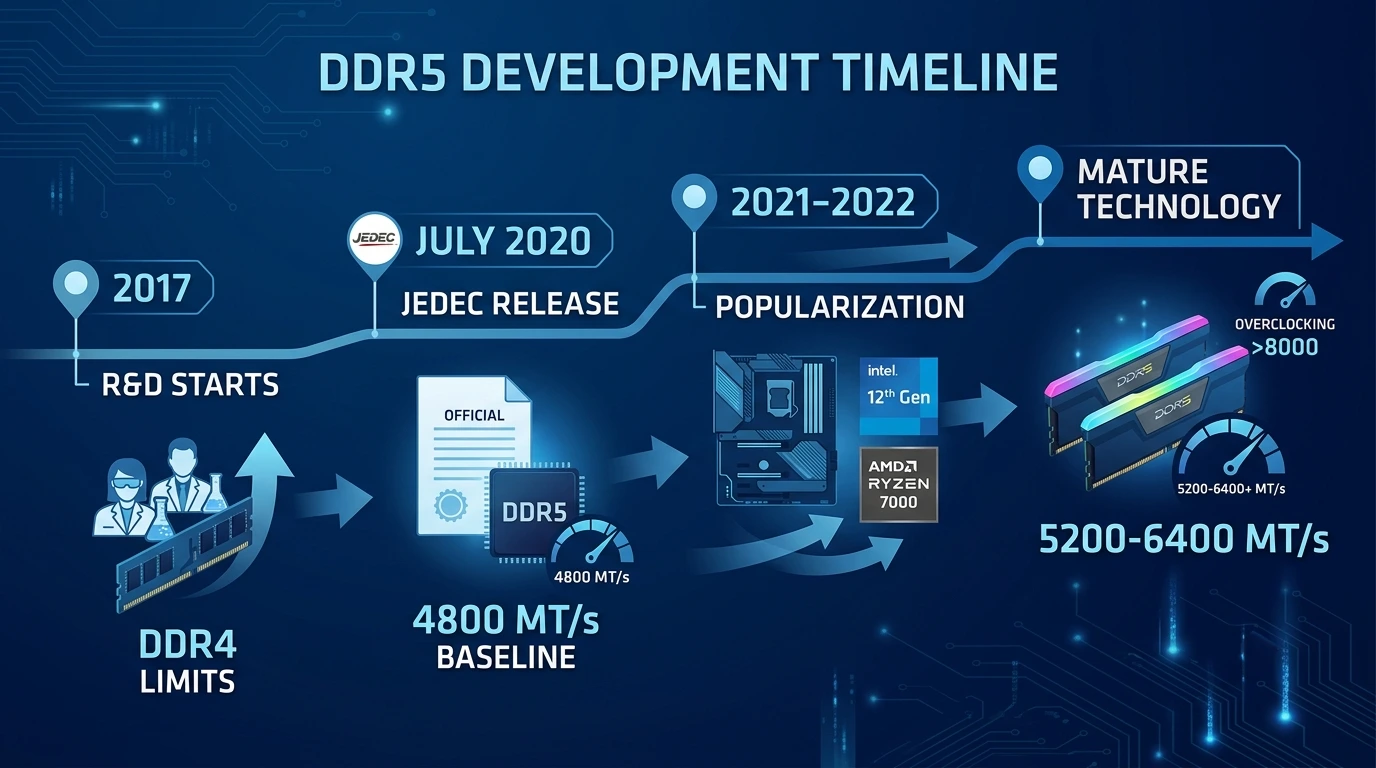
The research and development of DDR5 started back in 2017. At that time, DDR4 had been widely used for nearly a decade, and its performance limit could no longer keep up with the continuous upgrades of hardware and software. In July 2020, JEDEC officially released the complete DDR5 specification, setting a baseline speed of 4800 MT/s and marking the official launch of this new memory technology.
brief history of DDR development What is DDR5 RAM? A Complete Guide
The year 2021 to 2022 became the popularization period for DDR5. Intel’s 12th Gen Core processors and AMD Ryzen 7000 series rolled out platforms with full DDR5 support, bringing the new standard to mainstream consumer products. After years of iteration and optimization, DDR5 has become fully mature from a technical perspective. Its mainstream speed ranges from 5200 MT/s to 6400 MT/s, and overclocked modules can even exceed 8000 MT/s. 

Core Technical Innovations of DDR5

DDR5 is not just a minor upgrade with higher frequency. It features comprehensive redesigns on architecture, power supply and error correction, bringing fundamental changes to how memory works.
Core Technical Innovations of DDR5 What is DDR5 RAM? A Complete Guide
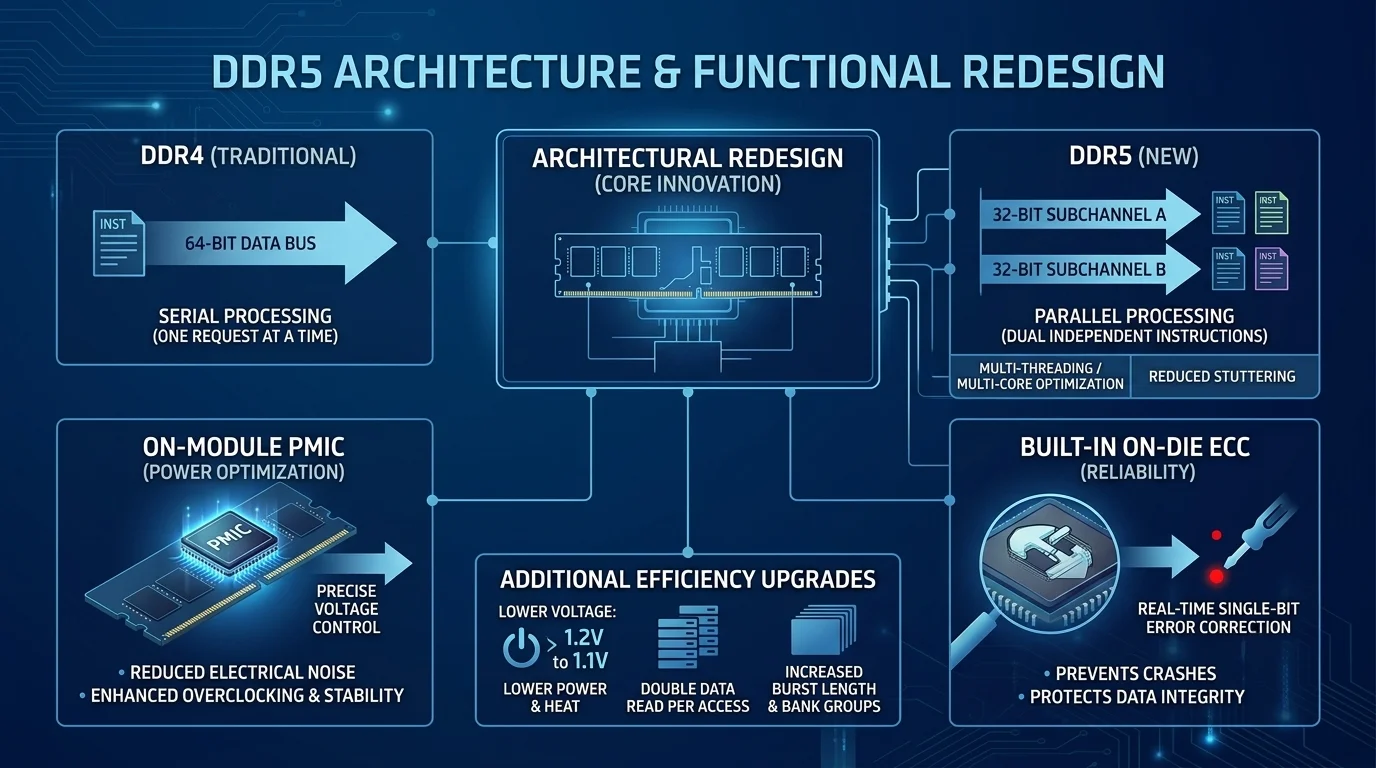
Dual independent 32-bit subchannels are the most critical upgrade. Traditional DDR4 uses a single 64-bit data bus, which can only process one set of data requests at a time. DDR5 splits the 64-bit bus into two separate 32-bit subchannels, enabling parallel processing of two groups of instructions. This greatly improves efficiency for multi-threaded tasks, works perfectly with today’s multi-core CPUs, and effectively reduces stuttering and loading delays.
On-module Power Management IC (PMIC) optimizes power delivery stability. DDR4 relies on the motherboard for voltage regulation, which leads to complex circuits, voltage fluctuations and signal interference. DDR5 integrates the PMIC directly onto the memory module. It delivers more precise and cleaner voltage control, reduces electrical noise, allows high-speed memory to run more steadily, and creates better conditions for overclocking.
The built-in on-die error correction code (ODECC) greatly enhances reliability. DDR4 has no native error correction function, and minor data errors inside memory chips can only be fixed by system restarts. DDR5 is equipped with on-die error correction, which can automatically correct single-bit errors inside chips in real time. This prevents blue screens, program crashes and data loss caused by memory faults, especially for devices running under heavy loads for long hours.
Besides the above upgrades, DDR5 increases burst length and the number of bank groups, doubling the amount of data read per access and raising the ceiling for parallel processing. Its operating voltage is lowered from 1.2V to 1.1V, so it delivers stronger performance while consuming less power. This helps extend laptop battery life and reduce heat generation on desktops.
oscoo 2b banner 1400x475 1 What is DDR5 RAM? A Complete Guide

DDR4 vs DDR5

To show the differences between DDR4 and DDR5 more intuitively, here is a comparison of mainstream industry-standard parameters, which clearly presents the overall improvements of DDR5.
ParametersDDR4 RAMDDR5 RAMMain Advantages
Standard Speed Range2133-3200 MT/s4800-6400 MT/s (overclockable to 8000+ MT/s)Nearly doubled base speed and higher performance ceiling
Maximum Capacity per Stick32GB128GBLarger capacity for professional productivity scenarios
Operating Voltage1.2V1.1VLower power consumption and better heat dissipation
Data Bus ArchitectureSingle 64-bit channelDual independent 32-bit subchannelsStronger parallelism and smoother multitasking
Burst Length816More data read at one time for higher transfer efficiency
Native Error CorrectionNot supportedOn-die error correction enabledHigher operational stability and fault tolerance
Power Regulation LocationControlled by motherboardOn-module PMICMore accurate power delivery and purer signal

Hardware Compatibility

One of the most concerned questions for users is whether old and new memory can be used together. To put it simply: DDR5 and DDR4 are completely incompatible, and they cannot be mixed or replaced with each other.
Physically, the two types of memory have different notch positions on the edge connector and different pin counts. A DDR5 module cannot be inserted into a DDR4 slot, and vice versa, so mixing is impossible from a hardware perspective. In terms of platform support, DDR5 requires dedicated hardware.  It is only compatible with Intel 12th Gen and newer Core processors , as well as AMD Ryzen 7000/8000/9000 series and newer CPUs and matching motherboards. Older platforms do not support DDR5 at all.
There are no mainstream consumer motherboards that support both DDR4 and DDR5. If you want to upgrade to DDR5, you have to replace the CPU and motherboard as a complete set. This was the main reason why DDR5 took some time to gain popularity in the early stage.

Higher CAS Latency Does Not Mean Worse Performance

Some users notice that DDR5 usually has a CAS latency ranging from 30 to 40, while DDR4 runs at 16 to 22. And they believe DDR5 has higher latency and worse real-world experience. This judgment only looks at numbers but ignores the essence. 

Memory latency figures represent the number of clock cycles, not the actual delay in nanoseconds. DDR5 runs at a much higher frequency, so each single clock cycle takes far less time. When converted into absolute latency measured in nanoseconds, mainstream DDR5 performs equally well or even better than DDR4. For example, DDR5-6000 CL30 has an absolute latency of exactly 10 nanoseconds (30 × 2000 / 6000), which is identical to DDR4-3200 CL16 (16 × 2000 / 3200 = 10 nanoseconds).

Combined with the parallel optimization of dual subchannels, DDR5 with seemingly high CAS latency delivers an experience no worse than low-latency DDR4 in daily use and gaming. In most modern workloads, it is actually superior. High-speed DDR5 will show its advantages in fluency more obviously.

Main Application Scenarios of DDR5
Main Application Scenarios of DDR5 What is DDR5 RAM? A Complete Guide
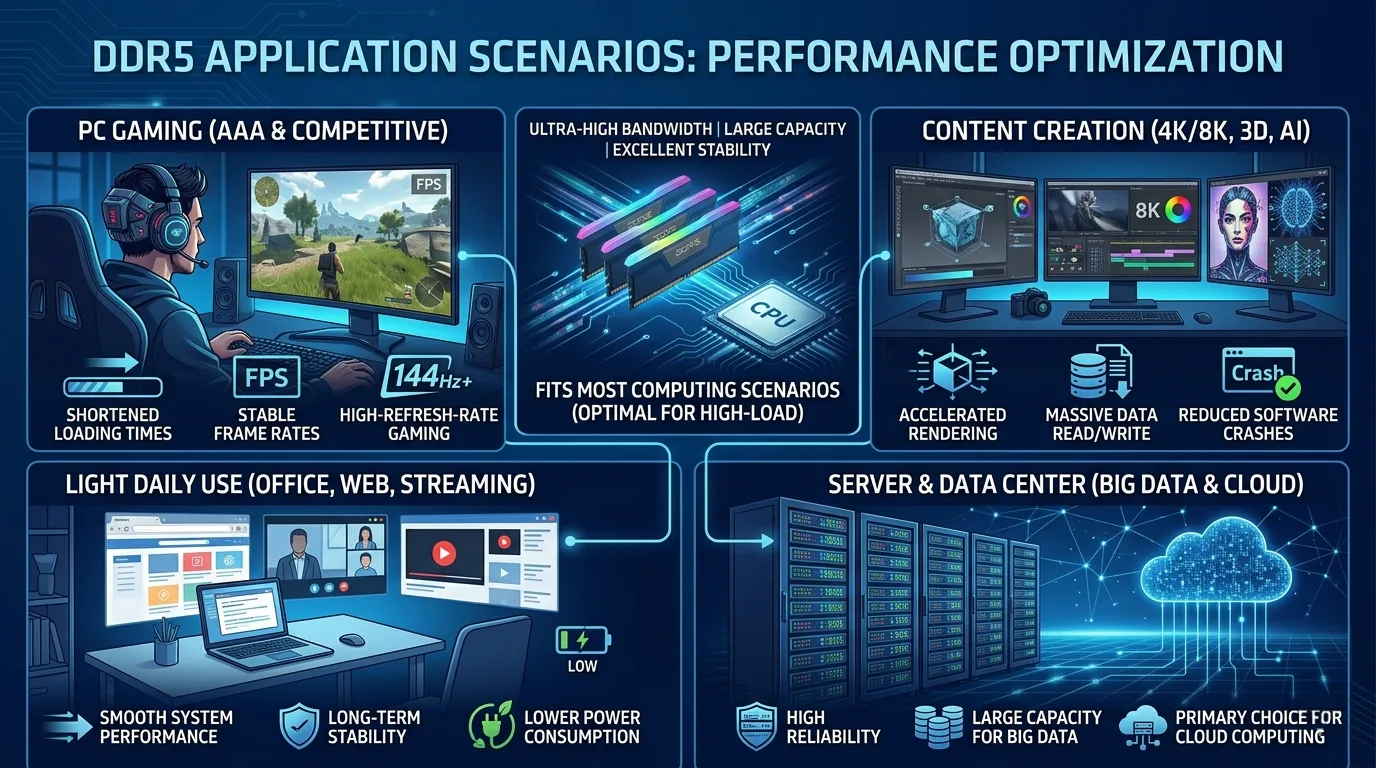
Thanks to its high bandwidth, large capacity and excellent stability, DDR5 fits most common computing scenarios, and its strengths are more prominent in high-load work.
  • For PC gaming, modern AAA titles and competitive online games set higher requirements for memory bandwidth and multitasking capability. DDR5 effectively shortens game loading time, reduces frame drops and unstable frame rates, and works exceptionally well for high-refresh-rate games and large open-world titles.
  • For content creation work, 4K/8K video editing, 3D modeling and rendering, graphic design, AI image generation and local AI computing require continuous reading and writing of massive data. DDR5’s ultra-high bandwidth and large capacity can greatly speed up rendering and file export, and reduce the chance of software freezes or crashes.
  • For light daily use such as office work, web browsing and video streaming, DDR5 may not show extreme advantages, but its lower power consumption and stable performance keep the system running smoothly for a long time and avoid gradual slowdowns. In server and data center fields, DDR5’s high reliability and large capacity also make it the primary choice for big data processing and cloud computing.

Pros and Cons of DDR5 RAM

Core Advantages

  • It features a much higher performance ceiling. Its bandwidth and read/write speed are nearly doubled compared with DDR4, which makes it well prepared for games and software updates in the next few years.
  • The maximum capacity per memory stick is greatly increased, fully meeting the demand for large memory in professional creation and server operation.
  • The lower operating voltage cuts down power consumption and heat output, and brings longer battery life for laptops.
  • Equipped with native on-die error correction and on-module PMIC, it runs more stably under long-term heavy loads with lower failure rates.
  • The dual 32-bit subchannel architecture improves parallel processing ability and delivers a noticeable upgrade for multitasking performance.

Existing Limitations

  • Strict hardware compatibility means users have to replace CPU and motherboard as a full set to use DDR5. Old devices cannot be upgraded directly, leading to relatively high overall upgrade costs.
  • When comparing products of the same grade, high-speed DDR5 modules still come with a certain price premium over DDR4. (since 2025, a severe supply shortage driven by AI/HBM production has caused DDR5 retail prices to skyrocket by 200–400%, making the upgrade financially painful for many users.)
  • Some entry-level high-speed DDR5 memory requires minor BIOS adjustments on the motherboard to reach optimal performance, which creates a slight learning curve for complete beginners.
Buying Guide

For daily office work, video streaming and general home use, a 16GB dual-channel DDR5 module running at 5200 MT/s is the most cost-effective option. It can handle all light tasks easily with sufficient performance headroom.
For mainstream gamers, DDR5 at 6000 MT/s with standard latency (CL30–CL36) is the sweet spot for gaming performance and cost. It balances latency and bandwidth perfectly for most game titles. A 32GB (16GB×2) kit is strongly preferred over 16GB.
For professional content creation, AI computing or large-scale rendering, it is recommended to choose modules of 6400 MT/s or higher. Prioritize 32GB or larger dual-channel memory to make the most of DDR5’s high bandwidth and large capacity and boost work efficiency.
DDR5 RAM is not a gimmicky upgrade, but an inevitable iteration to adapt to the new hardware ecosystem. It solves the long-standing bottlenecks of DDR4 including insufficient bandwidth, limited capacity and poor stability. Although the overall upgrade cost is still relatively high for now, DDR5 has become the mainstream choice for new PCs.
滚动至顶部

Cantact us

Fill out the form below, and we will be in touch shortly.

Contact Form Product