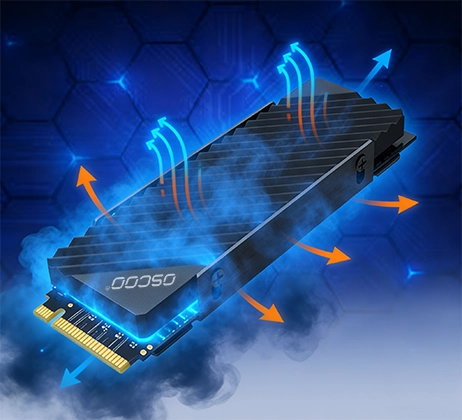
The primary advantage of the 2230 SSD lies in its extremely compact physical footprint, enabling high-speed NVMe storage in space-constrained devices such as handheld gaming consoles and ultra-thin laptops. It remains the only high-performance storage upgrade option for such systems. Current mainstream 2230 SSDs support the PCIe 4.0 interface, with sequential read speeds ranging from 5,000 to 7,000 MB/s. As of 2026, flagship models have also embraced PCIe 5.0, achieving sequential reads exceeding 14,000 MB/s. Capacities span from 256 GB to 4 TB. In everyday use, the performance difference between a PCIe 4.0 2230 SSD and a standard 2280 SSD is negligible. Additionally, 2230 drives offer low power consumption, single‑sided layout, and broad compatibility, making them ideal for mobile devices and fanless systems.
Understanding the 2230 SSD
The 2230 is one of the standard M.2 form factors for solid‑state drives. The “22” denotes a width of 22 mm, and the “30” a length of 30 mm. It is the smallest consumer M.2 SSD size currently available, with a PCB area of only about 660 mm², less than 40% that of the common 2280 form factor. Despite its diminutive size, the 2230 SSD uses the exact same M.2 edge connector and NVMe protocol as the 2280, differing only in component placement due to the compact layout. With the continuous increase in 3D NAND stacking layers, the capacity of a single NAND package has grown significantly. Consequently, the 2230 SSD has evolved from an early low‑capacity entry‑level product into a mature solution capable of meeting mainstream storage needs.
Core Advantages of the 2230 SSD
Extremely Compact Size for Tight Spaces
The small size is the fundamental advantage of the 2230 SSD and the raison d’être for its existence. For devices where internal space is at an absolute premium, longer SSDs simply cannot be installed, making the 2230 virtually the only high‑speed storage option. Such devices include Windows handhelds, 2‑in‑1 tablets, ultra‑thin laptops, mini PCs, and industrial embedded systems. For example, the Steam Deck has only enough room inside its chassis for a 2230 SSD, leaving users with no alternative when upgrading. Similarly, Microsoft’s Surface series and some Dell XPS models only offer M.2 slots that accept the 2230 length. Newer 2026 ultra‑portables, such as the Dell Latitude 3430 and Lenovo ThinkBook 13x, also continue to support this form factor, further broadening its ecosystem.
Single‑Sided Design for Better Physical Compatibility
The vast majority of 2230 SSDs adopt a single‑sided PCB design, with no NAND packages or other components protruding from the back side. This is critical in compact devices. Many thin‑and‑light laptops and handheld consoles have M.2 slots where the back side sits extremely close to the chassis, battery, or cooling modules, leaving very little vertical clearance. Dual‑sided SSDs would cause interference, preventing the lid from closing, stressing the motherboard, or even damaging components. The single‑sided nature of the 2230 SSD ensures near‑universal physical compatibility with all M.2 slots that support this length, eliminating installation conflicts.
Low Power and Heat for Mobile Devices
Due to the limited PCB area, 2230 SSDs generally use power‑efficient controllers and simplified component layouts. Overall, for comparable generations, 2230 SSDs still consume slightly less power than their 2280 counterparts, and their heat output is relatively manageable. For battery‑powered devices such as handhelds and tablets that often lack active cooling, lower power consumption translates to longer battery life and reduced thermal throttling. Within tight, sealed enclosures, heat control directly impacts sustained read/write stability. Although the 2230 has a smaller heat‑spreading surface, its self‑generated heat is comparatively modest, allowing it to maintain steady performance under light workloads.
Performance Meets Mainstream Standards
Early 2230 SSDs were mostly PCIe 3.0 and limited in capacity, but thanks to advances in flash memory, newer models now rival mainstream mid‑range SSDs. Current high‑end 2230 drives generally support PCIe 4.0×4 NVMe, achieving sequential read speeds of 5,000–7,100 MB/s and random IOPS on par with mid‑tier 2280 drives. More significantly, 2026 has seen a major leap: flagship 2230 models like the Samsung PM9E1 and Micron 3610 series now feature PCIe 5.0×4 interfaces. For everyday tasks—system boot, application launches, game loading—a PCIe 4.0 2230 SSD feels indistinguishable from an ordinary 2280 drive, comfortably handling office work, gaming, and light content creation. Capacity‑wise, 2230 SSDs now cover the range from 256 GB to 4 TB. The 2 TB version has become the mainstream choice for handheld upgrades.
Flexible Installation and Usage Scenarios
The M.2 connector of a 2230 SSD is fully compatible with 2242 and 2280 slots, enabling multiple usage approaches. For native support, if the device’s M.2 slot has mounting holes for the 2230 length, the drive can be directly installed. For backward compatibility, a 2230‑to‑2280 extension bracket allows the drive to be used in standard desktop or laptop 2280 slots. For portable expansion, pairing a 2230 SSD with a dedicated enclosure creates an extremely compact high‑speed external SSD, far more pocketable than a 2280‑based portable drive.
Key Specification Comparison
| Dimension | 2230 SSD | 2280 SSD |
|---|---|---|
| Physical size | 22 mm × 30 mm | 22 mm × 80 mm |
| PCB area relative | ~37.5% | 100% |
| Component layout | Almost exclusively single‑sided | Both single‑ and dual‑sided available |
| Mainstream interface | PCIe 3.0 / 4.0 | PCIe 3.0 / 4.0 / 5.0 |
| Typical sequential read | PCIe 4.0: 3,500–7,100 MB/s | 3,500–12,000 MB/s (PCIe 5.0 up to 14,000+) |
| Max consumer capacity | 4 TB | 8 TB+ |
| Typical peak power | 2.5–6.5 W | 5–7 W+ |
| Primary target devices | Handhelds, ultra‑thin laptops, mini PCs | Desktops, standard notebooks |
It should be noted that performance differences mainly emerge in extreme sequential transfers and prolonged high‑load scenarios. In most daily use cases—such as office work, game loading, and regular multitasking—the gap between a same‑generation 2230 and a 2280 SSD with the same protocol is barely noticeable.
The 2230 SSD is a clearly defined niche product—all its strengths revolve around the core principle of “small size.” It is not a replacement for 2280 SSDs but rather the optimal solution for space‑constrained environments. If you use a handheld console, ultra‑thin laptop, or mini PC, the 2230 SSD is virtually your only high‑speed upgrade path, delivering impressive performance and capacity within a tiny footprint. For desktops or standard notebooks, however, 2280 SSDs still hold the edge in price‑to‑performance ratio, maximum capacity, and thermal headroom.