Most regular consumer PCs cannot use mainstream server registered memory. Only a small number of server memory modules, such as unbuffered ECC UDIMMs, may be physically compatible with some platforms. However, the ECC error correction function will usually be disabled, so they work just like regular memory. Most low-cost used server memory on the market is RDIMM, which regular motherboards cannot recognize at all. Regular users are not advised to buy it without first checking compatibility.
Memory Type Is the Key to Compatibility
Server memory is not a single category, and whether it can be used in a regular PC depends entirely on its architecture type. There are currently four main types of server memory.
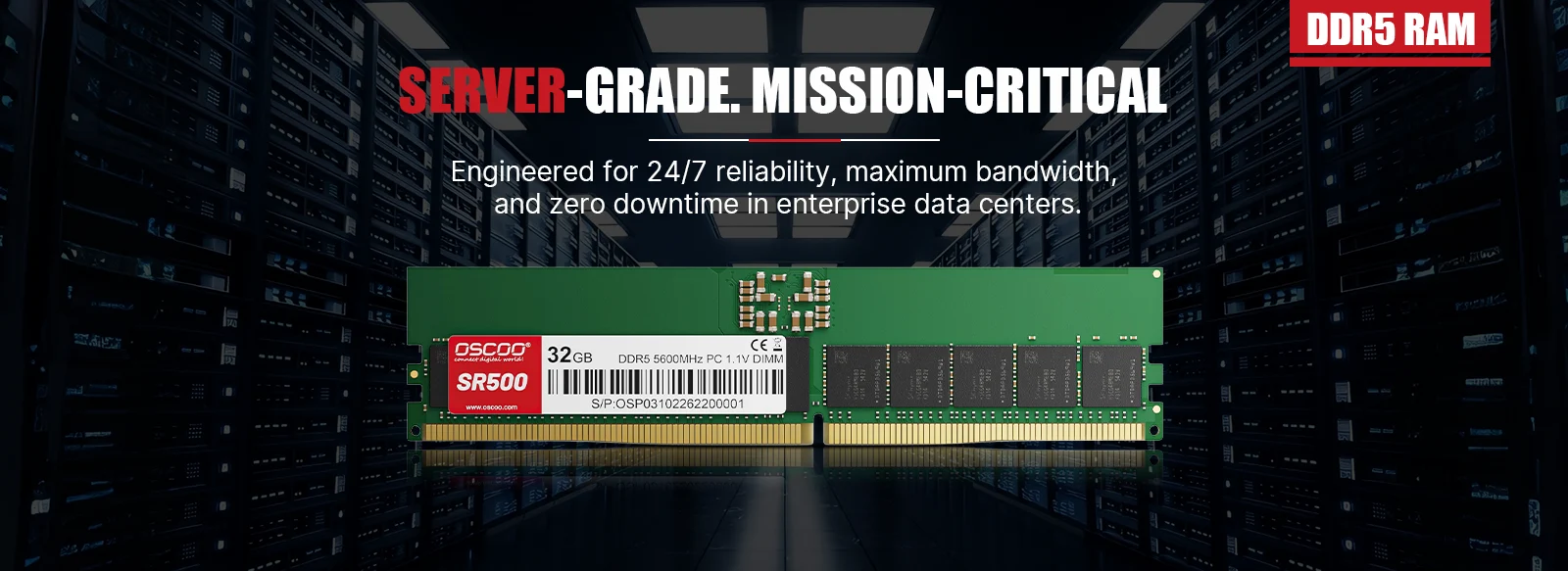
RDIMM, or Registered DIMM, is the most common standard type used in servers. It is completely incompatible with consumer platforms. These memory modules have register chips integrated into them. These chips buffer address and control signals, reduce the load on the memory controller, and allow the motherboard to support more memory slots and a larger total memory capacity. Most RDIMMs also include ECC error correction. This is also the most common type of used server memory on the market.
LRDIMM, or Load-Reduced DIMM, is an upgraded version of RDIMM. It is supported only by high-end multi-socket server platforms and cannot be used on consumer platforms at all. LRDIMM can buffer both address signals and data signals. This allows for higher capacity per module. Common capacities include 64GB and 128GB.
ECC UDIMM, or Unbuffered ECC DIMM, does not have register chips. Its signals connect directly to the memory controller. It only adds ECC error correction circuitry. Its physical size and pin layout are basically the same as those of regular PC memory. It is one of the types of server memory that may be used in a regular PC.
Non-ECC UDIMM, which is used in some entry-level servers. Its hardware specifications are exactly the same as those of consumer memory, so the two can be used interchangeably. However, this type accounts for only a small share of server memory products.
Compatibility on Different Platforms
Different levels of computer platforms have significantly different levels of support for server memory. They need to be considered separately.
Mainstream Consumer Platforms
Mainstream consumer platforms are the systems most commonly used by regular users. They include the Intel Core i series and AMD Ryzen series, together with consumer chipsets such as B760, Z790, B650, and X670. These platforms cannot use RDIMM or LRDIMM at all. The memory controllers in consumer CPUs and chipsets support only the UDIMM protocol. They cannot recognize the signal logic used by registered memory. After installation, the system will fail to pass the power-on self-test.
In the DDR5 era, the position of the notch also distinguishes different memory types. RDIMM physically cannot fit into a consumer memory slot. In the DDR4 era, the notch positions of some models were similar, but they were still electrically incompatible. Even if they were forced into the slot, the system could not start.
ECC UDIMM can physically fit into the slot, but its function will usually not work. Most consumer CPUs and motherboards do not support full ECC error correction. After installation, there are usually two possible results. The first is that the system starts normally, but the ECC function is automatically disabled. Its performance is then exactly the same as regular memory. The second is that some motherboards with stricter BIOS checks cannot boot or report an error directly.
High-End Workstation Platforms
Workstation-class platforms such as Intel Xeon W, Core X, and AMD Threadripper have memory controllers that support UDIMM, RDIMM, and ECC protocols. They can use the corresponding types of server memory normally and can fully enable ECC error correction.
Special-Purpose Platforms
Some multi-drive NAS systems, software routers, and industrial control motherboards may also support server memory. For example, some industrial control boards based on Intel J-series and N-series processors explicitly support ECC UDIMM. Some models even support RDIMM. These devices can use the corresponding types of server memory.
Common Problems When Using Incompatible Memory
If incompatible server memory is forcibly installed in a regular PC, several problems may occur.
- The most common problem is that the computer cannot start at all. After an RDIMM is installed, the motherboard may show no display or warning, or it may report an error directly. The system will be unable to pass the POST self-test. This is the case for the vast majority of consumer platforms.
- A small number of motherboards that can recognize ECC UDIMM may automatically reduce the memory frequency or use abnormal timings. They may even experience occasional blue screens or restarts. System stability cannot be guaranteed.
- Even if the memory can run normally, the core ECC error correction function will be disabled. It will only work as regular memory. This means that the main value of server memory is completely lost.
- In very rare cases, an electrical specification mismatch may cause the memory chips or motherboard slots to burn out. There is a risk of hardware damage. For this reason, forcibly trying to use incompatible memory is not recommended.
A Few Exceptions Where Server Memory May Work
There are a few special situations where server memory can work normally in a regular PC. However, these are all specific cases and do not apply generally.
- Standard UDIMM memory removed from a server. Some entry-level servers and rack-mounted workstations use standard non-ECC UDIMM. This type of memory is no different from consumer memory and can be used directly in a regular PC.
- Special compatibility with older DDR3 platforms. Some ECC memory from the DDR3 era could be used on a small number of older motherboards, such as some P67 and Z77 models, by adjusting the BIOS voltage and disabling memory checking. However, stability is extremely poor, so regular users are not recommended to try this.
- A consumer motherboard that is explicitly labeled as supporting ECC. A very small number of workstation-oriented motherboards, such as some high-end models on the AMD AM5 platform, have enabled full ECC support. For specific compatibility, the motherboard manufacturer’s official qualified vendor list should be used as the standard.
Performance and Stability
Whether using server memory in a regular PC will result in better or worse performance depends on the specific compatibility situation.
- If an ECC UDIMM runs on a motherboard that does not support ECC, its performance is exactly the same as regular memory. There is neither an improvement nor a loss in performance. You are simply paying more money for a feature that cannot be used.
- If the platform fully supports ECC, it will result in about a 1% to 3% performance loss. However, it can automatically correct single-bit memory errors and greatly improve stability during long periods of heavy load. It is suitable for scenarios that require the system to stay powered on for long periods.
- Because of the presence of register chips, RDIMM has about one clock cycle higher latency than UDIMM. Its bandwidth is also slightly lower. Its design is intended for server environments, so it is not suitable for consumer scenarios such as gaming and everyday office work.
In most cases, server RAM is not compatible with regular PCs, especially RDIMM and LRDIMM modules. While there are a few exceptions, they are limited to specific platforms and memory types. For most consumers, using server RAM in a regular PC is not recommended, as compatibility is not guaranteed and the main benefits of server memory may not be available.