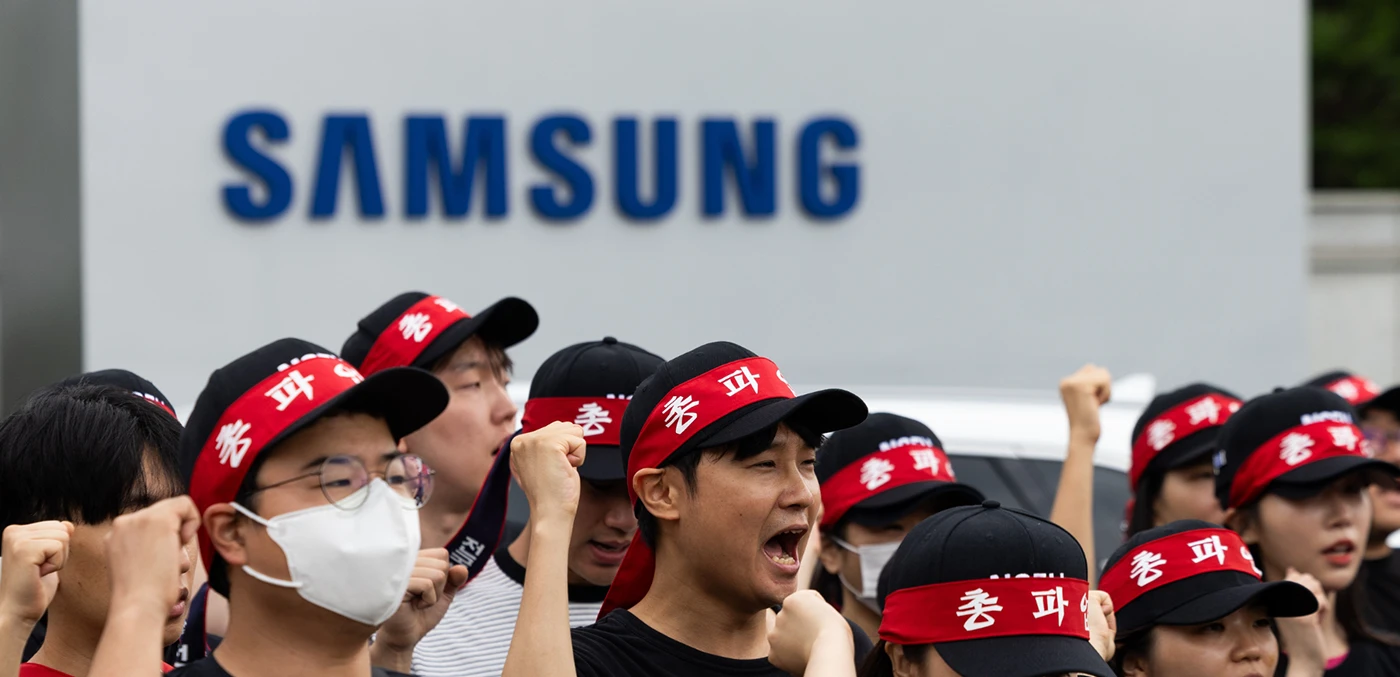
Samsung Electronics is facing the biggest and longest strike in its 56-year history. The National Samsung Electronics Union has announced that a total strike lasting 18 days will begin on May 21, 2026, and continue until June 7. As of May 20, after three days of marathon negotiations mediated by the South Korean government’s Central Labor Commission, talks have officially failed. The union confirmed that the strike will proceed as planned. The union has also rejected Samsung’s offer for unconditional dialogue, insisting on going ahead with the strike. In a significant development, a court injunction was issued on May 18 that restricts the strike’s scope, but the union says it will still begin the walkout. The outcome of this labor dispute will affect tens of thousands of workers and could have real consequences for the global semiconductor supply chain.
The Core Dispute: 15% of Operating Profit for Bonuses
The strike is not mainly about base salaries. The real conflict is over how performance bonuses are calculated. The union wants Samsung to remove the current cap on bonuses, set aside 15% of operating profit for employee bonuses, write this rule into the company’s long-term policy, and make bonus calculations more transparent. The union argues that Samsung’s profits have soared thanks to the AI chip boom – the company posted an operating profit of 57 trillion Korean won in the first quarter of 2026 – but employees receive much smaller bonuses than workers at rival SK Hynix.
Samsung’s management has proposed a one-time special bonus and raising the bonus pool to 10% of operating profit. The company says the union’s demand for 15% is “not sustainable in the long run” and could hurt its ability to invest in research and new factories. Two days of government-mediated talks ended on May 13 without an agreement. After that, Samsung offered to restart unconditional talks, but the union said “no talks until the strike ends” – they are willing to meet again after June 7.
Size and Scope
Between 40,000 and 50,000 workers are expected to join the strike. As of May 20, more than 48,000 union members had registered to participate. The strike will be heavily focused on Samsung’s semiconductor division, including DRAM, NAND flash, HBM, and foundry (chip contract manufacturing). These are Samsung’s core businesses – the company is the world’s largest memory chip maker, with over 40% of the global DRAM market and more than 30% of the NAND market. The table below summarizes the key facts:
| Item | Details |
|---|---|
| Planned start date | May 21, 2026 |
| Planned duration | 18 days (until June 7) |
| Expected participants | 40,000–50,000 workers |
| Main areas affected | DRAM, NAND, HBM, foundry |
| Union’s main demand | Remove bonus cap; set 15% of operating profit for bonuses |
| Samsung’s latest offer | One-time special bonus; set 10% of operating profit for bonuses |
Government Intervention
The South Korean government has taken a very firm stance. After the final talks failed on May 20, Prime Minister Kim Min-seok hinted that the government “will have no choice but to use emergency arbitration power” if the strike causes major economic damage. This emergency arbitration power is a rarely used legal tool that can force a strike to stop for up to 30 days and require both sides to enter binding mediation. President Lee Jae-myung has also called on both parties to resolve the dispute properly.

Why is the government so worried? Because semiconductors account for about 35% to 37% of South Korea’s total exports. A large strike lasting nearly three weeks could not only disrupt Samsung’s own deliveries but also shake customer confidence and raise global concerns about the stability of the Korean supply chain. The government is now considering whether to activate emergency arbitration – a step that would be extremely unusual in Korean labor history.
Samsung's Preparations
Samsung has already activated what Korean media call “emergency management mode.” The company’s actions include: adjusting work shifts, building up inventory in advance, reducing wafer input on some production lines, confirming over 7,000 essential workers who must remain on duty, and identifying backup workers for critical roles. The fact that Samsung is voluntarily cutting production shows that the company expects the strike to happen and wants to reduce the risk of a sudden shutdown.
Samsung has already obtained a court injunction. On May 18, the Suwon District Court issued an order that:
Production must continue “without affecting output”
Safety facilities and critical maintenance must operate “normally”
Union members are completely banned from occupying production or R&D lines
Violations could result in fines of up to 500 million Korean won (about $2.6 million USD) per day
This injunction does not ban the strike outright, but it severely limits what striking workers can do. The union says it will proceed anyway, raising the possibility of legal clashes starting May 21.
Possible Market Impact
Even if the strike does not fully happen or has only a limited effect, the market is already reacting. Industry analyst firm TrendForce notes that the strike news alone has increased expectations of higher prices for DRAM and NAND flash. The reason is that demand for memory chips used in AI servers and enterprise SSDs is already strong. Any uncertainty on the supply side can push customers to stock up in advance, which drives up spot prices.
The products most likely to be directly affected are HBM, DDR5 memory, and enterprise SSDs, key components for AI computing. If Samsung’s production slows down, customers like Nvidia and Apple may shift orders to SK Hynix or Micron Technology. After the final breakdown of talks on May 20, Samsung’s stock price fell more than 2.5% in a single session, while SK Hynix’s stock gained on expectations of order transfers. Analysts warn that a full 18-day strike could reduce global DRAM supply by 3-4% and NAND supply by 2-3%, potentially pushing up prices of electronics worldwide.
Key Dates to Watch
Here are the important dates in the coming weeks:
- May 18 – Court injunction issued, restricting strike activities.
- May 20 – Final government-mediated talks fail. Union confirms strike will begin as scheduled.
- May 21 – The planned 18-day strike is set to begin. This is also the first day the court injunction will be tested – potential legal confrontations are expected.
- Late May – Spot prices for DRAM and NAND could show volatility, and customer orders may start shifting to other suppliers.
- Early June – As the strike enters its third week, markets will watch whether the walkout expands to more production lines and whether the government activates emergency arbitration, which could force a 30-day cooling-off period.
This strike has drawn global attention because it comes at a unique moment: the union is stronger than ever, the AI-driven semiconductor boom is at its peak, and the global memory chip market is already tight. Unlike a smaller three-day strike in 2024 that had limited impact, this dispute has escalated into a much larger confrontation. The strike is now all but certain to begin on May 21. The most important question is whether the court injunction and potential government arbitration will cut it short – or whether the union’s resolve will lead to the longest and most disruptive labor action in Samsung’s history. Either way, global memory chip prices and supply chain patterns will feel the impact.