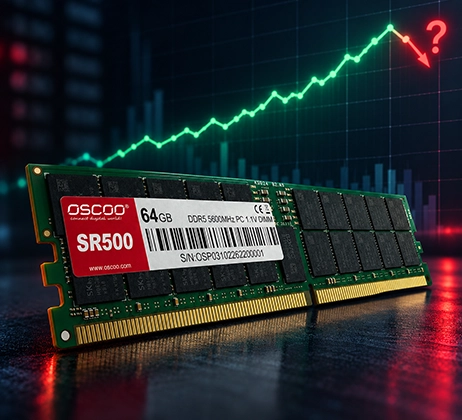
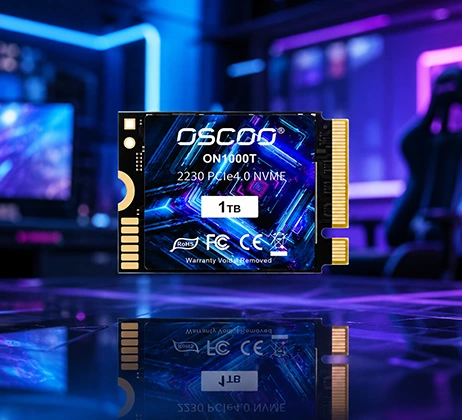
Running AI workloads relies on both memory (RAM) and solid‑state drives (SSDs), which act as a real‑time computing workspace and a high‑speed data warehouse respectively. Neither can be spared. RAM capacity determines whether an AI model can be loaded smoothly and how fast it runs, while the SSD affects model startup time and the data feeding efficiency during training. The larger the AI model, the higher the demands on both capacity and speed. This is the fundamental reason why the current AI boom has driven a surge in memory and storage chip demand.
The Core Role of RAM in AI
Memory serves as a high‑speed data staging area between the processor and permanent storage, with read/write speeds dozens to hundreds of times faster than SSDs, though data is lost when power is off. For AI, memory plays three critical roles.
- Model residency. Whether it is a chatbot or an image generation tool, an AI model must be fully loaded into memory during runtime so that the processor can access it quickly. If memory cannot hold the entire model, the system is forced to constantly read from and write to the SSD, slowing down performance by tens of times, and in severe cases, the program may fail to start at all.
- Temporary storage of intermediate variables. During AI model training, massive amounts of ephemeral data are generated, including activation values for each layer, computed gradients, and optimizer state parameters. These are repeatedly read and written throughout the training loop and must reside in high‑speed memory to ensure training efficiency. For large language models, the volume of intermediate data often far exceeds the model weights themselves.
- Data preprocessing buffering. Before being fed into the GPU, training data must undergo augmentation, normalisation, batching, and other preprocessing steps in memory. Insufficient memory capacity can stall the data pipeline, forcing the GPU to sit idle while waiting for data—wasting expensive compute resources.
Beyond capacity, memory bandwidth is equally critical. Today’s mainstream DDR5 memory modules can deliver up to 51.2 GB/s per module, and with multi‑channel configurations, total system bandwidth can easily exceed 400 GB/s, ensuring a steady stream of data to the GPU. As of the third quarter of 2025, DDR5 penetration in the server market had surpassed 90%, making it the undisputed mainstream choice for data centres and AI training clusters. Insufficient bandwidth will bottleneck even the most powerful GPUs.

The Core Role of SSDs in AI
SSDs are persistent storage devices that hold all AI‑related static data for the long term. Compared with traditional hard disk drives (HDDs), SSDs offer hundreds of times faster random read/write speeds and extremely low latency, which is crucial for AI workloads.
- Model file storage is the most basic use of SSDs. Today’s mainstream large models range from tens to hundreds of gigabytes in size, and each startup requires the full model to be loaded from storage into memory. Loading a 70B‑parameter model from a conventional HDD may take several minutes, while a high‑performance NVMe SSD can compress that time to tens of seconds.
- Training dataset read performance is even more critical. AI training randomly samples examples from the dataset to form batches—a workload characterised by a large number of random small‑file reads, which is exactly where HDDs struggle. HDDs can handle only about a hundred random reads per second, whereas current mainstream PCIe 4.0 SSDs commonly deliver over 1000K IOPS for random reads, and flagship PCIe 5.0 drives can reach up to 2000K IOPS, more than 20,000 times that of HDDs. If training data is stored on an HDD, GPU utilisation may fall below 20%, with most of the time spent waiting for data to load.
- Checkpoint saving during training also depends on SSDs. To prevent losing progress if training is interrupted, the system periodically saves model states, with each write ranging from several GB to tens of GB. Slow write speeds lengthen the intervals between checkpoints and reduce overall training efficiency.
- In large‑scale AI data centres, SSDs also serve as the hot‑data tier. Frequently accessed training data and active models reside on SSDs, while historical backups and infrequently accessed cold data are offloaded to cheaper HDDs or tape libraries, striking a balance between performance and cost.
How the Two Work Together
AI systems employ a hierarchical storage pyramid: the higher the tier, the faster the speed, the smaller the capacity, and the higher the cost per unit.
- At the very top is GPU VRAM or High Bandwidth Memory (HBM), which holds data currently being computed: fastest but with the smallest capacity.
- The second tier is system RAM, which stores data to be computed next and all intermediate results: slightly slower but with much larger capacity.
- The third tier is NVMe SSDs, housing frequently accessed models and datasets: slower again but capable of large capacities.
- At the bottom are HDDs and tape for long‑term cold backups: slowest but with the lowest cost per gigabyte.
Data flows orderly between these tiers. At the start of training or inference, model weights are loaded from SSDs into system RAM. During computation, the data for the current batch is transferred from RAM to GPU VRAM. After the GPU completes its work, results are written back to RAM, and then periodically saved to SSDs. A performance bottleneck at any tier will drag down the entire system, which is why upgrading an AI system usually requires a holistic approach. Swapping only the graphics card while keeping old memory and storage will yield very limited gains.
Configuration Guidelines for Different Scenarios
Different AI use cases have vastly different memory and SSD requirements. The following table offers recommended configurations based on typical setups in 2026.
| Use Case | Recommended RAM | Recommended SSD Capacity |
|---|---|---|
| Local inference for a 7B‑parameter LLM | 32GB or more | 512GB or more |
| Local inference for a 13B‑parameter LLM | 64GB or more | 1TB or more |
| Daily use of image generation AI | 32GB or more | 1TB or more |
| Small‑to‑medium model training and fine‑tuning | 64GB or more | 2TB or more PCIe 4.0 NVMe SSD |
| Single‑node multi‑GPU large‑model training | 256GB to 512GB | 8TB or more enterprise‑grade NVMe SSD |
| Data‑centre‑class AI server | 1TB to 4TB DDR5 | 30TB or more enterprise‑grade SSD |