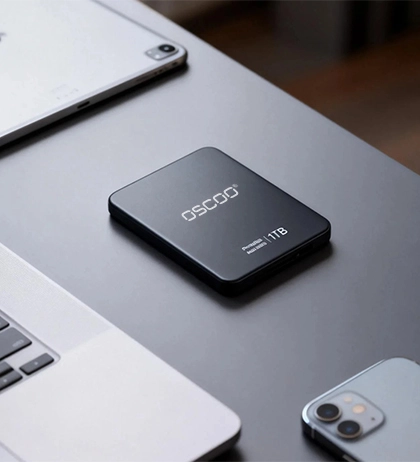
When you use a computer or smartphone, you must have experienced the huge speed improvement brought by SSDs: the system starts within a few seconds, and large games and applications load instantly. You may know that this data is stored in semiconductor flash memory chips. However, have you ever wondered why, even though they are all built with flash chips, different SSDs show huge differences in performance, stability, and lifespan? The real secret is not only inside the storage chips themselves, but in the “brain” and “commander” that manages these chips — the SSD controller.

Who Is the SSD Controller? Definition and Core Responsibilities
We can imagine an SSD as an efficiently run smart city. The NAND flash chips that store data are like land and buildings in the city, providing physical space for data storage. The SSD controller is like the city government and the traffic control center. It is a highly-integrated processor chip that manages all daily operations.
This “brain” takes on five main responsibilities:
Data scheduling — It receives commands from the CPU and quickly writes data into flash or reads it out.
Storage management — It allocates space to make sure data is stored in an organized way.
Reliability assurance — It prevents data loss or errors during transmission and storage.
Extending SSD lifespan — Smart algorithms ensure every memory cell is used evenly so no part wears out too early.
Security protection — It encrypts data to protect privacy.
These complex tasks make the controller the key factor that determines the performance and stability of SSDs.
Three Main Functional Modules of SSD Controllers
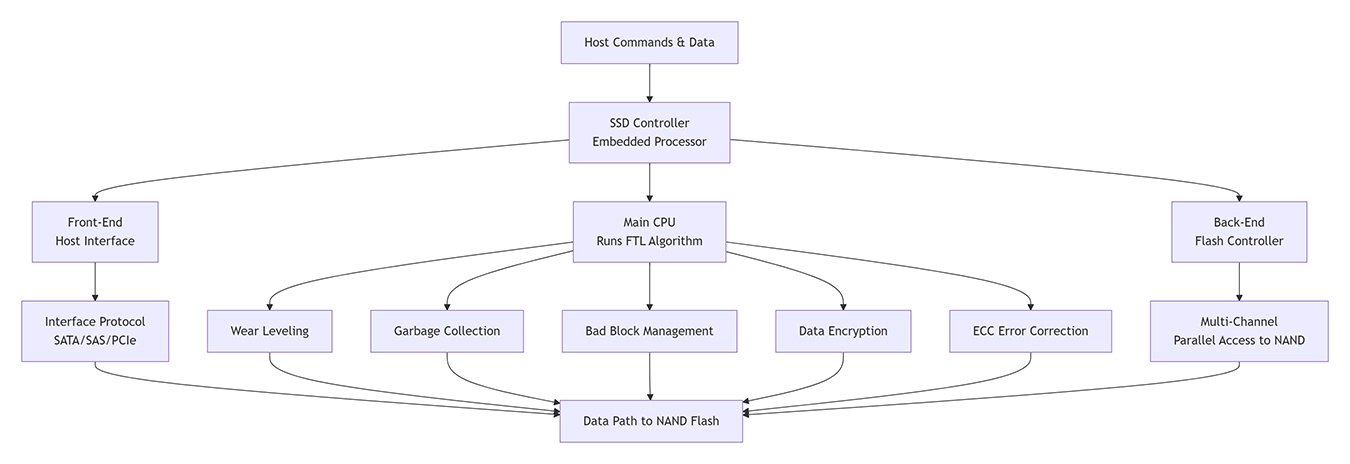
The internal structure of an SSD controller can be divided into three core parts that work together: the front-end interface, the main processor, and the back-end flash controller.
Front-end interface. It communicates with the computer host. It interprets commands and manages data transfer. The supported interface protocols, such as SATA or PCIe, directly decide the SSD’s maximum transmission bandwidth.
Main processor. This is the computing core, usually based on ARM architecture. It runs the FTL firmware — the management system of the SSD. The key task of FTL is address mapping. Since NAND flash must erase before writing and cannot overwrite data directly, FTL maps OS write commands to available empty spaces in flash, hiding this hardware limitation.
Back-end flash controller. It directly manages NAND flash chips. It accesses multiple flash chips at the same time through parallel channels to greatly improve throughput. It also includes a strong ECC error correction unit, which detects and fixes bit errors during reads to maintain data integrity.
These three modules connect through a high-speed internal bus and cooperate to complete the full process from receiving commands to safely storing data.
Key Algorithms and Technologies of SSD Controllers
SSD controllers run many complex algorithms to manage flash memory. The most important ones implemented by the Flash Translation Layer are the following four:
Wear leveling ensures longer SSD lifespan. Since each flash cell has limited write endurance, this algorithm distributes writes evenly across blocks.
Dynamic wear leveling writes data to blocks with the least wear.
Static wear leveling moves valid data from less-worn blocks to more-worn ones to balance the entire device.
Garbage collection (GC) cleans unused space. When files are deleted or modified, old data becomes invalid but space is not freed automatically. GC identifies blocks with invalid data, moves valid data elsewhere, then erases the whole block for reuse.
TRIM command helps the controller know which data blocks are invalid as soon as the OS deletes files. This allows SSDs to run GC during idle time, preventing sudden performance drops during writing.
Bad block management handles flash defects. The controller detects blocks that fail due to wear and maps their addresses to spare blocks. This replacement is invisible to the OS and ensures stability and safety.
Practical Guide to Buying and Using SSDs
Now that we understand the importance of controllers, how should we use this knowledge in real-world choices?
For most regular users, it is not necessary to study controller model numbers. It is smarter to look at brand reputation and major product series. Well-known brands’ mainstream or flagship SSDs usually offer reliable performance and durability due to mature controller solutions and firmware tuning. You can check reviews, especially regarding long-term performance consistency.
However, in some scenarios, controller performance becomes critical:
High-performance usage. Such as gaming, 4K video editing, and large software development. High-end controllers deliver faster and more stable random read/write performance.
QLC-based SSDs. A strong controller helps improve caching strategy and GC efficiency, reducing speed drops when the cache is exhausted.
NAS or server environments. These require controllers designed for large write workloads and long-term stability.
Finally, no matter how powerful the controller is, storage devices can fail. If the controller fails, data recovery is extremely difficult and expensive. Therefore, regular backup is the most important safety practice. Follow the 3-2-1 backup principle: 3 copies of data · 2 storage media · 1 copy kept offline. This ensures true data protection.
SSD Controller Failure and Data Recovery
When an SSD controller fails, the computer often cannot detect the drive, or capacity appears incorrect. The core issue is that the controller is the only “key” to accessing the data.
This key is the address mapping table in the FTL. User data is scattered across many flash chips and managed through unique internal algorithms. When the controller stops working, even though the electrical data still exists in the chips, there is no way to reassemble the fragments into a complete file system.
Data recovery is possible but extremely complex and expensive. Professionals generally try two approaches:
Replace the faulty controller with an identical working chip and migrate firmware.
Use special tools to extract raw data from flash chips, then attempt to rebuild the mapping table using software.
Both methods require deep knowledge of the specific controller and flash protocol, and success is not guaranteed. So for normal users, controller failure usually means permanent data loss. This reinforces why regular backup is essential.
Major Players in the SSD Controller Market
The SSD controller market is competitive and highly specialized. Different companies have different strengths based on technologies and supply chain positions. The table below summarizes the main players:
| Category | Representative Companies | Characteristics |
|---|---|---|
| Flash Manufacturers | Samsung, Kioxia, Western Digital, Micron, SK Hynix | Make flash chips and controllers mainly for their own SSDs, focusing on deep optimization of hardware and firmware |
| Controller Design Specialists | Silicon Motion, Phison | Known for cost-effective and mature designs, leading in the consumer market |
| Independent Chip Designers | Marvell | Focus on high-performance enterprise SSDs with strong reliability |
| Mainland China Companies | Maxio, InnoGrit | Growing quickly in consumer and industrial markets, expanding to enterprise field |
Together, this ecosystem serves both consumer and enterprise needs and drives continuous innovation.
Future Development Trends of SSD Controllers
To support increasingly complex workloads, SSD controllers are evolving toward higher speed, better reliability, and more intelligence.
Interface speed upgrades like PCIe 5.0 and PCIe 6.0 provide huge bandwidth, requiring more advanced architectures, smaller process nodes, and better signal integrity design.
With QLC/PLC flash becoming common, stronger LDPC engines and AI-assisted read-disturb control will be used to maintain data reliability.
Power efficiency is a key focus in data centers. New controllers will include finer power control and low-power states to reduce energy costs.
Security continues to improve. Hardware encryption and advanced protection protocols will become standard to protect the full data lifecycle.
These advances will make future controllers more efficient and intelligent.
As the true command center of SSDs, the controller directly determines the product’s overall performance, lifespan, and data safety. It not only manages basic data transfer but also quietly handles the unique challenges of flash memory through smart algorithms. Understanding controller fundamentals helps consumers make smarter purchasing decisions and reinforces the importance of regular data backup. With continuous technology progress, this precision chip will keep supporting fast and reliable storage in the digital world.