TF Card VS SD Card: An In-Depth Comparison

In today’s fast-moving digital world, memory cards have long become an essential part of everyday digital storage. From precious photos on smartphones to high-definition videos captured by professional cameras, these small storage devices quietly carry our important data and memories. In daily use, TF cards and SD cards are the two most common types of memory cards, and they are often compared side by side. For most users, the difference between them seems to be only “one is big and one is small.” However, when it comes to choosing the right product for specific use scenarios, many people still feel unsure. This article provides a detailed analysis of the similarities, differences, and core characteristics of TF cards and SD cards, helping you make the best choice based on your actual needs.
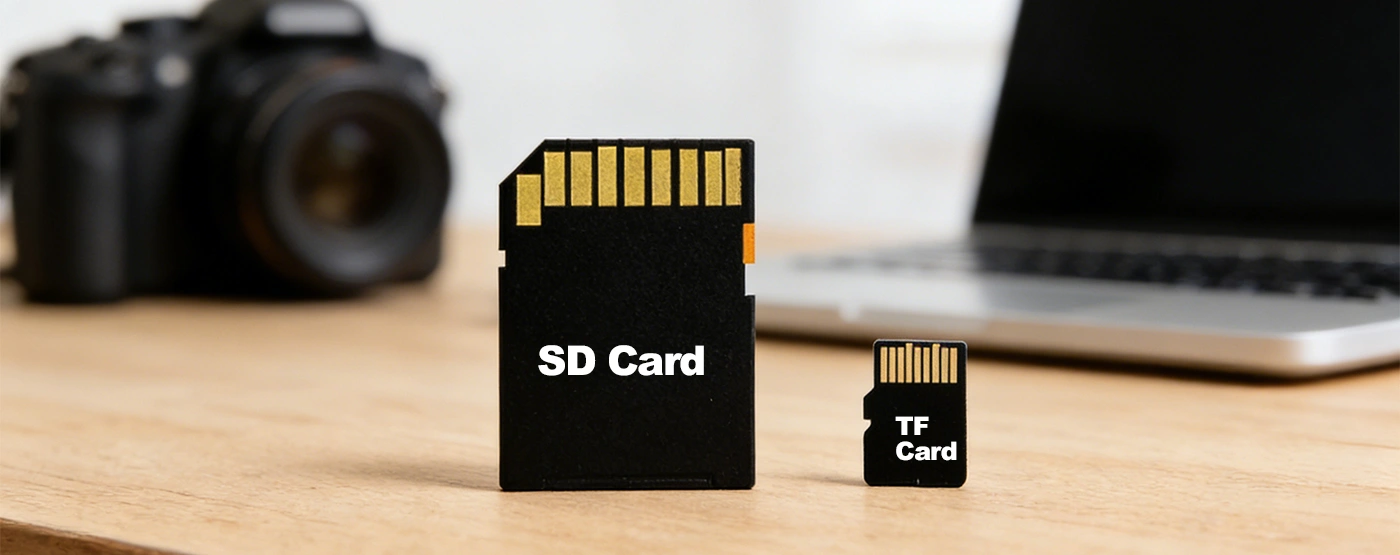
TF card vs SD card article header img 1400x555 1 TF Card VS SD Card: An In-Depth Comparison

What is a TF Card

The full name of a TF card is TransFlash Card. It was first introduced by SanDisk in 2004, with the original purpose of meeting the urgent demand for smaller and more portable storage media in mobile devices such as smartphones. Later, the SD Association incorporated TransFlash into the SD standard system and officially renamed it microSD. Today, although “TF card” is no longer an official technical term, the name is still widely used due to long-standing habits. Especially in consumer electronics such as smartphones, dash cameras, and security monitoring devices, “TF card” remains the most commonly used term among users.

What is an SD Card?

The full name of an SD card is Secure Digital Card. It was jointly developed by Panasonic, Toshiba, and SanDisk, and officially launched in 1999. At that time, early storage media often suffered from poor compatibility and limited capacity. The introduction of the SD card was intended to solve these industry problems. With standardized design, high capacity, and high data transfer speed as its core advantages, the SD card quickly became a widely accepted flash memory standard.
oscoo 2b banner 1400x475 1 TF Card VS SD Card: An In-Depth Comparison

SD cards are mainly used in professional imaging devices such as digital cameras and camcorders, as well as in devices that require stable and predictable read/write performance. The SD card family includes three main types: standard SD cards, Mini SD cards, and Micro SD cards. What we commonly call a TF card is essentially a Micro SD card, which means that TF cards are actually part of the SD card system.

TF Card vs. SD Card: Key Differences

Size Comparison

Physical size is the most intuitive difference between TF cards and SD cards, and the difference is significant. A standard SD card measures 32mm × 24mm × 2.1mm, roughly the size of a regular postage stamp, making it relatively large in volume. In contrast, a TF card measures only 15mm × 11mm × 1mm, less than one-quarter the size of a standard SD card, and is about the size of a fingernail. This extreme difference in size not only gives TF cards an advantage in portability and lightweight design, but also brings unavoidable limitations at the hardware design level.
sd cards sizes 1400x700 1 TF Card VS SD Card: An In-Depth Comparison
For a memory card to work properly, it must include key components such as NAND flash memory, a controller chip, and power management circuits, all of which require physical space. Thanks to its larger size, a standard SD card has more layout flexibility in its internal design. It can use larger and more stable controller chips, and leave enough room for more complete power filtering circuits and signal integrity optimization, which improves overall operational stability at the hardware level.
By contrast, a TF card must achieve similar storage functions within an extremely small space, which requires highly integrated design solutions. This means stricter chip selection and much denser circuit routing, making it more susceptible to electrical noise and temperature changes. In light-duty daily use scenarios, such as occasionally storing photos or transferring small files, this stability difference is usually not noticeable. However, in scenarios involving long-term continuous writing (such as real-time recording in dash cameras or 24/7 surveillance storage), high operating temperatures (such as inside vehicles in summer or outdoor devices exposed to sunlight), or vibration-intensive environments (such as drones or vehicle-mounted equipment), these limitations gradually become apparent. Typical symptoms include speed drops, stuttering, or even data transmission errors.

It is worth noting that there was once a Mini SD card, with a size between TF cards and standard SD cards (21.5mm × 20mm × 1.4mm). However, as TF card technology matured and became widely adopted, Mini SD cards were gradually phased out due to poorer portability compared to TF cards and weaker compatibility and stability compared to standard SD cards. Today, their market presence is extremely limited and they can generally be ignored in everyday use.

Interface Design Comparison
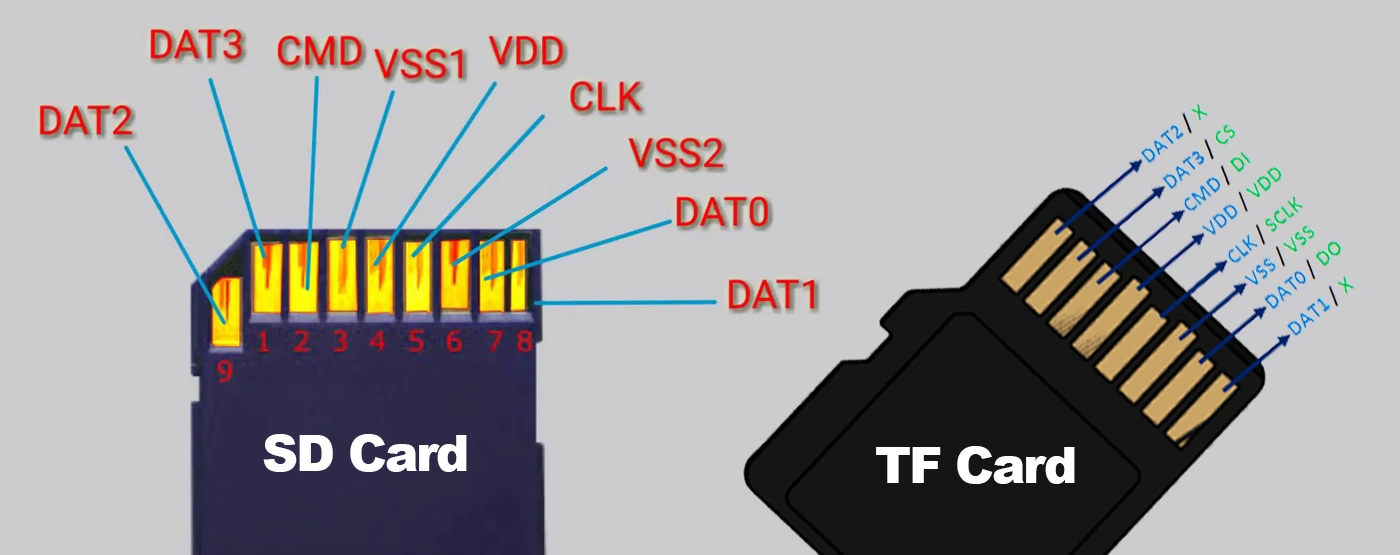
Although TF cards and SD cards both belong to the SD interface protocol system and share the same core communication logic, their physical interface specifications are not interchangeable. TF cards use a micro-sized interface, while SD cards use a standard-sized interface. This difference directly determines their native device compatibility scenarios. However, there is a flexible compatibility solution: a TF card can be used with a dedicated adapter to convert it into the physical form of an SD card, allowing it to work in devices that support SD cards.
At the pin design level, the differences between the two further affect read and write stability. SD cards use a 9-pin design, giving them more physical pins than TF cards. This provides greater redundancy for signal transmission optimization and power supply stability. Especially under high-speed transmission modes such as UHS (Ultra High Speed), signal integrity directly determines read/write stability. The larger card body of SD cards allows for more relaxed pin layout, which effectively reduces signal interference and makes it easier to maintain stable timing and voltage output during high-speed data transfer, ensuring uninterrupted transmission and preventing data loss.
tf card vs sd card pins comparison TF Card VS SD Card: An In-Depth Comparison
TF cards, limited by their miniaturized size, not only have fewer pins, but also much tighter pin spacing. As a result, when operating in high-speed transmission modes, they place higher demands on the design precision of the device controller, the manufacturing quality of the card slot, and the overall circuit layout of the device. If there are even minor flaws on the device side—such as routing interference or poor card slot contact—these issues tend to first appear as reduced read/write stability in TF cards, leading to stuttering, speed drops, or even data transmission errors.
This is why, in devices with extremely high requirements for storage stability—such as digital cameras and professional surveillance systems—even when TF cards and SD cards have the same theoretical speed specifications, manufacturers still prefer to use standard SD cards as the native storage solution. The stability advantages brought by SD cards’ pin design and physical structure are difficult for miniaturized TF cards to replace.

Speed Comparison

There is no fundamental difference between SD cards and TF cards in terms of transmission speed. Both follow the same SD speed class standards, including Class 2/4/6/10, UHS-I/UHS-II/UHS-III, and V30/V60/V90. Within the same speed class, their rated speeds are basically the same, and high-end products from both types can meet demanding requirements such as 4K video recording and high-speed continuous shooting. However, high-end SD cards have a slight advantage in extreme read/write speeds, with some products exceeding 300 MB/s, making them more suitable for professional use cases. TF cards have slightly lower peak speeds, but they are more than sufficient for everyday use.
That said, users often encounter situations where “the rated speed does not match real-world performance.” Even when the speed class and read/write numbers printed on the packaging are the same, performance differences gradually become noticeable in scenarios such as continuous writing, high-bitrate video recording, and long-term operation.
The core reason lies in differences in sustained performance capability. Controller design headroom is a key factor affecting continuous write performance. Thanks to their larger size, SD cards can accommodate more complex controllers, with larger caches, more advanced write scheduling and wear-leveling strategies, and more stable power management. During long periods of continuous writing—such as 4K recording or log data storage—SD cards can manage NAND resources more consistently and are less likely to experience speed drops. TF cards, constrained by size and power consumption, require highly integrated controller designs with more compromises, and some products show noticeable speed degradation after several minutes of sustained writing.
tf card vs sd card speed comparison1 TF Card VS SD Card: An In-Depth Comparison
Thermal conditions are another important factor. During high-load write operations, both flash memory and controllers generate heat, and cooling capability directly affects performance. SD cards, with their larger size and thicker structure, have clear advantages in passive heat dissipation, allowing heat to spread and dissipate more effectively. TF cards, due to their extremely small size and low thermal mass, heat up more quickly. Once a temperature threshold is reached, they actively reduce speed to protect the chips. This type of “thermal throttling” is not reflected in specification sheets, but it frequently occurs in high-temperature environments or high-bitrate recording scenarios.
Power supply stability also plays a role. High-speed data transfer requires very stable power delivery. SD cards, with more pins, have more flexible power and ground designs and can better tolerate transient current fluctuations. TF cards integrate power and signal lines more tightly, making them more sensitive to power fluctuations or changes in contact resistance on the device side. This can lead to performance instability or even write interruptions. While this issue does not appear in specification tables, it is commonly encountered in real-world use.

In summary, speed class ratings represent only a minimum performance threshold, not the upper limit of real-world experience. In light-duty, intermittent read/write scenarios, the difference between TF cards and SD cards is minimal. However, in situations involving continuous writing, high temperatures, vibration, or long-term operation, SD cards generally offer better stability due to greater design headroom in controllers, cooling, and power delivery. This does not mean TF cards have poor performance, but rather that they are optimized for everyday use in compact portable devices, rather than for professional, high-intensity workloads.

Capacity Comparison

TF cards and SD cards share exactly the same capacity system and both fully comply with SD card standard specifications. Their capacity ranges and upper limits are essentially the same, with no fundamental differences. Both support capacities from 8GB up to terabytes, meeting the needs of different users.
Capacities from 8GB to 32GB are considered small capacity and are suitable for storing a limited number of photos or documents, or for use in devices with simple functions such as smartwatches and electronic dictionaries. 64GB to 256GB is the mainstream capacity range, suitable for common devices such as smartphones, dash cameras, and cameras, allowing storage of large numbers of photos, videos, and application data. 512GB to 1TB is considered large capacity and is mainly used in professional imaging scenarios such as long-duration 4K or 8K video recording and large file storage.

In terms of maximum capacity, both TF cards and SD cards can currently reach 2TB, and some brands have already released related high-end products, mainly targeting professional use cases that require extremely large storage capacity. However, in the real market, ultra-high-capacity products are more commonly seen in TF cards, especially in the consumer segment. This is mainly because TF cards are primarily used in smartphones, tablets, and portable devices, where users care more about obtaining larger capacity within limited physical space, while requirements for sustained write performance and extreme stability are relatively lower.

SD cards, on the other hand, are more often used in cameras and professional equipment. In these fields, demand for capacity increases more conservatively, while stability and consistency are far more important. This difference in application orientation makes SD card capacity expansion more cautious. Overall, when choosing between a TF card and an SD card, capacity itself does not need to be a deciding factor. The choice should instead be based on device compatibility, usage scenarios, and cost performance.

Write Protection Comparison

Write protection is an important safety feature of memory cards, designed to prevent accidental deletion or modification of data. TF cards and SD cards differ significantly in how this function is implemented and how easy it is to use, but the level of protection they provide is the same and can effectively safeguard data.
tf card vs sd card write potection
SD cards use a physical write-protection mechanism. A small sliding switch is located on the side of the card. When the switch is moved to the “LOCK” position, the card enters write-protected mode, allowing data to be read but preventing deletion, modification, or formatting. Sliding the switch back disables write protection and restores normal read/write operation. This physical switch is intuitive and easy to use, does not rely on device settings, and is suitable for all types of users. It is especially useful in professional shooting and important data storage scenarios, as it effectively prevents data loss caused by accidental operations.
Due to their small size, TF cards do not have a dedicated physical write-protection switch. Instead, write protection is mainly implemented through device software or specialized tools. Some devices that support TF card expansion, such as certain Android smartphones and cameras, allow users to enable write protection for TF cards in system settings. For devices that do not support this feature, write permissions must be configured using dedicated software on a computer. Compared to the physical switch on SD cards, write protection on TF cards is less convenient and depends more on device and software compatibility. However, the level of protection is equivalent and sufficient for everyday data safety needs.

It should be noted that whether using the physical switch on SD cards or software-based protection on TF cards, write protection can only prevent accidental operations during normal use. It cannot protect against data loss caused by viruses, card damage, or other failures. For important data, regular backups are still strongly recommended.

Service Life Comparison

There is no fundamental difference in service life between TF cards and SD cards. Lifespan mainly depends on factors such as flash memory type, number of write cycles, usage environment, and manufacturing process, rather than on whether the card is a TF card or an SD card. The evaluation standards, influencing factors, and methods for extending lifespan are essentially the same for both.
From a core factor perspective, the type of flash memory is the key determinant of service life. Currently, most memory cards use TLC flash, while some high-end products use MLC flash. The difference in write endurance between the two is significant. MLC flash has a theoretical write endurance of about 10,000 cycles, while TLC flash typically supports around 3,000 cycles. QLC flash, which is commonly used in entry-level large-capacity products, generally supports fewer than 3,000 write cycles. TF cards and SD cards using the same type of flash memory have similar theoretical lifespans.

However, due to size and cost constraints, TF cards are more likely to use high-density NAND and rely on more aggressive write strategies to balance capacity and performance. This is usually not an issue within the typical usage cycle of ordinary consumers, but in high-frequency write scenarios, it can accelerate NAND aging.

Write volume is another important factor affecting actual lifespan. The lifespan of a memory card is measured by total bytes written. Frequent writing and deletion of large files, such as high-resolution video recording or continuous burst shooting, will accelerate wear and shorten lifespan. Cards used mainly for reading data, such as storing documents or video materials, experience minimal wear. Under the same usage scenarios, the actual lifespan difference between TF cards and SD cards is generally small.

Usage environment affects both types in the same way. Harsh conditions such as high or low temperatures, humidity, strong vibration, or strong magnetic fields can damage card interfaces and chips, accelerating aging. For long-term storage, cards should be kept in a dry, room-temperature, non-magnetic environment and protected from bending or physical impact. It is worth noting that industrial-grade TF cards, often used in embedded systems such as automotive and surveillance applications, typically have stricter requirements for vibration resistance and temperature tolerance. As a result, they may be more durable in practice, but this is a difference in product positioning rather than in card type.

Application Scenario Comparison

Due to differences in size and interface design, TF cards and SD cards have different priority compatibility across device types.

Scenarios Where SD Cards Are Preferred

  • Professional imaging equipment. Devices such as digital cameras, DSLR cameras, and camcorders natively support SD card slots, allowing easy insertion and removal. In addition, the physical write-protection switch on SD cards helps prevent accidental deletion of footage during shooting.
  • Gaming devices. Devices such as the Nintendo Switch and some retro gaming consoles are equipped with standard SD card slots. Using standard SD cards provides better overall stability.
  • Legacy electronic devices. Older devices such as early MP3 players, MP4 players, printers, and digital cameras often support only standard SD cards and do not include TF card compatibility.
  • Frequent insertion and removal scenarios. In situations where memory cards need to be frequently removed for data transfer, SD cards are easier to handle due to their larger size, making them less likely to be lost. Their outer casing is also more resistant to wear from repeated use.

Scenarios Where TF Cards Are Preferred

  • Mobile smart devices. Smartphones, tablets, and smartwatches have very limited internal space and typically support only micro-sized interfaces, making TF cards the only viable option.
  • In-vehicle devices. Dash cameras, car navigation systems, and car audio systems usually have limited installation space, making TF cards more convenient to install.
  • Security and surveillance devices. Home security cameras and outdoor monitoring devices are often embedded systems designed to work with compact TF cards.
  • Portable digital devices. Drones, action cameras, and voice recorders prioritize lightweight and compact designs, making TF cards better suited to these devices.
  • Internet of Things (IoT) devices
    Devices such as smart speakers, routers, and electronic dictionaries feature high integration levels and require small storage media for capacity expansion, which TF cards can provide.

Using TF Cards with Adapters

In theory, a TF card can be inserted into a dedicated adapter to convert it into the physical form of a standard SD card, allowing it to be used in devices that support SD cards. However, this conversion is not always a seamless replacement. In certain scenarios, compatibility issues may arise, and use is not recommended or may not function properly, as outlined below:

  • Legacy device scenarios. Some early SD card devices, such as digital cameras and printers manufactured before around 2010, have poor compatibility with TF card plus adapter combinations. These devices may fail to recognize the card, experience slow reading, or encounter write errors. In such cases, using a TF card with an adapter is not recommended.
  • High-speed data transfer scenarios. When using high-speed TF cards rated for UHS-II or V60/V90 with low-quality or standard adapters, performance may be significantly reduced due to insufficient interface bandwidth or excessive contact resistance in the adapter. As a result, the card cannot deliver its rated speed. In these scenarios, it is recommended to use a native high-speed SD card or a high-quality adapter that explicitly supports the corresponding high-speed protocol.
  • Long-term, high-frequency insertion and removal. Frequent insertion and removal of a TF card and adapter combination can lead to wear on the adapter’s contacts, poor electrical connection, or even loosening of the adapter, increasing the risk of the TF card slipping out. This can affect normal device operation. In such scenarios, using a standard SD card directly is recommended.
  • Harsh environment scenarios. In environments with high or low temperatures, strong vibration, or heavy dust—such as outdoor shooting or long-term in-vehicle use—the connection between a TF card and its adapter may loosen due to environmental stress, causing data transmission interruptions or device recognition failures. In these cases, industrial-grade native SD cards or specially protected TF card plus adapter combinations should be prioritized.
  • Write-protection–dependent scenarios. If a device frequently relies on write-protection features, such as in professional shooting to prevent accidental deletion, a TF card plus adapter combination may provide write protection through certain adapters with physical switches. However, this solution is generally less stable than the native write-protection switch on SD cards, and many low-cost adapters do not support write protection at all. In such cases, relying on a TF card and adapter is not recommended.

FAQ

Can you use an SD card as a TF card?

A standard SD card cannot be directly used as a TF (Micro SD) card, because the two have completely different physical sizes and form factors, and there is no adapter or converter that can shrink a full‑size SD card to fit into the tiny TF card slot designed for compact devices; only a TF card with an SD adapter can work in an SD card slot, not the other way around.
 

Can an SD card reader read a TF card?

Most modern SD card readers can read a TF card, but only when the TF card is inserted into a compatible SD‑form adapter, as the reader’s physical slot is sized for standard SD cards and cannot directly accept the much smaller TF card without this conversion piece.
 

Why do I need a TF card?

You need a TF card primarily because small, portable electronic devices such as smartphones, tablets, dashcams, security cameras, drones, and smart wearables only have compact slots designed for TF cards, allowing you to expand storage capacity for photos, videos, files, and system data without increasing the device’s physical size, and it also offers a cost‑effective way to upgrade storage on many budget and mid‑range electronics.
 

Which is better, SD card or TF card?

Neither the SD card nor the TF card is universally better, since they share the same underlying technical standards, performance specifications, and capacity ranges, and their quality depends on the flash memory chip, speed rating, and manufacturer rather than the form factor; the SD card is more suitable for professional cameras, video equipment, and devices requiring physical write protection and frequent handling, while the TF card is ideal for small, space‑constrained portable and IoT devices, so the better choice is determined entirely by your device’s slot and actual usage scenario.
 

Are TF cards still commonly used?

Yes, TF cards remain widely and commonly used across a huge range of consumer and industrial devices, including smartphones (in models that support expandable storage), dashcams, surveillance cameras, drones, portable speakers, routers, single‑board computers like Raspberry Pi, and various IoT equipment, as their small size and low cost make them irreplaceable for compact and embedded applications.
 

Are SD cards being phased out?

SD cards are not being phased out, even though many mobile phones have abandoned external storage slots; they still hold a dominant and irreplaceable position in professional imaging fields such as DSLR cameras, mirrorless cameras, and professional video recorders, and they continue to evolve with higher speed standards including UHS‑II and V90, larger capacities, and more durable industrial designs, so they will coexist with TF cards for a long time and maintain steady market demand.

TF cards and SD cards share the same technological origin. There is no fundamental difference in performance or capacity, and neither is inherently superior to the other. The key differences lie in physical size and device compatibility. When choosing between them, there is no need to ask “which is better.” The correct choice depends on usage scenarios and device support.

TF cards are storage media highly optimized for consumer electronics. Their advantages lie in size, cost, and versatility, but these come with compromises in heat dissipation, stability, and long-term endurance. SD cards, by contrast, are more focused on ensuring stable device operation. Their size and structure provide more room for controller design, signal integrity optimization, and long-term reliability.

When the usage scenario aligns with the original design intent, both TF cards and SD cards can perform their tasks effectively. Looking ahead, as device miniaturization continues, demand for TF cards will keep growing, while SD cards will remain dominant in professional imaging fields. The two formats will continue to coexist and evolve toward higher speeds, larger capacities, and greater durability.
滚动至顶部

Cantact us

Fill out the form below, and we will be in touch shortly.

Contact Form Product