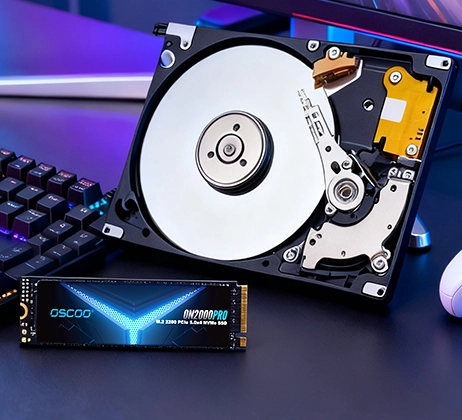
With the rapid development of businesses like cloud computing, big data, artificial intelligence, and virtualization, data centers have an increasingly strong demand for high-capacity, high-performance, high-density storage. Traditional Solid State Drives (SSDs) used in servers or storage devices—such as the M.2 common in consumer PCs, or the 2.5-inch U.2/U.3 SSDs common in enterprise/servers—are struggling to meet the comprehensive requirements of new-generation data centers regarding performance, density, cooling, and maintainability. To address these limitations, a new standard specifically designed for enterprise and data center environments was born: EDSFF.

What is EDSFF?
The full name of “EDSFF” is “Enterprise and Datacenter Standard Form Factor.” By unifying mechanical size (form factor) and interface (connector/pinout/power/signal) specifications, EDSFF allows SSDs from different manufacturers and with different specifications (size/power/layout) to be used interchangeably in standardized server chassis, racks, and backplanes, thereby simplifying system design, deployment, and maintenance. In short, EDSFF is a “new body shape and new interface standard” for SSDs tailor-made for modern data centers and enterprise storage environments, considering both high performance, as well as density, cooling, scalability, and operational convenience.
Types of EDSFF
EDSFF is not a single specification, but a “family.” Currently, there are two main series: E1 and E3. Each series further has Short and Long form factors (suffix .S and .L). This multi-specification design aims to cover the needs of different types of server/storage systems. Below are the main specifications and their suitable uses and characteristics:
E1 Series: "Ruler" type SSDs for high-density, high-scalability storage
E1.S: This is the shorter one in the E1 series. It uses vertical mounting, fits 1U chassis (standard rack servers with a height of about 1U), uses x4 PCIe lanes, and is compatible with the NVMe protocol. Compared to traditional M.2, it is more suitable for data center use because it provides better cooling design and higher storage density. The E1.S form factor is typically compact, but being designed for servers, it allows fitting a larger number of drives into a 1U chassis, achieving high storage density. For example, some manufacturers indicate that 6 to 12 E1.S SSDs can be loaded into a 1U chassis. Based on this design, E1.S is particularly suitable for application scenarios where “space is limited but high storage density is desired,” such as large-scale cloud storage, scale-out storage systems, or edge/high-density server configurations.
E1.L: This is the “long” version in the E1 series, also known as the “ruler” specification. Its length is much greater than E1.S (about three times longer), thus it can accommodate more NAND flash chips, providing larger capacity. E1.L is very advantageous for situations where deploying massive storage within a single server rack is desired. The design goal of E1.L is to maximize storage capacity per rack. In some configurations, using E1.L can achieve astonishing levels of raw storage capacity per rack unit. Therefore, E1.L is very suitable for large-capacity storage infrastructures, such as large distributed storage clusters, cold storage, archive systems, or data center environments requiring high-density, high-capacity SSDs.
Overall, the E1 series leans more towards the purpose of “high density, high capacity, high scalability, high rack utilization.”
E3 Series: For high-performance enterprise and general-purpose server environments
E3.S: The size of this specification is similar to traditional 2.5-inch SSDs (e.g., U.2), making it easier to adapt to servers that already have 2.5″ drive bays and backplanes. E3.S supports wider designs, common widths include single-width (about 7.5mm) or double-width/double-thick (e.g., 16.8mm), to adapt to different power, cooling, and capacity needs. Because it maintains a size similar to traditional form factors while adopting the EDSFF interface design, E3.S is a “modernization” of older U.2/U.3 SSDs in traditional enterprise server environments. It balances performance, cooling, and power control. E3.S is suitable for enterprise servers that want to improve performance, bandwidth, and stability without significantly modifying server chassis and rack structures. For traditional workloads like enterprise computing, databases, virtualization, and storage arrays, it offers a smooth upgrade path.
E3.L: This is the larger “long, large, high-capacity” specification in the E3 series. Compared to E3.S, it can provide a higher power budget (some specifications support up to 70W power supply), thereby accommodating more flash chips and increasing capacity and performance. Such an SSD is typically used in 2U servers, or environments with high demands for both capacity and performance. For enterprise applications requiring high performance, high concurrent I/O, and large-capacity storage (such as large databases, high-speed caching, AI/big data/analytics platforms, virtualized storage pools, etc.), E3.L offers an option that balances modern performance with traditional compatibility.
In summary, the E3 series leans more towards traditional enterprise/general-purpose server environments—if you are not pursuing ultimate density/scalability, but want better performance, more reliable cooling, and larger capacity on existing infrastructure, E3 would be a more suitable choice.
Design Intent and Advantages of EDSFF
Using EDSFF instead of traditional SSD specifications (like M.2, U.2/U.3) offers many important advantages. Here are the main points and why they are crucial for data centers.
Improved Storage Density and Scalability
Traditional 2.5-inch SSDs (U.2) or M.2 SSDs often face issues like insufficient rack space, limited number of drive bays and backplanes, and restricted scalability when dealing with large-scale storage deployments. EDSFF redesigns the SSD form factor and connection method, allowing more SSDs to be fitted within the same or less space. For example, using the E1 series (especially E1.L), a large number of SSDs can be placed per rack unit, significantly increasing the raw storage capacity per rack. Furthermore, because EDSFF uses a unified standard interface, SSDs from different manufacturers, models, and specifications can be mixed and deployed. For data centers, this means expansion and upgrades don’t require large-scale infrastructure changes, offering greater flexibility and cost-effectiveness.
Better Cooling and Power Efficiency
Cooling is a major issue for SSDs in high-density, high-performance, long-running server and data center environments. Overheating can lead to performance throttling, reduced device lifespan, and even instability. EDSFF’s design considers cooling and ventilation from the start—especially the E1 series often uses vertical mounting, which is more suitable for server airflow channel design, thereby improving cooling efficiency. Additionally, EDSFF offers stronger power delivery support. Some specifications (like the E3 series) allow power supplies up to 70 watts (W), whereas traditional 2.5″ SSDs typically handle much lower power levels. For data center applications with sustained high load, high IOPS, and high concurrent access, good thermal management and power support are critical. These advantages of EDSFF ensure SSD stability and efficiency under heavy loads and long-term operation.
Higher Performance and Bandwidth, Supporting Future Protocols
Modern data centers and enterprise storage have increasing demands for bandwidth, concurrency, latency, and throughput. EDSFF typically uses the PCIe + NVMe protocol, which has become the mainstream standard for modern high-speed storage. Compared to traditional SATA or older interfaces, PCIe + NVMe provides much higher bandwidth and lower latency. More importantly, because the EDSFF interface standard is unified and allows for higher power and more lane support, it provides a good foundation for new generations of PCIe (e.g., PCIe Gen5, Gen6) and potentially future new storage/acceleration/computing/CXL device types. That is, EDSFF is not only suitable for current SSDs but also leaves room and standards for future hybrid devices like “storage + accelerator + computational storage.”
Better Maintainability and Serviceability
For enterprise data centers, functions like equipment maintenance, replacement, expansion, and hot-plug or hot-swap are very important. EDSFF is typically designed to support hot-swap, making it possible to replace SSDs without shutting down the server or affecting operations. This greatly improves the operational efficiency of data centers. Combined with unified standards and compatibility, SSDs from different manufacturers, batches, capacities/specifications can be interchangeable, which is very convenient for distributed storage and heterogeneous clusters.
Scenarios Suitable for EDSFF
Based on the design philosophy and advantages of EDSFF, we can summarize several typical application scenarios particularly suitable for EDSFF:
Large-Scale Cloud Storage / Scale-out Storage: For cloud service providers, cloud hosting, object storage, tiered storage (hot/cold data), etc., where fitting as many storage devices as possible into limited space is needed, pursuing high storage density, high reliability, and high scalability. The E1 series (especially E1.L) is very suitable.
High-Performance Computing / High Concurrency / High IOPS / Data-Intensive Workloads: Such as databases, big data analytics, real-time log processing, AI/ML training and inference, virtualization, dense container/VM deployment, caching/middleware storage, etc. The E3 series (especially E3.L/E3.S) can provide excellent bandwidth, stability, and cooling for these scenarios—especially when upgrading existing traditional 2.5″ SSD infrastructure without completely redesigning chassis/rack structures.
High Maintainability / High Serviceability / Large-Scale Operational Environments: For enterprises and data centers with a large number of devices requiring frequent replacement, expansion, and mixed use, the hot-swap, modularity, and standardization features of EDSFF are very important. It helps save maintenance time and reduce operational complexity.
Future Hybrid / Heterogeneous Deployment (Storage+Compute+Accelerator+CXL): With the development of storage + acceleration + computing architectures (e.g., computational storage; CXL memory expansion; NVMe-based accelerators/network cards/SmartNICs/FPGAs/AI accelerators, etc.), the universal interface, high bandwidth, high power support, and standardized connector of EDSFF make it an ideal platform. In other words, even if it’s SSDs now, it could be other devices in the future, without requiring major modifications to servers/racks/backplanes.
In summary, the design and characteristics of EDSFF make it particularly suitable for modern data centers oriented towards the “future, scalability, performance intensity, and operational friendliness.”
Comparison of EDSFF vs. Traditional SSDs
To understand the advantages of EDSFF more clearly, let’s compare it with traditional SSD specifications (M.2, 2.5″ U.2/U.3) across several key dimensions:
Shape and Installation Method
Traditional M.2 SSDs are for PCs and client devices, small in size, usually inserted horizontally into the motherboard M.2 slot. Suitable for lightweight applications but not for high-density server/rack deployment. Traditional 2.5″ U.2/U.3 SSDs are for servers and enterprise storage but are limited by the number of 2.5″ drive bays and backplane slots, as well as power, cooling, and expansion capabilities.
EDSFF (E1/E3) redesigns the SSD’s “body shape + interface + installation method.” For example, E1.S can be mounted vertically in the front of a 1U server, E1.L can be elongated for greater capacity, E3.S/E3.L maintain a width similar to traditional 2.5″ but use more advanced interfaces and cooling designs. This redesign makes SSDs more suitable for rack-level, data center-level deployment.
Performance, Bandwidth, and Power Support
The interface and power design of traditional SSDs are often limited (especially in cooling and power budget), unable to well support large-scale, high-concurrency, high-bandwidth, high-IOPS enterprise/data center workloads. EDSFF supports PCIe + NVMe interfaces and allows higher power (some specifications up to 70W), while supporting more lanes, meaning higher bandwidth, lower latency, and more stable performance output. This is very important for high I/O scenarios like databases, big data, AI/ML, and virtualization.
Density and Scalability
When using traditional 2.5″/U.2 SSDs, server and storage system expansion are limited by the number of drive bays and backplanes. For large-scale deployments, this either occupies a lot of physical space or requires multiple racks, reducing space utilization. EDSFF, especially the E1 series, can fit more drives into the same or even smaller space, thereby increasing storage density per rack. Combined with its standardized interface and universal connector, allowing mixed deployment of SSDs from different manufacturers and specifications, expansion becomes more flexible and economical.
Cooling / Thermal Management / Reliability / Maintainability
Traditional SSDs are prone to cooling, power, and stability issues in high-density deployments or under high load. EDSFF’s design considers cooling and stability from aspects like physical shape, ventilation, installation method, and power budget. It also supports hot-swap/hot-plug, facilitating maintenance and replacement. For data centers running 24/7 with a large number of devices, this maintainability is very important.
Future Compatibility and Expansion Potential
Traditional specifications are more targeted at current SSDs, and upgrades (e.g., accelerators/CXL/new storage/computational storage) would encounter interface, compatibility, and layout limitations. EDSFF is designed for the future: unified interface standards, universal connectors, sufficient power and bandwidth support, and high-density/high-scalability layouts make it very suitable for future new storage/acceleration/computing/hybrid hardware forms.
Therefore, it can be said that EDSFF is a comprehensive evolution and optimization of traditional SSDs in terms of “form factor + interface + system architecture + operational convenience + expansion capability + performance support.” For modern data center/enterprise storage infrastructure, it represents the “next-generation” standard.
Limitations of EDSFF
Although EDSFF has obvious advantages, it is not a universal solution. It is more suitable for large-scale, high-density, high-performance environments like data centers and cloud, and is not suitable for ordinary consumers. Here are some limitations or scope of application to note:
Requirements for Chassis/Rack/Backplane: To use EDSFF, the server/chassis/backplane must support the corresponding specifications. For traditional servers, consumer PCs, ordinary NAS, or desktop devices, compatibility is unlikely. Ecosystem Currently Mainly for Enterprise/Data Center: Compared to the popularity of M.2/2.5″ SSDs in the consumer market, the supply, compatibility, and supporting equipment for EDSFF are still mainly focused on enterprises, data centers, clouds, etc. It is not practical, nor very necessary, for general consumers to purchase and deploy EDSFF SSDs on their own. Cost and Complexity: High density, high power, high cooling capability, and high reliability designs often mean higher costs. For small-scale deployments and ordinary use (like lightweight storage, desktop environments, home/office use), traditional SSDs are often more economical and convenient. Clearly Purpose-Driven: Many designs of EDSFF (high density, high capacity, high bandwidth, high I/O, high concurrency) target enterprise/data center/cloud/large-scale storage/hybrid hardware deployment. For scenarios like gaming, daily office work, lightweight storage, and simple backup, these advantages might be completely unnecessary.
Therefore, whether to use EDSFF should be decided based on actual needs, budget, hardware infrastructure, and deployment scale. For large-scale, high-performance, high-density, high-expansion environments, it is ideal; for ordinary users/small-scale deployments, it might be a case of “not being able to use the advantages, and causing trouble.”
EDSFF is not just a change in the SSD’s外形 (form factor); it is a set of high-density, high-performance, standardized, easily scalable, and easily maintainable storage solutions built for modern data centers. It can provide greater capacity and higher bandwidth within limited space, while improving cooling and power management, enhancing system stability and operational efficiency. For large enterprises, cloud computing, and high-performance computing environments, EDSFF represents the future development direction of storage infrastructure, while traditional SSDs remain suitable for desktops and small-scale deployments.