An industrial SSD is a non-volatile storage device designed for demanding, unattended, mission-critical industrial applications. Its primary design goals are reliable operation and data integrity in extreme environments. This differs from consumer products, which focus on maximum speed and low cost, and from enterprise products, which are designed for high performance in the controlled environments of data centers.
Throughout the manufacturing process, the core components of industrial SSDs use industrial-grade or automotive-grade specifications. PCB materials, capacitors, crystal oscillators, and other components are selected through wide-temperature-range and stability screening. Firmware algorithms are specifically optimized for industrial challenges such as long-duration write cycles and power fluctuations. Finished products must also pass multiple rounds of environmental stress testing before they can meet the long-term service requirements of industrial applications.
It is important to note that industrial SSD is not a product category with a single, unified certification standard or definition. Different manufacturers may use different definitions and specifications.
Key Features of Industrial SSDs
Wide Operating Temperature Range
Wide-temperature-range operation is one of the most distinctive features of industrial SSDs and an important factor affecting storage reliability. A standard industrial SSD may support an operating temperature range of -40°C to 85°C. Some customized military- or aerospace-grade models can extend this range to -55°C to 105°C. Consumer SSDs, by comparison, typically support normal ambient temperatures of only 0°C to 70°C. Please note that these temperature ranges are representative examples, not universal standards. Actual temperature specifications vary by manufacturer and model.
To operate reliably across a wide temperature range, industrial SSDs use wide-temperature-range NAND flash, crystal oscillators that can start at low temperatures, and highly reliable capacitors. These components are combined with thicker PCB materials and dynamic thermal-control algorithms to maintain electrical stability and signal integrity through high- and low-temperature cycles. This allows the SSDs to operate in extreme conditions such as severe cold in northern regions, high outdoor temperatures, and heat buildup inside enclosed equipment.
High Data Reliability and Integrity
In industrial environments, data errors can cause production downtime, equipment failures, or even safety incidents. Data reliability is therefore one of the key specifications of industrial SSDs. Mainstream industrial SSDs generally use Low-Density Parity-Check (LDPC) error-correction technology. Some high-end models use multi-level error-correction architectures to correct read errors caused by flash-memory wear and significantly reduce the risk of data corruption. Most products also support end-to-end data-path protection.
Checks are performed throughout the data path, from the host interface to the flash memory, to prevent silent errors during transmission. To meet data-security requirements, mid-range and high-end industrial SSDs generally include AES-256 hardware encryption. Some military-grade models also support higher-level security standards to meet the data compliance requirements of critical industries.
| Technology | Full Name | Main Function |
|---|---|---|
| ECC | Error Correction Code | Detects and corrects data errors |
| Wear Leveling | Wear-Leveling Management | Distributes write operations evenly across different NAND blocks |
| Bad Block Management | Bad Block Management | Identifies and manages unusable flash-memory blocks |
| Over-Provisioning | Reserved Storage Capacity | Provides extra reserved space for internal management |
| SMART | Self-Monitoring, Analysis and Reporting Technology | Monitors SSD health |
| LDPC | Low-Density Parity-Check | Provides advanced error-correction capabilities |
High Write Endurance
Most industrial applications run continuously, 24 hours a day, 7 days a week. Tasks such as log recording, monitoring-data collection, and image capture generate continuous write workloads. As a result, they require much higher flash-memory endurance than consumer products. Consumer TLC flash typically supports 1,000 to 3,000 program/erase cycles, while industrial 3D TLC flash can natively support tens of thousands of cycles. With pSLC (Pseudo Single-Level Cell) mode enabled, endurance can increase to more than 100,000 cycles. Some customized models can reach 150,000 cycles.
Combined with global wear-leveling algorithms, write operations are distributed evenly across all flash blocks. This prevents excessive wear on individual blocks and can extend the overall service life of the device. The industry generally uses TBW (Terabytes Written) and DWPD (Drive Writes Per Day) to quantify endurance. A qualified industrial SSD can support more than five years of continuous, high-load writing. Models designed for critical applications may offer an even longer service life.
Shock and Vibration Resistance
Industrial sites, vehicles, and rail transit systems commonly experience continuous vibration and sudden shocks. The mechanical structures and soldering processes used in ordinary SSDs may not withstand these conditions over the long term, which can lead to poor connections, detached components, and other failures. industrial SSDs may use reinforced PCB designs, more secure component mounting, mechanically stronger connectors, and shock and vibration testing to improve resistance.
Typical shock resistance can reach 50G (11 ms half-sine pulse), while vibration resistance can reach 20G. These products may meet industry standards such as GJB 150 and EN 50155. Some models designed for highly corrosive or dusty environments also receive conformal coating to protect against dust, moisture, and corrosion, further improving their ability to survive in harsh conditions.
Power-Loss Protection
Unexpected power outages are common at industrial sites. Many edge devices and outdoor terminals do not have an uninterruptible power supply (UPS). A sudden loss of power can easily cause cached data to be lost, mapping tables to become corrupted, or even make the drive unrecognizable. industrial SSDs commonly offer hardware-based Power Loss Protection (PLP) and are equipped with highly reliable tantalum capacitors or arrays of solid-state capacitors.
When power is suddenly lost, the capacitors provide power for a short time so that data in the DRAM cache can be fully written to flash memory and the flash mapping tables can be updated. This helps prevent data corruption. industrial SSDs from major manufacturers undergo thousands of power-loss cycling tests to ensure that no data abnormalities occur during power-loss events. However, not all industrial SSDs have hardware-based PLP. Some products rely on firmware recovery mechanisms or provide only partial protection.
Long Product Life Cycle and Stable Supply
Industrial equipment typically remains in service for 5 to 10 years. Some rail transit and energy equipment remains in use for more than 15 years. Frequently changing storage models can create significant compatibility and maintenance costs. industrial SSD manufacturers therefore typically commit to product supply periods of 5 to 8 years, much longer than the 1- to 2-year product refresh cycles common for consumer products. Manufacturers also implement a bill-of-materials (BOM) lock policy. They do not change key components such as the controller or flash-memory chips without good reason. This helps maintain compatibility during long-term equipment maintenance and prevents system compatibility problems caused by hardware changes.
Main Applications of Industrial SSDs
- Industrial automation. Industrial automation is the largest application area for industrial SSDs, accounting for more than 32% of the total market in 2025. Industrial PCs, programmable logic controllers (PLCs), computer numerical control (CNC) machine tools, supervisory control and data acquisition (SCADA) systems, and machine-vision inspection equipment all rely on industrial SSDs. These drives support continuous 24/7 production-line operation and ensure stable storage of production data and control programs.
- Rail transit and vehicle applications. Onboard train control systems, vehicle surveillance systems, autonomous-driving domain controllers, and shipboard industrial-control systems all use industrial SSDs. These applications need to meet rail-industry standards such as EN 50155. They must withstand continuous vibration during vehicle operation, outdoor temperature changes, and power fluctuations while ensuring reliable storage of operational data and control commands.
- Outdoor applications and edge computing. Outdoor devices such as smart light poles, outdoor digital signage, security-surveillance network video recorders (NVRs), 5G base stations, and edge-computing gateways must withstand seasonal temperature changes, moisture, dust, and unstable power supplies. The wide-temperature operation, power-loss protection, and protective coating features of industrial SSDs make them well suited to these applications. As edge-computing nodes are deployed rapidly, demand in this area continues to grow.
- Energy and power. Grid terminal devices, solar and wind power control systems, energy-storage converters, and oilfield monitoring equipment are commonly deployed in remote areas, deserts, and offshore environments. They must withstand extreme temperatures, strong electromagnetic interference, and long periods of unattended operation. The high reliability of industrial SSDs can greatly reduce on-site maintenance costs.
- Military, aviation, and aerospace. Rugged computers, airborne storage devices, satellite payloads, and individual soldier equipment have the most demanding storage-reliability requirements. They typically use customized industrial-grade or military-grade SSDs to meet requirements for wide-temperature operation, shock resistance, radiation resistance, and high-level information security.
- Medical equipment. Medical imaging systems, patient monitors, and embedded medical terminals have very high requirements for operational stability and data integrity. industrial SSDs can ensure the secure storage of medical data and continuous equipment operation, helping prevent storage failures from affecting diagnosis and treatment.
Key Differences Among the Three Types of SSDs
| Comparison | Consumer SSD | Industrial SSD | Enterprise SSD |
|---|---|---|---|
| Main Applications | Desktop and laptop computers | Industrial equipment and embedded devices | Servers and data centers |
| Design Focus | Performance and cost | Environmental adaptability and long-term stable operation | Performance, endurance, and data integrity |
| Temperature Support | Usually commercial temperature range | May support wide-temperature operation | Depends on the specific product |
| Write Endurance | Varies by model | Designed for industrial workloads | Usually designed for high-intensity workloads |
| Power-Loss Protection | Usually limited | Available on some models | Available on many models |
| Shock and Vibration Resistance | Depends on the product | Usually verified through dedicated testing | Depends on the product |
| Long-Term Supply | Not necessarily guaranteed | Usually an important consideration | Depends on the product life cycle |
| Common Form Factors | 2.5-inch, M.2 | 2.5-inch, M.2, mSATA, SATA DOM, etc. | U.2, E1.S, E3.S, M.2, etc. |
Common Technical Specifications for Industrial SSDs
TBW (Terabytes Written): The total amount of data that an SSD can write under specified endurance testing conditions. In general, a higher TBW value indicates greater rated write endurance.
DWPD (Drive Writes Per Day): The number of full-drive writes per day. It indicates how many times the SSD’s entire capacity can be written each day during the specified warranty period or endurance period. DWPD is particularly useful for evaluating storage devices used for continuous data recording, database workloads, and industrial data-logging systems.
MTBF (Mean Time Between Failures): A statistical reliability metric, usually measured in hours. Depending on the model, some SSD manufacturers specify an MTBF of one million hours or more. MTBF is a statistical metric based on reliability assumptions and testing methods. It is not the same as TBW, the warranty period, or the expected service life.
IOPS (Input/Output Operations Per Second): The number of input/output operations performed per second. It measures how many read and write operations an SSD can process each second. IOPS is particularly important for workloads involving large numbers of small, random data requests.
Sequential read and write speeds: These measure how quickly an SSD can process large, continuous blocks of data. They are usually expressed in MB/s or GB/s. Maximum sequential read and write speeds do not necessarily reflect the SSD’s actual performance during long periods of continuous writing. For industrial applications, sustained performance and predictable response times can sometimes be more important than short-term peak speed.
UBER (Uncorrectable Bit Error Rate): The rate at which data errors remain uncorrectable after the SSD’s error-correction mechanisms have been applied. In general, a lower UBER indicates a lower rate of uncorrectable read errors under the specified conditions. This parameter is especially important in enterprise and high-reliability storage applications.
Common Form Factors of Industrial SSDs
| Product Form Factor | Main Interface Protocol | Typical Applications |
|---|---|---|
| 2.5-inch SATA SSD | SATA III | General-purpose industrial PCs, security NVRs, and industrial servers. Offers the broadest compatibility. |
| M.2 SSD | SATA / NVMe PCIe | Compact industrial PCs, edge gateways, and machine vision. NVMe models are suitable for high-performance applications. |
| mSATA | SATA III | Embedded devices and compact industrial terminals. Suitable for space-constrained applications. |
| SATA DOM | SATA III | Plugs directly into the motherboard without a cable and offers strong vibration resistance. Used in embedded industrial-control systems and thin clients. |
| PATA/IDE SSD | IDE/PATA | Provides compatibility with legacy interfaces in older industrial equipment and military rugged computers. |
| U.2 NVMe SSD | PCIe NVMe | High-performance industrial servers, AI edge computing, and high-speed image acquisition. |
Current Status and Development Trends of Industrial SSDs
According to industrial storage industry research data published by PW Consulting in 2026, the global industrial SSD market was worth approximately USD 5.42 billion in 2025. It is expected to grow to USD 9.38 billion by 2032, representing a compound annual growth rate (CAGR) of approximately 8.15%. Asia-Pacific is currently the largest regional market. Industrial automation is the largest application area, accounting for approximately 30% to 32% of the market in 2025. In terms of interfaces, industrial SSDs using the PCIe NVMe protocol had captured 55.5% of the market in 2025, overtaking the traditional SATA interface to become the mainstream choice. This reflects the growing demand for high-performance storage in industrial applications.
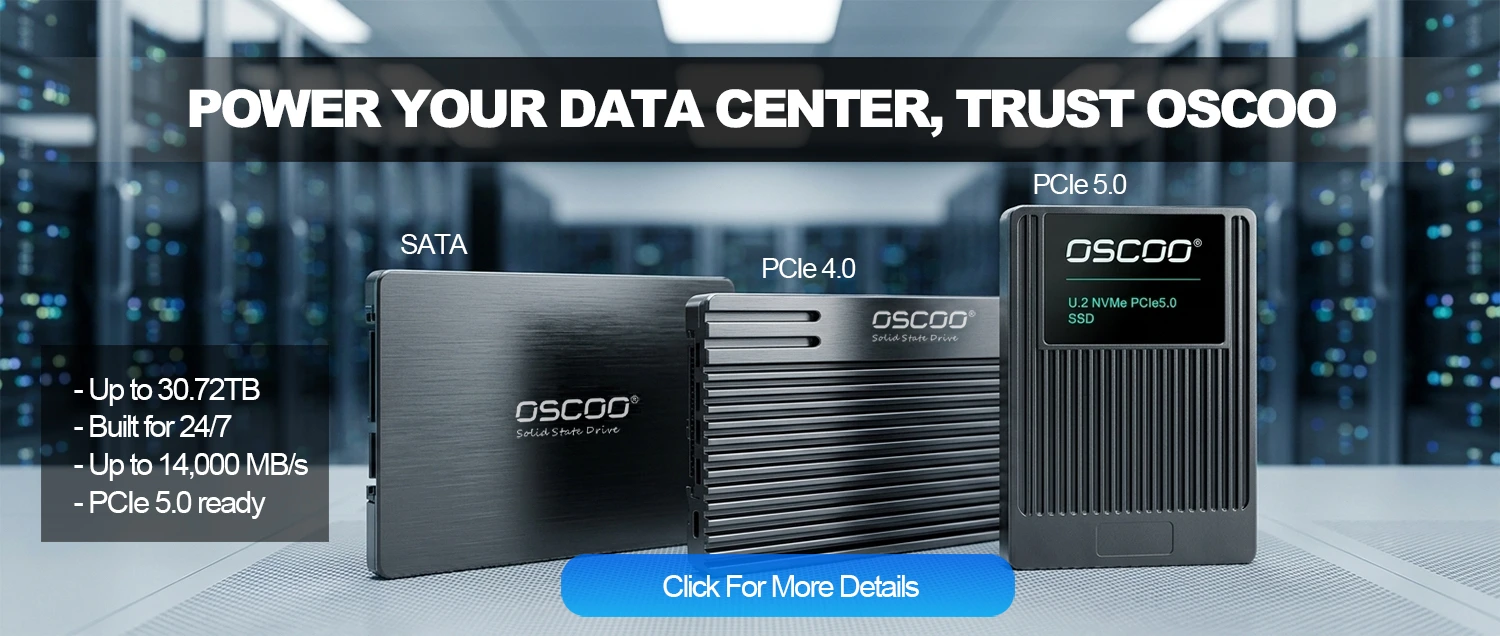
Looking ahead, the industrial SSD industry will continue to evolve in four areas: performance, intelligence, security, and application scenarios. As demand for high-speed data transfer grows in applications such as machine vision and edge AI, the share of products using PCIe 4.0 and even PCIe 5.0 interfaces will continue to increase. Leading manufacturers have already introduced PCIe 5.0 industrial-grade products with sequential read speeds of up to 14,000 MB/s. These products aim to meet the performance requirements of high-end applications while maintaining reliability in extreme environments.
At the firmware level, AI technology will gradually become part of SSD self-management processes. It will enable predictive wear management, early failure warnings, and dynamic workload optimization, further reducing long-term operating and maintenance costs at industrial sites. At the same time, stricter global data compliance requirements are making hardware encryption and secure erasure standard features in mid-range and high-end products. Together with the expansion of edge-storage nodes driven by industrial digital transformation and the wider adoption of AIoT, storage demand in outdoor and distributed deployment scenarios will become a key driver of long-term industry growth.