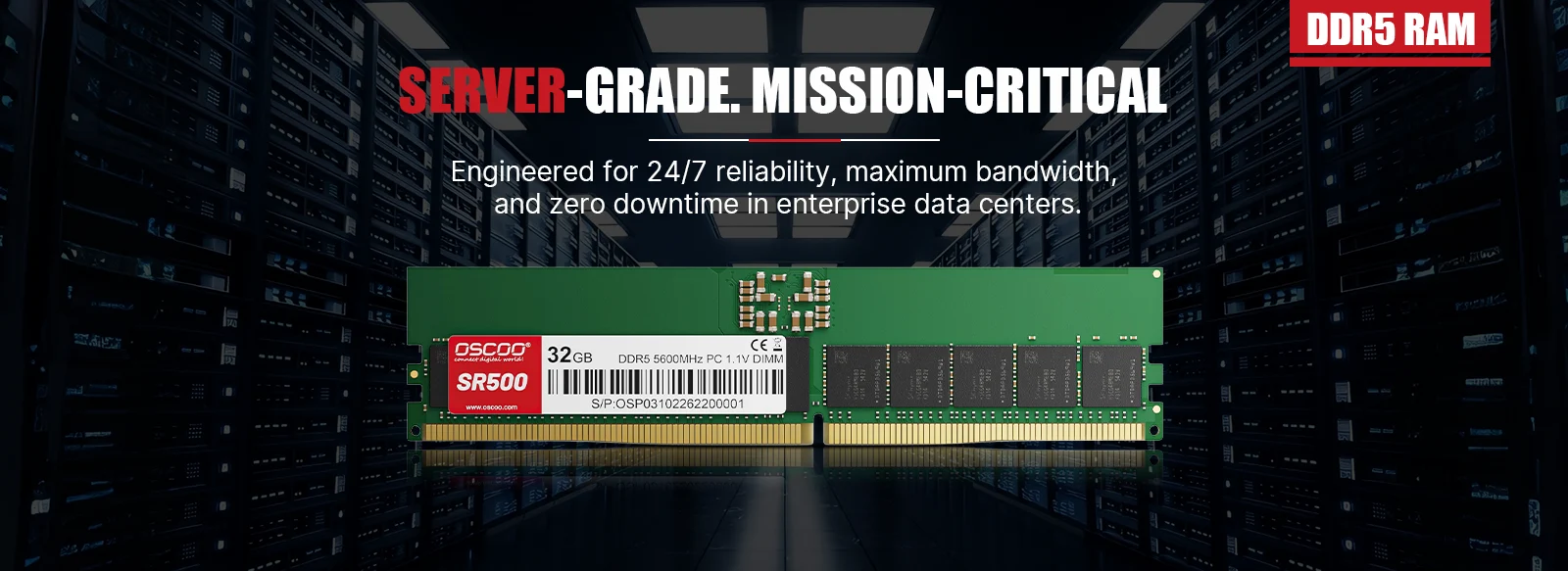
AI servers widely use DDR5 memory, which is now the standard system memory configuration for AI computing infrastructure. Whether for high-end AI training servers or large-scale inference servers, DDR5 serves as the core memory on the CPU side and works together with HBM high-bandwidth memory on the GPU side. The two have different but complementary roles and jointly support the stable operation of AI workloads. Driven strongly by AI demand, DDR5 penetration in the global AI server market has reached a high level in 2026, making it an essential core component of AI computing infrastructure.
DDR5 Is Now a Standard Configuration for AI Servers
With the rapid growth of the AI industry, DDR5 has completed its shift from “optional configuration” to “standard configuration” and has become a required component for AI servers.
In terms of market penetration, the overall penetration rate of DDR5 in the global server DRAM market is expected to be between 62% and 82% in 2026. In the AI server segment, the rate is significantly higher. New models from mainstream vendors have fully switched to DDR5, and the generational replacement of DDR4 with DDR5 is basically complete.
AI servers use far more DDR5 memory than traditional enterprise servers. The DDR5 memory capacity of a single AI server is 8 to 10 times that of a traditional server. Demand for DDR5 from cloud service providers and AI companies has become the most important growth driver of the global DDR5 market, accounting for a significant share of total market value and becoming the biggest growth driver for the memory industry. For example, a mainstream high-end AI training server based on the NVIDIA H100 platform typically uses 2TB to 4TB of DDR5 system memory, together with 640GB of HBM memory, forming a hierarchical memory architecture. The two respectively handle model parameter caching and active computing data buffering.
The industry supply chain has also completed full adaptation. Intel and AMD’s new-generation server CPU platforms natively support DDR5. Memory vendors such as Micron, SK hynix, and Samsung have launched DDR5 RDIMM products specifically optimized for AI, covering high-end specifications such as 256GB high-capacity modules and speeds of 9200MT/s. In the Chinese market, mainstream server vendors such as Inspur Information, Dawning Information Industry, and H3C are expected to have DDR5 configuration rates above 92% in newly sold AI servers in 2026, completing the product transition.
Key Reasons AI Servers Choose DDR5
Compared with the previous-generation DDR4, DDR5 provides key improvements in bandwidth, capacity, and energy efficiency. These improvements match the core needs of AI workloads and are a key reason why DDR5 has become a standard configuration for AI servers.
Higher Bandwidth Matches AI Acceleration Instruction Sets
The mainstream speed of server DDR5 is currently 5600MT/s to 6400MT/s, while the latest high-end products in 2026 have exceeded 9200MT/s. High-bandwidth DDR5, combined with CPU-side AI acceleration instruction sets such as Intel AMX and AMD AVX-512, can greatly improve inference performance in CPU-only scenarios. According to Micron’s test data, compared with a DDR4 platform, a server equipped with DDR5 and a 4th Gen Intel Xeon processor achieves 7.3 times higher computer vision inference performance, 4.9 times higher natural language processing inference performance, and 4.3 times higher recommendation system inference performance, effectively supporting lightweight AI inference workloads.
Larger Capacity Supports Large-Model Inference
A single DDR5 RDIMM module now offers capacities of 64GB, 128GB, and even 256GB, allowing a dual-socket server to be easily configured with several terabytes of system memory. For AI inference, large-capacity DDR5 can cache the key-value (KV) pairs of large models, significantly reducing time-to-first-token latency for long-context inference while also supporting a higher number of concurrent requests. Industry tests show that offloading large-model KV caches to large-capacity DDR5 on the CPU side can reduce time-to-first-token latency for real-time long-context inference by up to 98% and double concurrent inference capacity, greatly improving the user experience of large-model services.
Better Energy Efficiency Supports Large-Scale Deployment
With the new-generation manufacturing process, DDR5 memory consumes 15% to 20% less power than the previous-generation DDR4 at the same capacity. At the same time, using high-capacity single modules can further reduce overall power consumption. For example, replacing multiple smaller modules with a single 256GB DDR5 module can significantly reduce memory power consumption and motherboard space usage, helping improve energy efficiency. For AI data centers that may deploy tens of thousands of servers, the energy-efficiency improvement of DDR5 can significantly reduce long-term operating costs while also reducing cooling pressure, making it more suitable for high-density rack deployment.
DDR5 Configuration Differences Across AI Scenarios
Different AI workloads have significantly different DDR5 requirements. From training to inference, and from centralized systems to edge systems, each scenario has its own configuration priorities.
AI Training Servers. AI training servers use GPUs as the core computing resource and are paired with HBM memory. DDR5 is mainly responsible for data preprocessing, task scheduling, model loading, and temporary storage. A single training server typically has 384GB to 768GB of DDR5, while high-end 8-GPU training systems can be configured with 2TB to 4TB. As the coordinating role of the CPU in training continues to increase, memory capacity is also continuing to grow.
AI Inference Servers. In GPU inference servers, DDR5 works together with GPU memory to handle input/output caching and task scheduling. A typical configuration is 192GB to 384GB. There is also a type of CPU-only inference server that uses DDR5 as its core memory. In addition to being suitable for lightweight models and edge inference scenarios, it is also commonly used for cost-sensitive or latency-insensitive large-model inference deployments. By combining high-bandwidth DDR5 with AI instruction sets, these systems perform inference entirely on the CPU, with lower deployment costs and greater flexibility.
Edge AI Scenarios. Edge AI and lightweight AI scenarios usually use lower-power DDR5 or LPDDR5X memory to reduce power consumption while maintaining performance, meeting the deployment requirements of edge data centers and embedded AI devices.
Division of Roles and Differences Between DDR5 and HBM
DDR5 and HBM are different levels of memory in AI servers. Each has its own role, they complement each other, and there is no replacement relationship between them.
| Comparison Dimension | DDR5 System Memory | HBM High-Bandwidth Memory |
|---|---|---|
| Serves | CPU, responsible for system scheduling, data preprocessing, and model caching | GPU/AI accelerator, responsible for core AI computing |
| Installation location | Motherboard memory slots; removable and replaceable | Inside the GPU package; 3D stacked and soldered |
| Bandwidth level | Tens to more than 100 GB/s | More than 1.5TB/s per chip, over 10 times that of DDR5 |
| Key advantages | Large capacity, high cost-effectiveness, flexible deployment | Extremely high bandwidth, very low latency |
| Comparison Dimension | DDR5 System Memory | HBM High-Bandwidth Memory |
| Role in AI scenarios | Runs the system, schedules tasks, caches KV pairs, and stores preprocessed data | Continuously supplies the AI computing core with large amounts of model parameters |
In simple terms, HBM determines the upper limit of AI training computing power, while DDR5 determines the overall scheduling efficiency, inference concurrency, and long-context processing capability of an AI server. Both are indispensable. It should be clearly noted that HBM is dedicated memory for GPUs and is not system memory in the traditional sense. Server system memory specifically refers to the DDR5 memory modules installed on the motherboard, which are a basic configuration of all servers.
Future Development of DDR5 in AI Scenarios
Continued growth in AI demand is driving rapid development of DDR5 technology. There are three main development directions in the future.
- First, speed and capacity will continue to increase. DDR5 speeds will move toward more than 10000MT/s, while single-module capacity will exceed 512GB, further meeting the long-context and high-concurrency inference needs of large models.
- Second, MRDIMM technology will become more widely adopted. Multiplexed DIMM technology can increase DDR5 bandwidth by 30% to 40% without changing the motherboard slot architecture. The first-generation products have already reached 8800MT/s in the sample stage, while the second generation is expected to reach 12800MT/s from the end of 2026 to early 2027 (subject to the vendors’ final mass-production announcements). This can effectively ease the memory bandwidth bottleneck caused by the increasing number of CPU cores.
- Finally, supply and demand will remain tight. AI-driven growth in DDR5 demand is far outpacing the expansion of global memory production capacity. High-density, high-frequency server-grade DDR5 is expected to remain in short supply throughout 2026 and 2027, becoming one of the key bottlenecks in AI computing capacity supply.