As we enter the phase of large-scale LLM and AI inference deployment, the true performance bottleneck in server systems has long shifted from compute units to the memory side. Over the past five years, server CPU core counts have nearly tripled, yet memory bandwidth has grown at a far slower pace, causing per-core available bandwidth to decline steadily. The “memory wall” has become the core constraint on compute power release. In LLM inference, the frequent reads of KV Cache further amplify this issue; in many scenarios, system throughput is directly determined by memory bandwidth rather than CPU’s theoretical compute capability. As traditional DDR architecture approaches its physical limits, MRDIMM, with its multiplexing architecture that doubles effective bandwidth, has emerged as a next-generation technical path for breaking through memory bottlenecks.
What Is MRDIMM?
MRDIMM stands for Multiplexed Rank Dual In-line Memory Module. Its defining feature is this: without increasing the native speed of the DRAM chips themselves, the module uses dedicated control chips to make two ranks work in parallel, delivering doubled effective bandwidth to the memory controller.
The "Single-Lane" Mechanism of Traditional Memory
In traditional DDR memory, a rank operates as a “single-lane” access mechanism. On a typical dual-rank memory module, the DRAM chips are split into two independent ranks that share the same data bus. Due to the limitations of the DDR protocol, the memory can only activate one rank at a time for data transfer, leaving the other rank in a waiting state. This is like a single-lane highway: even though two rows of vehicles are queued, only one row can pass at any given time, so the total road capacity does not increase simply because there are more vehicles.
The "Dual-Lane Merging" Approach of MRDIMM
MRDIMM’s core innovation lies in adding a set of dedicated multiplexing buffer chips on the module, enabling parallel reads from two ranks and merging the outputs internally. Specifically, the DRAM chips on both ranks simultaneously transmit data at their standard rates; the multiplexing chips time-division multiplex the two data streams inside the module, combining them into a single stream with doubled data rate before sending it to the CPU-side memory controller. From the host’s perspective, it appears to be interacting with a high-speed memory running at double the rate. From the DRAM chip’s perspective, however, the chips still operate at their original standard speed range, requiring no underlying process upgrades.
Why This Is a Smart Solution
The elegance of this architecture is that it circumvents the physical speed bottleneck of DRAM chips themselves. Simply pushing chip frequencies higher would face a host of challenges—signal integrity, power consumption, yield rates, and more—with skyrocketing costs. MRDIMM shifts the complexity to the module-side interface chips, achieving a system-level bandwidth boost at a relatively manageable cost. At the same time, MRDIMM maintains full protocol-level compatibility. Data access still follows the standard 64-byte cache-line alignment, and all RAS reliability features such as ECC error correction and fault isolation are preserved. No modifications to server memory instruction sets or software stacks are required for adaptation. Physically, MRDIMM has the exact same pinout as standard DDR5 RDIMMs and can be plugged directly into existing server memory slots; it only needs native CPU and BIOS support to unlock its full performance.

From 1 Chip to 11 Chips: Hardware Differences Between MRDIMM and Standard Memory
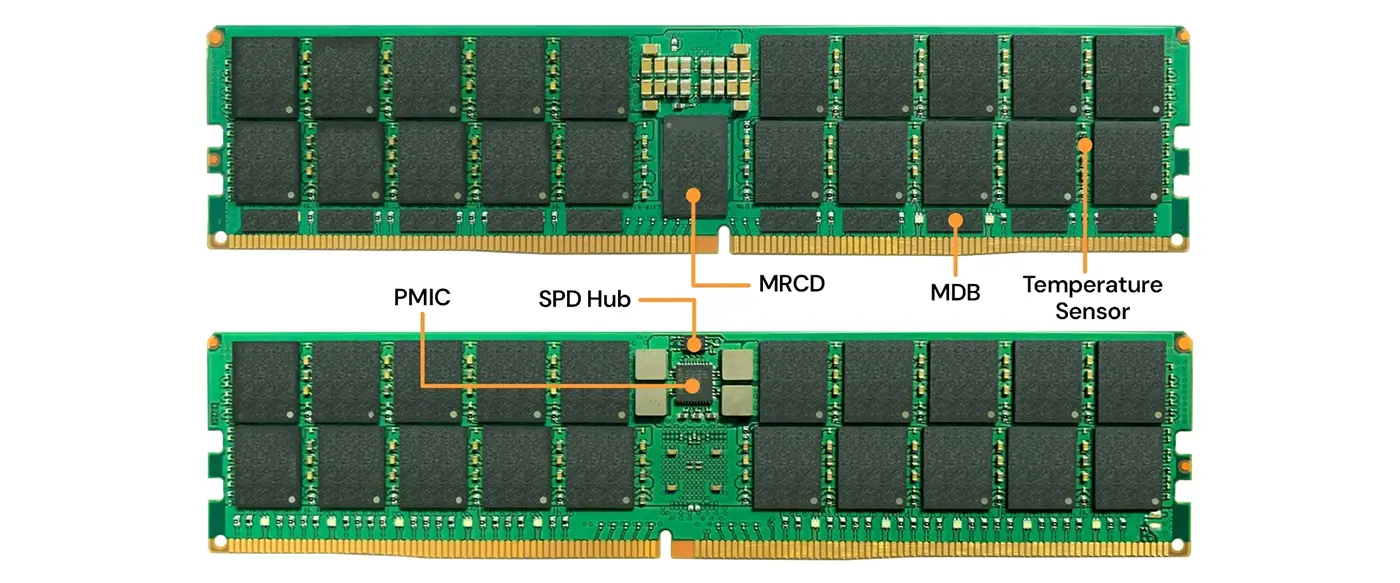
Externally, MRDIMM looks almost identical to a standard DDR5 RDIMM—the same length, same pins, and fits into the same server memory slots. But flip the PCB over, and you’ll see a significant hardware difference: MRDIMM carries an extra set of dedicated buffer chips, which are the hardware foundation for doubling bandwidth. A standard DDR5 RDIMM has only one central control chip, whereas according to the official JEDEC standard, a single MRDIMM uses a “1+10” core chip configuration.
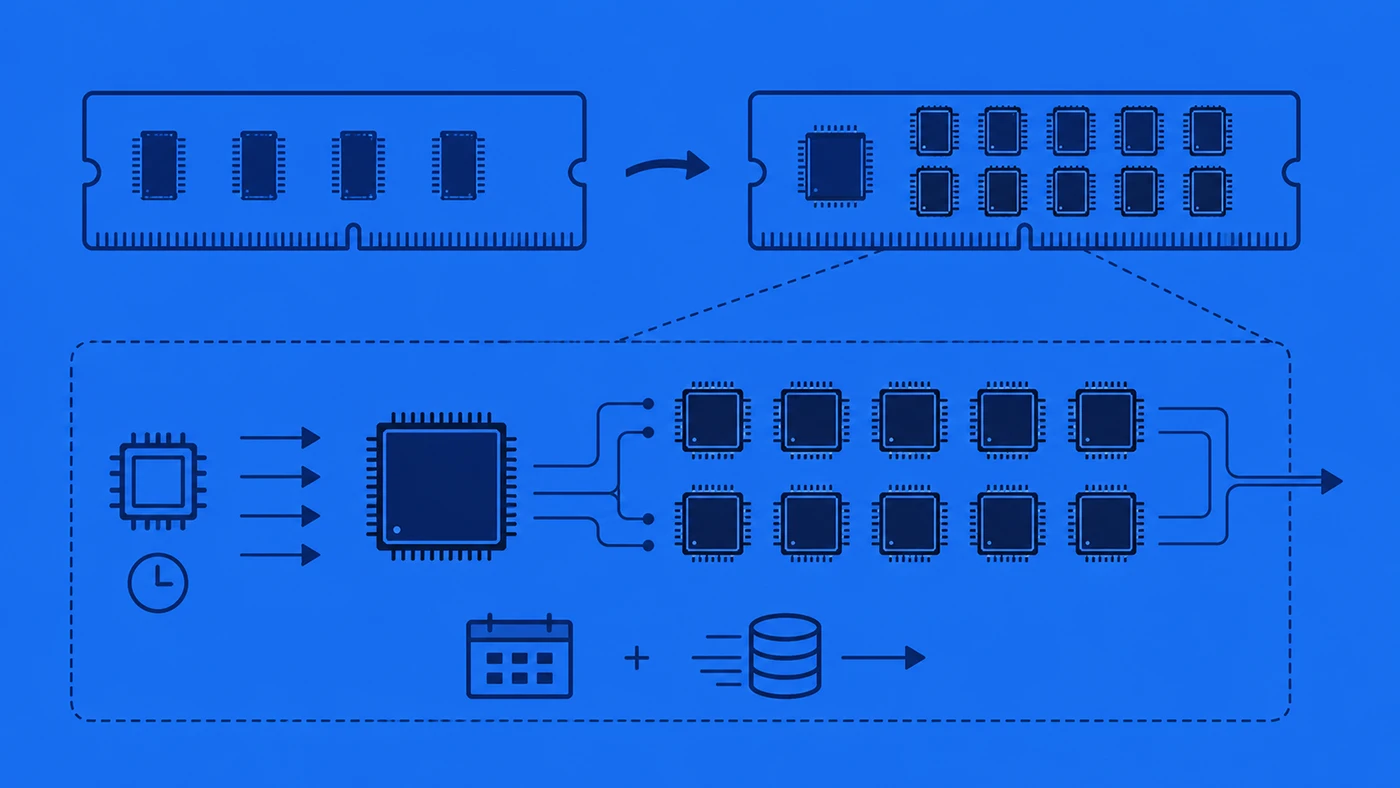
1 MRCD: The Module's Control Hub
MRCD stands for Multiplexed Register Clock Driver. It is an upgraded version of the traditional RCD and serves as the control brain of the entire MRDIMM. The MRCD’s primary responsibilities include: receiving and decoding address, command, and clock signals from the memory controller; coordinating the read/write timing of the two ranks to ensure precise alignment of the two data streams; and managing the multiplexing scheduling logic to guarantee that the merged data stream has no timing skew. Compared to a standard RCD, the MRCD has significantly greater internal logic complexity and a larger number of functional blocks.
10 MDBs: The Parallel Engine for Data Channels
MDB stands for Multiplexed Data Buffer. This is the new core component on MRDIMM and the key to achieving doubled data bandwidth. Each MDB chip corresponds to one data bit lane and is responsible for receiving, buffering, and time-division multiplexing the corresponding data bits from both ranks in parallel. The 10 MDBs collectively cover all data channels (including ECC parity bits), merging the two data streams inside the module and sending them out at twice the rate over the memory bus. In simple terms, the MRCD handles “command scheduling,” while the MDBs handle “data movement”—the two work together to complete the entire multiplexing process.
Real-World Performance of MRDIMM
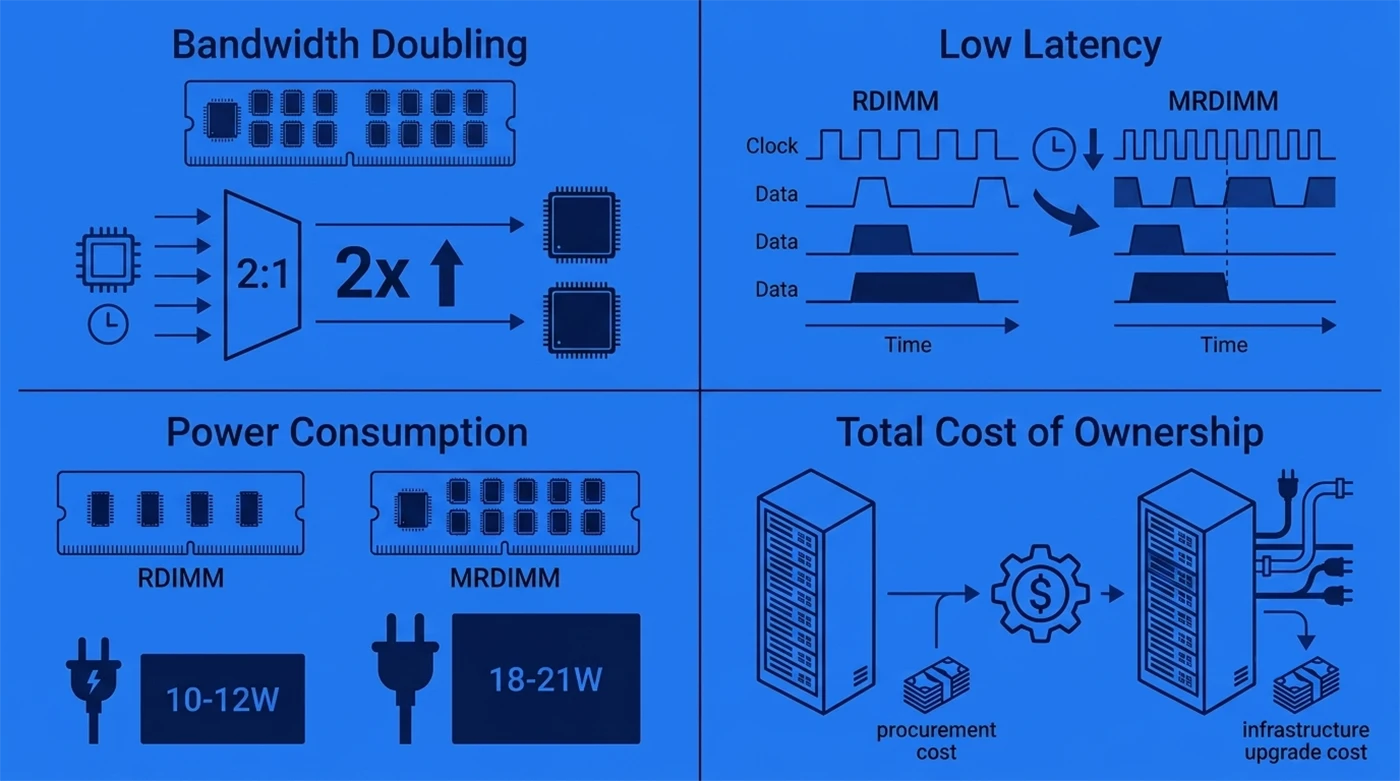
Bandwidth: A Leap of Double or More
Bandwidth is MRDIMM’s core performance metric and its most distinguishing feature compared to other memory types.
First-generation MRDIMM runs at a standard speed of 8800 MT/s, delivering 70.4 GB/s per channel in theoretical bandwidth. Compared to the current mainstream server DDR5-6400 RDIMM (51.2 GB/s), this represents a bandwidth increase of about 37.5%; against the previous-generation DDR5-5600 platform, the uplift exceeds 40%. For workloads already bottlenecked by memory bandwidth, this improvement can translate almost linearly into business performance gains. Second-generation MRDIMM pushes the speed further to 12800 MT/s, breaking the 100 GB/s per-channel barrier and reaching exactly double that of DDR5-6400. According to JEDEC’s roadmap, third-generation MRDIMM targets 16000 MT/s, continuing along the path of bandwidth doubling.
It is worth noting that this bandwidth increase is a genuine boost in “effective bandwidth,” not a paper gain from capacity stacking. This means the memory controller can indeed send and receive more data per second—a fundamental advantage for bandwidth-intensive workloads.
Latency: An Unexpected Benefit Alongside High Bandwidth
High-bandwidth memory typically comes with higher latency, but MRDIMM offers a different story. Compared to standard DDR5 RDIMMs, MRDIMM actually delivers lower effective access latency under bandwidth-sensitive workloads, with reductions up to 40%. This counterintuitive result stems from MRDIMM’s higher effective data rate (8800 MT/s). Compared to a 6400 MT/s RDIMM, MRDIMM takes less time to complete the same volume of data transfer, resulting in better overall access latency under high-load, high-queue-depth scenarios. Micron’s real-world measurements on the Intel Xeon 6 platform confirm this: using memory latency testing tools, MRDIMM shows significantly better latency performance than DDR5 RDIMMs on the same platform under bandwidth-intensive conditions.
Compared to LRDIMM, MRDIMM’s latency advantage is expected to be even more pronounced. LRDIMMs, in order to support higher capacities and more ranks, add extra buffering layers on the data path, introducing non-negligible latency overhead. MRDIMM’s multiplexing architecture, by contrast, features a more streamlined buffer design on the data path, with greater timing optimization headroom. This makes MRDIMM one of the few memory solutions that offers both “high bandwidth” and “relatively low latency,” making it particularly suitable for scenarios like quantitative finance and real-time analytics that demand both attributes.
Power Efficiency and Absolute Power Consumption
In terms of bandwidth per watt, MRDIMM performs better: the energy consumed per 1 GB of data transferred is lower than that of traditional RDIMMs. This is because the increase in interface chip power consumption is far smaller than the increase in bandwidth, so from a “per-bit transfer cost” perspective, it is more efficient. However, in absolute power consumption per module, MRDIMM is noticeably higher than standard memory. A typical DDR5 RDIMM draws about 10 to 12 watts, whereas an MRDIMM module consumes between 18 and 21 watts—nearly double. This extra power mainly comes from the 10 MDB chips and the 1 MRCD chip. For data centers, this means deploying MRDIMM requires simultaneous upgrades to power delivery and cooling capacity; the total cost of ownership includes not only the memory procurement itself but also infrastructure investments.
MRDIMM vs. RDIMM vs. LRDIMM vs. HBM
| Memory Type | Core Positioning | Typical Speed | Key Advantages | Cost Tier | Typical Use Cases |
|---|---|---|---|---|---|
| UDIMM | Consumer unbuffered memory | 4800–6400 MT/s | Low latency, low cost | Low | Desktops, entry workstations |
| RDIMM | Standard server memory | 4800–6400 MT/s | Stable, balanced, broadly compatible | Medium | General-purpose servers, virtualization |
| LRDIMM | High-density, high-capacity memory | 4800–5600 MT/s | Very large per-module capacity, supports dense configurations | Medium–high | In-memory databases, high-capacity nodes |
| MRDIMM | High-bandwidth server memory | 8800–12800 MT/s | Doubled bandwidth, good latency, slot-compatible | Higher | AI inference, HPC, real-time data analytics |
| HBM | 3D-stacked high-bandwidth memory | 6400+ MT/s | Extremely high bandwidth, deployed near compute units | Very high | GPU accelerators, AI training chips |
It is important to note that MRDIMM and HBM are not competitors but complementary technologies. HBM uses 3D stacking and is packaged directly inside GPUs or AI accelerators, sitting extremely close to compute units to provide ultra-high-bandwidth near-memory, but its capacity is limited by package space and its cost is extremely high—it serves GPU-side accelerated computing. MRDIMM, on the other hand, is deployed in standard memory slots on the server motherboard as the CPU’s system main memory, with per-module capacities reaching 256 GB or even higher, at a cost far below HBM—it serves CPU-side general-purpose computing. In a typical AI server, GPU cards are equipped with HBM for core compute, while the CPU side is equipped with MRDIMM for system scheduling, data preprocessing, and KV Cache management—each playing its own role and jointly supporting AI workloads.
Four Key Application Scenarios for MRDIMM
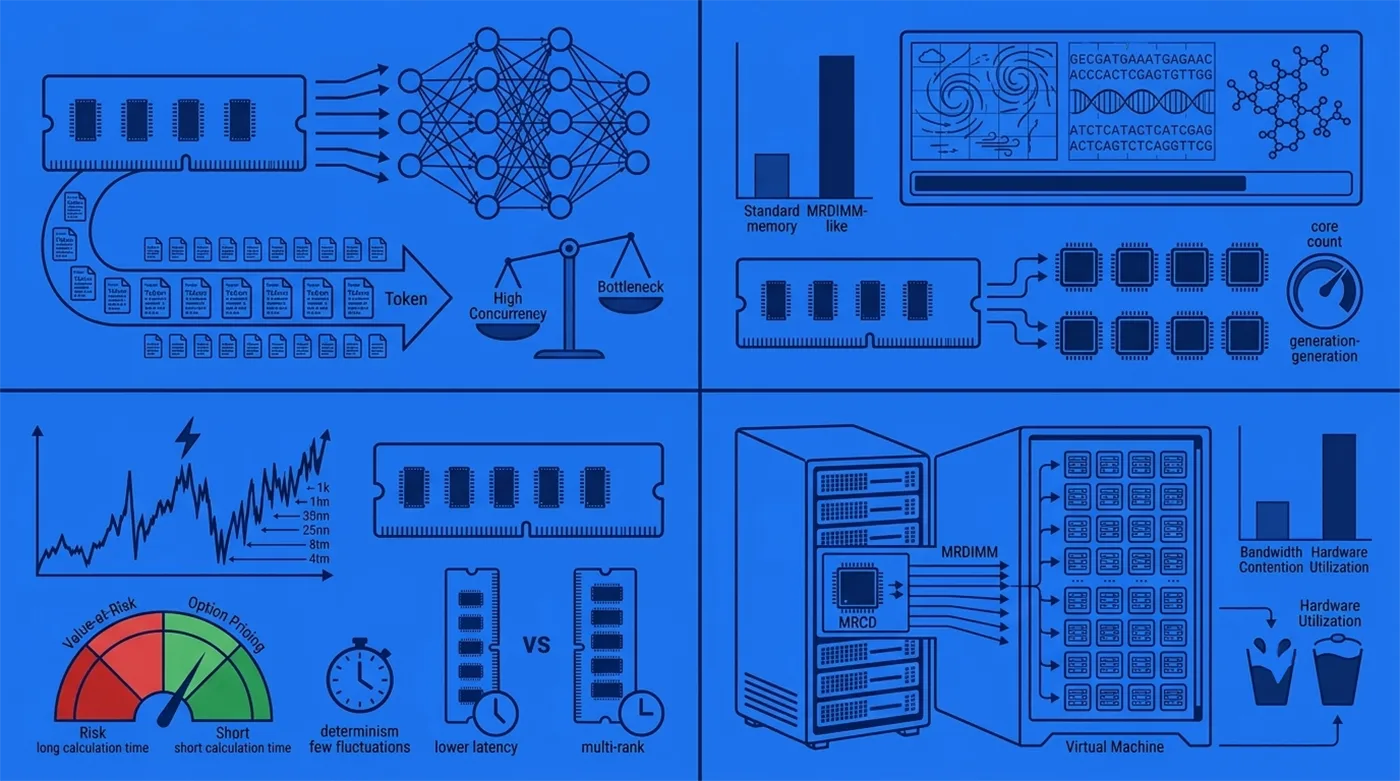
AI Inference and Large Model Serving
AI large-model inference is currently MRDIMM’s most critical application scenario and the fastest-growing area. During LLM inference, every token generated requires repeated reads of the KV Cache. As concurrency increases and model parameter counts grow, the volume of KV Cache reads explodes, and system throughput often becomes directly bounded by memory bandwidth rather than CPU compute.
MRDIMM’s doubled bandwidth directly translates into higher inference throughput. In real-world tests on the Intel Xeon 6 platform, servers equipped with MRDIMM showed about a 33% speedup in LLM inference tasks—meaning a single server can handle more concurrent requests, significantly lowering the per-token inference cost. For CPU-based inference servers, edge inference nodes, and small-to-medium model deployment scenarios, MRDIMM is emerging as a cost-effective performance upgrade option.
High-Performance Computing
Traditional HPC workloads—scientific computing, weather simulation, numerical simulation, genomics—are also prime targets for MRDIMM. These applications typically process massive datasets, with CPU cores continuously reading large matrices and arrays from memory. Once core counts grow past a certain point, memory bandwidth becomes the bottleneck in the compute pipeline, leaving many cores idle waiting for data. MRDIMM’s high bandwidth can better feed multi-core CPUs, keeping more cores simultaneously busy. For memory-bandwidth-bound HPC workloads, the performance uplift from MRDIMM approaches the theoretical bandwidth gain—on the order of 30% to 40%. For supercomputing centers and research institutions, this translates to roughly a generation’s worth of performance improvement at a relatively manageable cost, without replacing the CPU.
Finance and Real-Time Data Analytics
Financial industry use cases—high-frequency trading, risk quantification, real-time data warehousing—impose extremely stringent requirements on memory performance: not only high bandwidth but also low latency and high determinism. Take value-at-risk (VaR) calculations or option pricing models as examples: these tasks need to scan and compute across massive datasets in extremely short time windows, and memory bandwidth directly determines the total time for each risk computation.
In the STAC-A2 financial risk analytics benchmark, platforms equipped with MRDIMM have already set new performance records, dramatically shortening the computation cycles of quantitative models. MRDIMM’s advantage lies in delivering high bandwidth while keeping latency better than high-capacity memories like LRDIMM, satisfying both “speed” and “stability” requirements. For financial institutions that are highly sensitive to trading speed and computational timeliness, MRDIMM offers an option to further squeeze performance out of the traditional DDR architecture.
High-Density Cloud Computing and Virtualization
As single-server CPU core counts break the 100-core barrier, cloud providers and enterprise data centers face a new problem: per-core available memory bandwidth continues to decline, impacting the performance experience of cloud instances and virtual machines. In high-density virtualization scenarios, a single server may host dozens of VMs, each with very limited memory bandwidth. When multiple tenants simultaneously run memory-intensive workloads, bandwidth contention can easily cause performance jitter, jeopardizing service-level agreement (SLA) compliance.
MRDIMM raises the total system memory bandwidth, indirectly increasing the average bandwidth available per core and per VM, thereby supporting higher VM density. For cloud providers, this means more cloud instances can be hosted per server, improving hardware utilization and return on investment. For enterprise private clouds, it enhances performance stability in multi-tenant environments.
Industry Landscape and Future Trends
The MRDIMM industry chain has three layers. The upstream interface-chip layer has the highest technological barriers; Montage Technology, as one of the primary lead companies in the JEDEC standard, is a key global supplier of MRCD/MDB chips, with its second-generation products already in volume shipments. Midstream module vendors include Samsung, Micron, SK hynix, and others, all of which have launched MRDIMM products covering multiple capacity tiers. The downstream CPU platform is currently centered on Intel Xeon 6, the first server platform with native MRDIMM support. Overall, MRDIMM is currently in the transition from early validation to scaled trial deployment: first-generation 8800 MT/s products are in production and have seen small-scale deployment at leading cloud providers and AI companies, while the second-generation 12800 MT/s is in the large-scale validation phase.
The next two to three years will be the critical window for MRDIMM to move toward mainstream adoption, driven by three core factors: the surge in KV Cache bandwidth demand from AI inference, narrowing cost gaps as production scales up, and broadening support from more CPU platforms. According to JEDEC’s roadmap, MRDIMM will continue to iterate along the trajectory of 8800 MT/s, 12800 MT/s, and 16000 MT/s. Before DDR6 standards see large-scale deployment, MRDIMM will serve as the core bandwidth-upgrade path within the DDR memory ecosystem, complementing HBM in a layered, differentiated fashion to jointly support CPU-side and accelerator-side memory needs in the AI era.
Looking back at the history of memory technology, every architectural innovation has occurred at a point when compute power and bandwidth fell significantly out of balance. MRDIMM is precisely a product of the AI compute explosion. It does not attempt to overturn the fundamental framework of DDR memory; rather, through a clever multiplexing architecture, it achieves a leap in bandwidth within the existing ecosystem. As AI inference and HPC demand continue to grow, and as the CPU platform ecosystem matures, MRDIMM is expected to evolve from an optional high-end server component to a mainstream configuration for CPU-side main memory in the AI era, working alongside HBM to build a layered, complementary memory hierarchy that sustains the ongoing evolution of next-generation compute infrastructure.