Modern enterprise SSDs typically have an annual failure rate between 0.3% and 0.6% in standard data center environments, with high‑end enterprise models achieving rated values as low as 0.1% to 0.2%. These drives are widely considered to be more reliable than consumer SSDs and enterprise hard disk drives over their full service life, especially in long‑term operation. Unlike HDDs, SSD failure rates remain relatively flat over time rather than rising sharply as the hardware ages.
Core Reliability Metrics About Failure Rate
Annualized Failure Rate (AFR) – shows the percentage of drives in a large fleet that fail over one full year of operation. This is the most practical metric for data center capacity and maintenance planning.
Mean Time Between Failures (MTBF) – is a probabilistic estimate of average operating time between failures across a large population. Most enterprise SSDs carry a rated MTBF of 2.0 to 2.5 million hours, which translates to a theoretical AFR of roughly 0.35% to 0.44%.
Annual Replacement Rate (ARR) – tracks the share of drives physically replaced each year. It closely matches real‑world AFR but also includes proactive replacements made before a drive fully fails.
Real‑World Enterprise SSD Failure Rate Data
Vendor Specification and Field Data
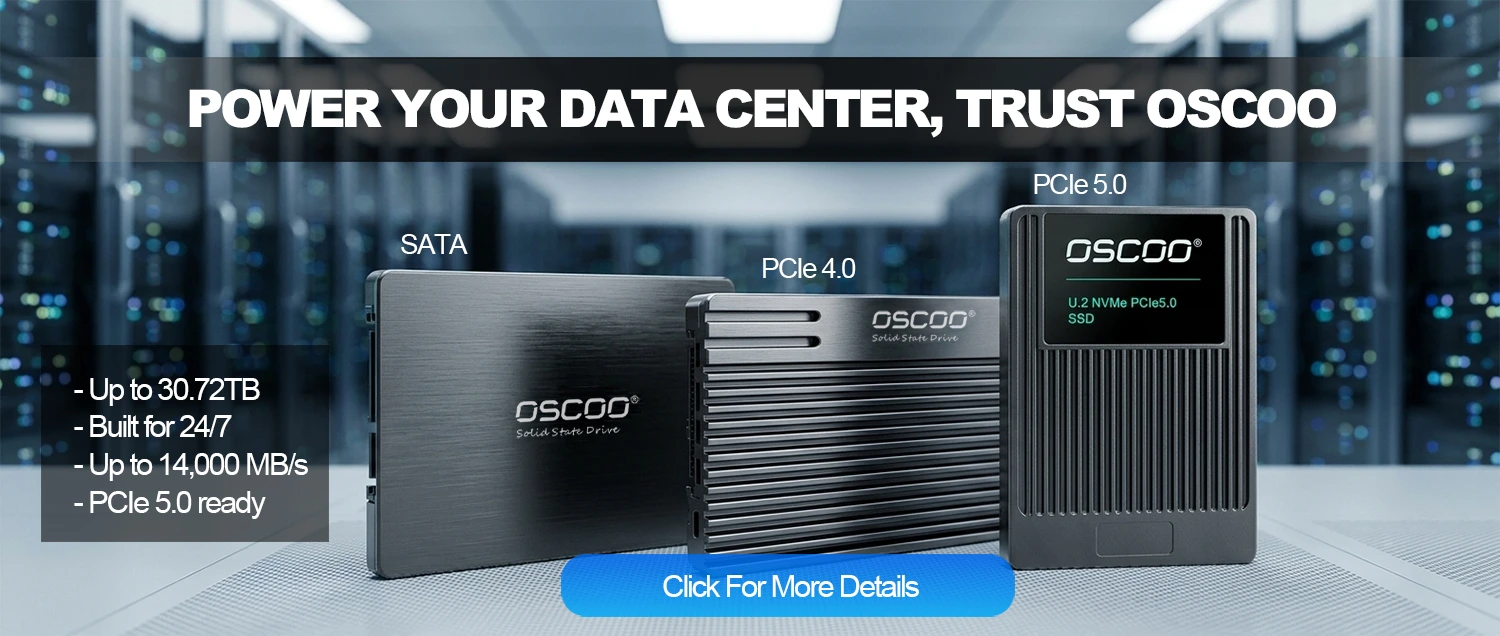
- OSCOO OE series enterprise SSDs have a rated MTBF ranging from 2.0 to 2.5 million hours.
- Seagate Exos series enterprise drives (the series includes both HDD and SSD product lines) carry a rated AFR of 0.44% and an MTBF of 2.0 million hours in official product manuals.
- Union Memory UH812a/UH832a PCIe 5.0 enterprise SSDs are rated at AFR ≤ 0.35% and MTBF ≥ 2.5 million hours.
- Samsung PM1735 enterprise NVMe SSDs have a rated MTBF of 2.0 million hours.
Across the industry, modern mainstream enterprise SATA and NVMe SSDs generally fall within the 0.3–0.6% AFR range when operated within their rated workload limits.
Academic and Industry Research
A FAST ’20 study analysed data from over 1.4 million SSDs, spanning 2.5 years, in a large‑scale enterprise storage system. The study found that the average annual replacement rate (ARR) across the entire fleet was 0.22%, but with wide variation among individual models, ranging from 0.07% to 1.2%. The study covered drives with various NAND types (SLC, cMLC, eMLC, and 3D TLC) from three manufacturers and 18 models. SCSI errors were the primary cause of drive replacements, accounting for about one‑third of all replacements.
Older historical data from major cloud operators between 2014 and 2015 shows higher rates: Google reported 1–2.5% AFR for early flash drives, Microsoft recorded 1–2% across over one million SSDs, and Facebook reported 1.33% AFR for its flash fleet. These numbers include older and near‑consumer‑grade drives. Current enterprise models perform substantially better than those from that era.
Key Factors That Influence Failure Rates
Unlike HDDs, where mechanical wear causes most failures, SSD reliability is shaped by four main factors.
NAND Flash Technology. Different types of NAND flash have different inherent reliability levels. In general, reliability ranks from highest to lowest as SLC, eMLC/MLC, 3D TLC, and QLC. Modern 3D TLC with LDPC error correction and advanced wear leveling has narrowed the reliability gap with MLC for most enterprise use cases. QLC SSDs are better suited for read‑heavy and cold storage workloads due to their lower write endurance.
Write Workload and Endurance. Enterprise SSDs are rated by Drive Writes Per Day (DWPD) , ranging from 1 DWPD for read‑heavy workloads to 10+ DWPD for write‑intensive applications. Under rated workloads, NAND wear‑out is not the primary cause of failure for most enterprise SSDs. Most failures come from controller electronics, firmware bugs, or power events rather than exhausted write cycles.
Operating Conditions. High temperatures accelerate NAND wear and electronic component degradation. Enterprise SSDs are validated for 0–70°C operation and include thermal throttling protection. Power loss protection via on‑board capacitors is standard on enterprise models, and it greatly reduces data corruption and sudden failures from unexpected power outages. With no moving parts, SSDs are far more resistant to vibration and shock than HDDs.
Controller and Firmware Quality. Enterprise‑grade controllers with advanced error correction, dynamic wear leveling, and over‑provisioning reduce failure risk significantly. Firmware defects are a leading cause of early‑life failures. Enterprise SSDs undergo more rigorous validation and receive longer firmware support than consumer models, which lowers long‑term failure risk.
Enterprise SSD vs Enterprise HDD Reliability Comparison
| Metric | Modern Enterprise SSD | Enterprise SATA/SAS HDD |
|---|---|---|
| Typical AFR | 0.3 – 0.6% | 0.45 – 1.6% |
| AFR after 5 years | ~0.9% (flat trend) | ~3.5% (sharply rising) |
| Rated MTBF | 2.0 – 2.5M hours | 1.0 – 1.2M hours |
| Dominant failure mode | Sudden / catastrophic | Gradual mechanical wear |
| Primary limiting factor | Write endurance (TBW) | Calendar age & mechanical wear |
In long‑term deployments of five years or more, enterprise HDDs typically show 3 to 4 times higher failure rates than enterprise SSDs of the same age. The gap is even larger in high‑vibration or high‑IOPS environments.