AI data centers do not use SSDs or HDDs exclusively. They typically deploy both types of drives in a hybrid manner. SSDs, with their excellent performance, handle the core workloads in AI operations that demand high speed, serving as the primary means to unlock computing power. HDDs, relying on their large capacity and low cost, take on the storage and archiving of massive amounts of data. The two work together to form a complete storage system.
Why Hybrid Deployment Is Needed
AI data centers adopt hybrid deployment of SSDs and HDDs primarily because the two have clear complementary strengths in performance and cost. SSDs have no moving parts and read and write data entirely through electronic signals, making them extremely fast. Their latency is typically measured in microseconds, and their random read/write performance (IOPS) is hundreds or even thousands of times higher than that of HDDs. These characteristics enable SSDs to meet the high data access speed requirements of AI training and inference. HDDs, by contrast, rely on magnetic heads to read and write data on spinning disks. Due to their mechanical structure, their latency is measured in milliseconds, and their random read/write performance is far lower than that of SSDs. Their advantage lies in cost.
| Feature | SSD | HDD |
|---|---|---|
| Working principle | Flash memory based, no moving parts | Magnetic head reads/writes on spinning disks, moving parts involved |
| Latency | Microsecond level | Millisecond level |
| Random read/write performance | Very high (IOPS hundreds of times higher than HDD) | Relatively low |
| Cost per TB | Approximately 10 to 20 times that of HDD | Relatively low |
| Maximum capacity per drive | Reaching 128TB–245TB level | Reaching 32TB and above (HAMR technology) |
| Power efficiency | Power per TB far lower than HDD | Spinning continuously, relatively higher power consumption |
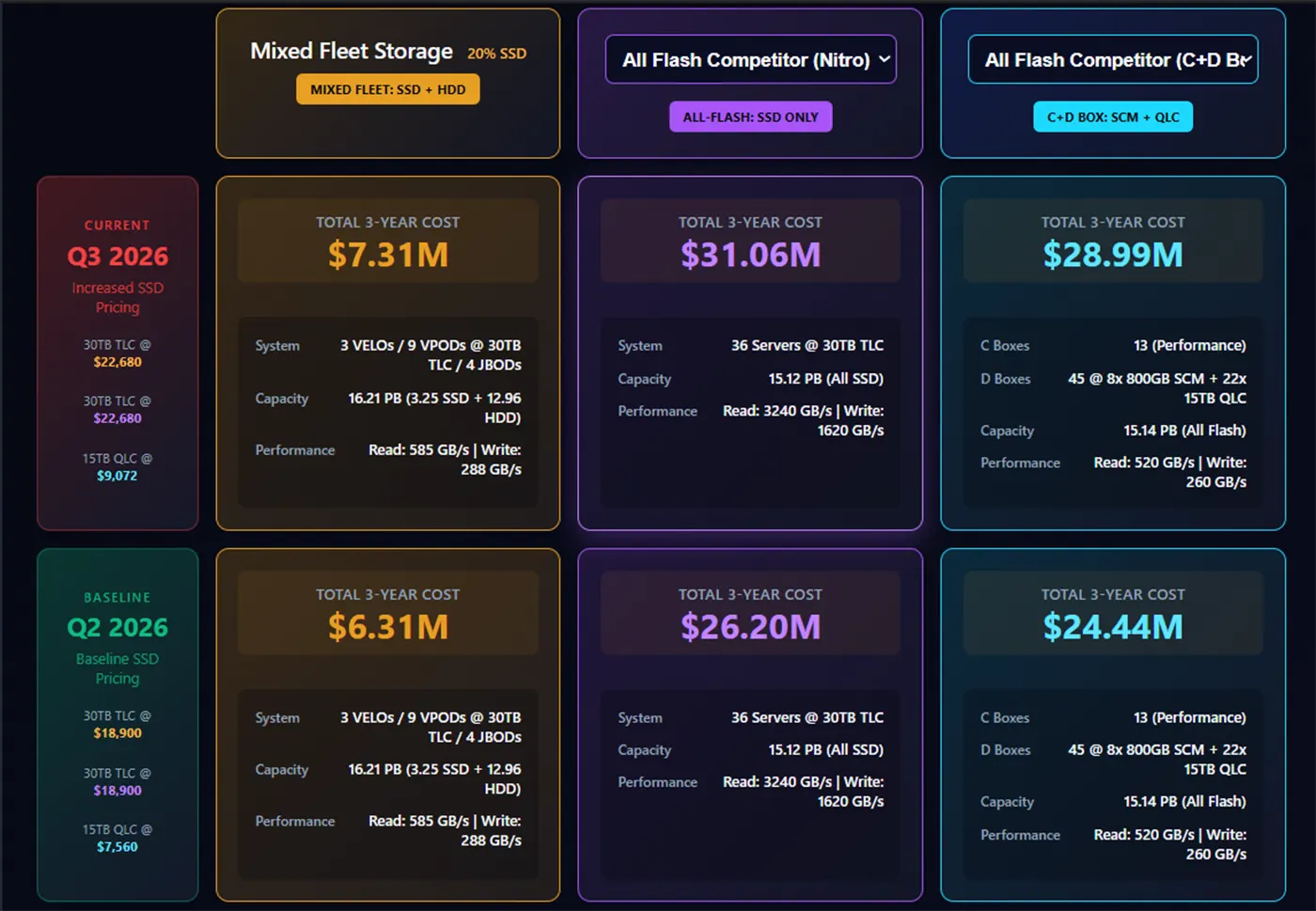
According to VDURA data from the first quarter of 2026, the cost per unit capacity of 30TB QLC enterprise SSDs reached 22.6 times that of HDDs of the same capacity. The price of 30TB TLC enterprise SSDs rose from about $3,062 to about $17,500 over the past year, while HDD prices increased only about 35% over the same period. This gap makes pure SSD solutions increasingly unaffordable.
VDURA’s modeling of a typical data center configuration shows that over a three-year lifecycle, the total cost of ownership for a hybrid storage system is approximately $7.31 million, while a pure SSD system costs approximately $31.06 million. The three-year cost of the hybrid solution is about one quarter that of the pure SSD solution. In short, SSDs provide speed, while HDDs provide capacity and cost control. Both have irreplaceable value, so hybrid deployment is essentially an inevitable choice for data centers today.
Storage Selection Logic for Core AI Operations
The data preparation stage processes raw data. This stage primarily involves large-scale sequential reads, which do not require high random read/write performance but demand significant capacity. Industry practice mostly adopts HDD-based storage solutions, supplemented by some SSD cache to improve access speed for hot data.
The model training stage has the highest storage performance requirements. The entire process requires continuous reading of massive training samples and frequent writing of model checkpoint files, creating extremely high data throughput demands. If HDDs were used as the primary storage, their inherent latency would cause data supply to lag behind GPU computation, directly leading to idle computing cycles and a significant drop in hardware utilization. Therefore, in training clusters, NVMe SSDs are deployed both locally on GPU servers and in shared storage clusters. Technologies such as RDMA and NVMe‑oF are used to build parallel file systems, providing a continuous stream of data for multi‑GPU clusters.
The inference serving stage has two core requirements: low response latency and high concurrency capacity. Mainstream large language model applications and retrieval‑augmented generation (RAG) services generate a large number of KV cache and vector retrieval requests. These types of data access are highly random and latency‑sensitive, and must therefore run on SSDs. The model weights and vector databases used in inference are also fully deployed on NVMe SSDs to ensure fast time‑to‑first‑token and overall service stability. HDDs play only a supporting role in inference, storing historical logs, infrequently accessed knowledge bases, and backup files — they do not participate in real‑time front‑end services.
Multi‑Tier Storage Architecture
Mature AI data centers today all adopt a tiered storage architecture. Data is divided into three tiers — hot, warm, and cold — based on access frequency and performance requirements, and the hardware configuration changes accordingly to balance performance and cost.
- The hot tier is the highest‑performance part of the architecture, including memory, high‑bandwidth GPU memory, and local NVMe SSDs in servers. Its total capacity accounts for only 5% to 20% of the overall storage footprint. This tier stores model weights, real‑time caches, and frequently used training data. It directly determines GPU efficiency and is the core link that ensures the smooth operation of AI workloads.
- The warm tier typically uses high‑capacity QLC NVMe SSDs or high‑performance HDDs, and in some cases HDD arrays accelerated by SSD cache. It stores moderately accessed data such as cleaned datasets and commonly used model files, striking a balance among performance, capacity, and cost.
- The cold tier occupies more than 80% of a data center’s storage capacity. Its primary hardware consists of enterprise HDD arrays; some very large clusters also incorporate tape libraries. It is dedicated to storing rarely accessed cold data, such as raw corpora, expired data, and full backups, maximizing control over overall deployment costs.
Industry Status and Technology Trends
In terms of overall capacity share, HDDs still account for about 80% of total storage capacity in AI data centers today, serving as the foundation for massive data. Although SSDs excel in performance, their capacity share remains relatively limited due to cost constraints. Looking at growth trends, the boom in the AI industry is driving demand for both types of storage products. However, the compound annual growth rate for enterprise SSDs is much higher than that for HDDs, reflecting the essential role of high‑performance storage in AI scenarios.
As flash memory technology evolves, large‑capacity QLC SSDs are becoming more widespread and are gradually encroaching on warm data markets that previously belonged to HDDs. Some moderately accessed data is starting to move to SSD storage. In the long term, however, HDDs will not be completely replaced. In petabyte‑scale or exabyte‑scale cold data archiving scenarios, HDDs remain irreplaceable due to their cost per unit capacity, while SSDs — constrained by their physical characteristics and pricing — are unlikely to fully take over large‑capacity archival storage. Long‑term coexistence of the two hardware types, working together in a tiered fashion, will be the mainstream storage model for AI data centers in the future.
SSDs and HDDs are not competing alternatives; they are complementary components in the storage architecture of AI data centers. NVMe‑based SSDs handle the high‑performance core workloads, allowing AI compute to be fully unleashed. Enterprise HDDs hold the line on large capacity and low cost, accommodating the storage needs of massive data. The hybrid, tiered deployment model balances performance, capacity, and cost — the three essential factors. It is the most reasonable storage solution for AI data centers today and will remain so for the foreseeable future.