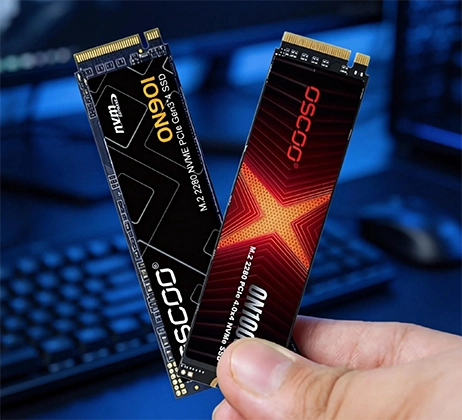
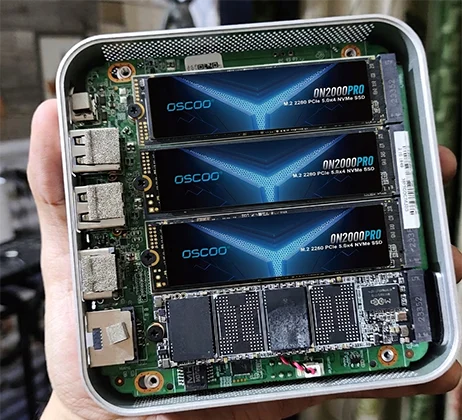
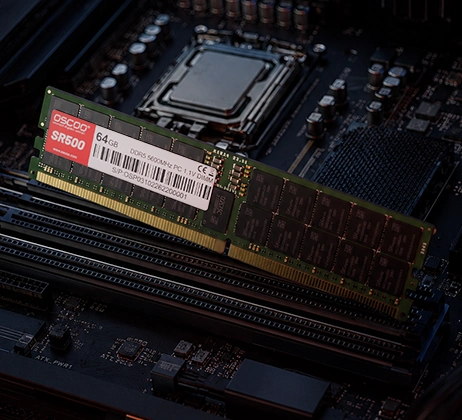
DDR4 is still good enough for most users in 2026. It remains a perfectly viable and cost-effective choice for budget-conscious builders and those upgrading older platforms. For gaming and everyday tasks, the performance gap between DDR4 and DDR5 is surprisingly small, while the price difference remains substantial enough to matter for many buyers. However, you should also be aware that choosing DDR4 locks you into a platform with no forward upgrade path. Whether it’s “worth it” mainly comes down to your budget and how long you plan to keep your PC.
Real-World Performance Differences
While DDR5 has clear technical advantages on paper, the differences often translate to smaller real-world gains than you might expect, especially for typical consumer use cases.
Core Technical Comparison
| Parameter | DDR4 | DDR5 |
|---|---|---|
| Frequency Range | 3200-3600MHz | 5600-6400MHz |
| Voltage | 1.2V | 1.1V |
| Channels | Single 64-bit channel per module | Dual 32-bit sub-channels per module |
| Latency | Lower (CL16-CL18 for high-performance kits) | Higher (CL30-CL36 for similar price range) |
| Max Capacity | 128GB per DIMM (consumer) | 256GB per DIMM (consumer) |
Gaming Performance
At 1080p resolution, DDR5-5600 typically delivers a 3-10% average FPS improvement over DDR4-3600 (performance gaps may vary by title but generally fall within this bracket). However, this gap narrows significantly at 1440p and 4K, where the GPU becomes the primary bottleneck, and differences shrink to just 1-3%. Most modern games released in 2024-2026 are GPU-bound rather than memory-bound, meaning DDR4 can still run every title at high settings without noticeable limitations.
Productivity Workloads
For content creation tasks like video editing in Premiere Pro or DaVinci Resolve, DDR5 shows 5-10% faster exports, particularly with 4K/8K footage. 3D rendering sees minimal differences of 2-5% unless working with extremely large scenes. For office work, web browsing, and business applications, the performance gap is practically nonexistent. Both memory types handle these tasks flawlessly with no perceptible difference in responsiveness. AI/ML workloads represent the clearest advantage for DDR5, where it can outperform DDR4 by 20-30%.
Not Cheap, But Still a Better Deal
Since mid-2025, DRAM prices have entered an unprecedented upward trend, driven primarily by surging AI server demand. Major manufacturers including Samsung, SK Hynix, and Micron have redirected a significant portion of their DRAM wafer capacity toward higher-margin HBM (High Bandwidth Memory) and server-grade DDR5, leaving mainstream DDR4 and consumer DDR5 supply severely constrained. As a result, DDR4 spot prices have kept rising since July 2025. That said, although DDR4 is no longer the bargain it was two years ago, it still offers significant savings over DDR5 while delivering 80% or more of DDR5’s real-world performance in gaming and everyday tasks.
Platform Support: The Factor You Can't Ignore
Intel and AMD have both taken steps to keep their previous-generation DDR4 platforms alive in 2026. On Intel’s side, the LGA1700 platform (12th to 14th Gen Core processors, codenamed Alder Lake and Raptor Lake) continues to support DDR4 memory. Intel has also explicitly stated that Raptor Lake is “a big part of our strategy” and will remain abundantly available. For AMD, the venerable AM4 platform is still receiving new motherboard releases in 2026, including recent B550 models from MSI and Gigabyte, and AMD even launched a new AM4-compatible CPU (Ryzen 5 5600F) as recently as September 2025.
However, all new platforms moving forward have dropped DDR4 support entirely. Intel’s Arrow Lake and AMD’s AM5 are both DDR5-only. Choosing a DDR4-based system today means you are locking yourself into a platform with no forward CPU upgrade path. If you are the type of user who tend to keep a PC for 4–5 years and then replace it entirely, this isn’t a problem. But if you prefer to upgrade incrementally, the lack of future compatibility is a critical issue you should consider carefully before committing to DDR4.
When DDR4 Is the Best Choice
- Upgrading an existing DDR4 system. If you already own an AM4 or LGA1700 system, upgrading to more DDR4 capacity is one of the most cost-effective performance boosts available. Pair that with a new GPU, and you can extend your current system‘s useful life by another 2–3 years without rebuilding from scratch.
- Building a budget gaming PC. DDR4-based systems provide nearly identical gaming performance to DDR5 at 1080p/1440p while freeing up funds for a better GPU, which will deliver far more noticeable improvements in frame rates.
- Office and productivity workstations. For web browsing, document editing, spreadsheets, and business applications, DDR4 offers all the performance needed with superior stability and lower cost.
- Secondary systems. Media centers, home servers, and casual-use PCs don’t benefit from DDR5’s bandwidth advantages and will run perfectly on DDR4 for years to come.
When to Choose DDR5
Opt for DDR5 if you’re building a new high-end system where you plan to keep the platform for 5+ years, run memory-intensive workloads like 8K video editing or AI/ML development, prioritize maximum future-proofing, or need large RAM capacities for specialized applications. DDR5 also provides better 1% lows in competitive games, which can be beneficial for esports players seeking every possible advantage.