Driven by the rapid rise of artificial intelligence, high-performance computing, and cloud data centers, traditional memory systems are facing unprecedented challenges. Processor performance continues to grow exponentially, but data transfer speeds have struggled to keep up — creating a “bandwidth bottleneck” that limits overall system performance. In response, HBM (High Bandwidth Memory) was born. By using 3D stacked packaging and ultra-wide bus interfaces, HBM greatly increases data transfer bandwidth per watt of power. It is now seen as one of the key technologies capable of breaking through the limits of memory performance.

The Technology and Architecture of HBM
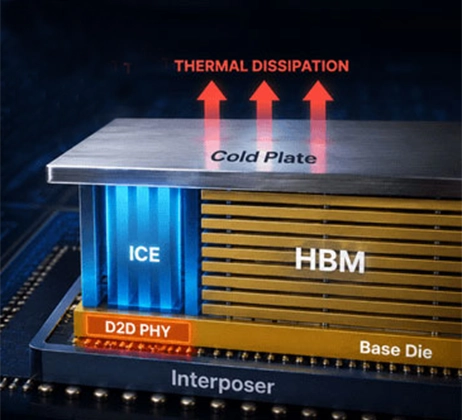
HBM differs from traditional DDR memory in its 3D TSV (Through-Silicon Via) vertical interconnection design. Multiple DRAM dies are stacked vertically and connected through silicon vias, then packaged together with a logic die (typically a GPU or AI accelerator) on a silicon interposer. This design drastically shortens signal paths, allowing for much higher transfer speeds at lower power consumption. In contrast, DDR4 and DDR5 still use conventional parallel PCB wiring, where further bandwidth increases come with higher power and signal integrity costs.
| Feature | HBM | DDR4 | DDR5 |
|---|---|---|---|
| Connection | TSV vertical stacking | PCB parallel wiring | PCB parallel wiring |
| Packaging | Co-packaged with logic die (2.5D) | Separate module | Separate module |
| Per-pin speed | ~2 Gbps | ~3.2 Gbps | ~6.4 Gbps |
| Total bandwidth (per stack) | 256 GB/s (HBM2) – 1 TB/s (HBM3E) | ~25 GB/s | ~50 GB/s |
| Power efficiency | High | Medium | Medium-high |
| Applications | HPC, AI, GPU, Networking | PCs, Servers | PCs, Servers |
As of 2025, HBM technology has advanced to HBM3E, offering up to 24 GB per stack and bandwidths reaching 1.2 TB/s. The next generation, HBM4, is expected to use a chiplet + active interposer architecture for even greater integration and thermal efficiency.
Industry Landscape: Oligopoly and Technical Barriers
HBM is extremely difficult to manufacture. The main challenges include 3D stacking yield, packaging precision, heat dissipation, and interposer fabrication. As a result, the global market is highly concentrated, dominated by three major memory producers:
| Company | Market Share (approx.) | Core Product | Key Customers |
|---|---|---|---|
| SK hynix | 50%+ | HBM3 / HBM3E | NVIDIA, AMD, Intel |
| Samsung | 35% | HBM2E / HBM3 | AMD, Google, Amazon |
| Micron | 10–15% | HBM2E / HBM3 | NVIDIA, Meta, Tesla |
Meanwhile, companies in Japan and Taiwan (like Kioxia, Nanya, and Winbond) are still in R&D stages and remain two to three generations behind in commercialization. In mainland China, CXMT and YMTC have started early HBM projects, but due to limited advanced packaging capability and dependency on imported equipment, large-scale production is not expected soon.
This “technical oligopoly” gives enormous pricing power to a few companies. From 2023 to 2025, NVIDIA’s H100, H200, and Blackwell GPUs drove explosive demand for HBM, resulting in record profits for SK hynix and tight global supply.

Market Dynamics: HBM Fuels the AI and Compute Economy
AI Training as the Main Growth Driver
With the rise of generative AI and large language models, HBM has become an essential companion for GPUs. NVIDIA’s H100 uses 80 GB of HBM3 with 3.35 TB/s bandwidth, while the new Blackwell GPU uses HBM3E with twice the capacity and up to 8 TB/s total bandwidth. This means that the memory bandwidth required for AI training has grown nearly tenfold since 2020. HBM performance now directly determines GPU efficiency — making it a central factor in chip competitiveness.
Price Surge and Supply Shortage
The booming AI market has caused HBM prices to jump by more than 60% between 2024 and 2025. SK hynix has been operating at full capacity, often unable to meet demand. Because HBM production consumes advanced packaging capacity, some DDR5 lines have been shifted to HBM, pushing up general memory prices.
New Entrants and Supply Chain Expansion
Advanced packaging firms such as TSMC, ASE, and Samsung are expanding CoWoS and InFO production lines. EDA and testing equipment vendors — including Cadence, Synopsys, and KLA — are developing verification and inspection tools for 3D DRAM. The entire ecosystem is maturing rapidly.
The Impact of HBM on Traditional Memory Markets
HBM’s rise is not an isolated event. It is reshaping the entire memory ecosystem and having deep effects on DDR and GDDR markets.
DDR Shifts Toward Mid-Range and Server Segments
Since HBM fits best in high-performance systems, consumer PCs and basic servers will continue to use DDR4/DDR5. However, as AI servers become the main source of demand growth, DDR’s market share will shrink. According to TrendForce, HBM adoption in data centers may exceed 35% by 2026. DDR4 will rapidly be phased out, while DDR5 transitions into maturity.
Predicted Market Share by Application (2025–2027)
| Application | 2025 | 2026 | 2027 |
|---|---|---|---|
| AI / HPC | HBM → 70% | 80% | 85% |
| General servers | DDR5 → 70% | 65% | 60% |
| PC / Consumer | DDR4 → 60% | 45% | 30% |
| GPU memory | DDR6 / HBM mix | Transition to HBM | Mainstream HBM |
DDR Makers Enter “Second Transformation”
Traditional memory makers like Micron and Samsung are shifting strategies. They are increasing HBM investment and advanced packaging capacity, while repositioning DDR as a mid- to low-end product for cost-sensitive markets. HBM has thus become both a new growth engine and a force reshaping corporate competition.
Future Outlook: HBM4 and the Chiplet Era
Over the next five years, HBM will increasingly merge with chiplet architectures. HBM4, expected around 2026–2027, could deliver bandwidth beyond 2 TB/s through active interposers, achieving new levels of energy efficiency.
HBM Technology Roadmap
| Generation | Year | Stack Layers | Capacity (per stack) | Bandwidth (GB/s) | Main Application |
|---|---|---|---|---|---|
| HBM1 | 2015 | 4 | 4 GB | 128 | GPU |
| HBM2 | 2017 | 8 | 8 GB | 256 | HPC |
| HBM2E | 2020 | 8 | 16 GB | 460 | AI / 5G |
| HBM3 | 2023 | 12 | 24 GB | 819 | AI training |
| HBM3E | 2025 | 16 | 24 GB | 1200 | LLMs, HPC |
| HBM4 | 2027* | 16+ | 32 GB+ | 2000+ | Chiplet SoC |
At the same time, chipmakers like NVIDIA, AMD, and Intel are exploring tighter integration of HBM directly onto compute modules, blending computing and memory into one. This trend is blurring the boundaries between memory, cache, and storage — paving the way for a new architecture concept known as “Memory-as-Compute.”
The Turning Point of the Memory Revolution
HBM is more than just a new memory type — it is the driving force behind the next era of computing. It symbolizes the industry’s shift from a “compute-first” to a “bandwidth-first” paradigm. In AI, autonomous driving, simulation, and cloud computing, HBM will continue expanding its reach, becoming a critical metric for performance. However, its high cost, complex manufacturing, and concentrated supply chain also introduce new risks. Balancing performance with affordability remains the industry’s greatest challenge. In the years ahead, as HBM4 and HBM5 emerge, we may enter an age where memory itself becomes the core of compute power — and HBM will stand at the very heart of that revolution.