In most everyday use cases, твердотельные накопители have a longer practical service life and better overall reliability than mechanical hard drives. Based on manufacturers’ design standards and rated workloads, consumer HDDs have a reliable service life of 3 to 5 years, while mainstream TLC consumer SSDs have a designed reliable service life of 5 to 10 years. In normal, light home use, HDDs commonly have a physical service life of 7 to 10 years, while SSDs generally do not wear out from writes and can usually remain in service until they are naturally replaced because their performance no longer meets current needs.
However, the underlying principles of the two storage technologies and the standards used to measure their lifespans are completely different, so their advantages and disadvantages cannot be determined using a single metric. Their failure modes and the key factors affecting lifespan are fundamentally different, so actual performance needs to be analyzed according to the specific use case.
Core Lifespan Metrics for SSDs and HDDs
Both storage technologies are based on completely different physical principles, so the industry uses separate measurement systems to define their lifespans. Directly comparing the numbers can therefore be misleading.
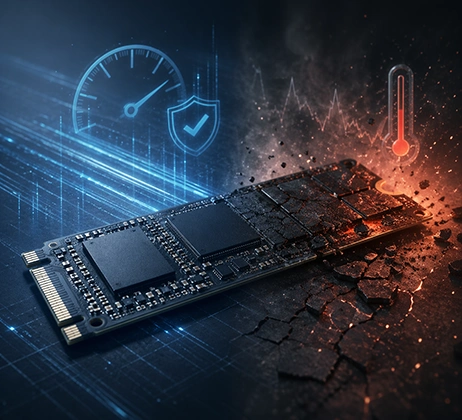
An SSD’s maximum lifespan is determined by the write endurance of its flash memory cells. SSDs store data on Флэш-память NAND chips and have no moving mechanical parts. Their key lifespan parameters include P/E cycles and TBW.
- Циклы P/E refer to the maximum number of program/erase cycles that each flash memory cell can withstand. The differences among flash types are very large: SLC flash supports about 100,000 cycles and is mainly used in enterprise-grade, high-endurance applications. MLC flash supports about 3,000 to 10,000 cycles and is mainly used in high-end consumer and enterprise products. The current mainstream TLC flash supports about 1,000 to 3,000 cycles. Entry-level QLC flash supports about 300 to 1,000 cycles.
- TBW, or Total Bytes Written, is the total amount of data that the manufacturer guarantees can be written to the drive over its lifetime, and it is the most direct reference metric for consumers. For example, a mainstream 1TB TLC consumer SSD is usually rated at 600 TBW, meaning that a total of 600TB of data can be written. If a user writes 150GB per day, the SSD can be used normally for more than 10 years. For ordinary office users, daily writes are only about 10–20GB, so the theoretical lifespan can reach several decades. SSDs also list an MTBF rating, usually between 1.5 million and 3 million hours, but this mainly represents the statistical reliability of electronic components rather than the actual lifespan caused by flash wear.
HDD lifespan is determined by the physical wear of mechanical components. HDDs use rotating platters and mechanical heads to read and write data, and the industry commonly uses MTBF, or Mean Time Between Failures, as the rating. Consumer HDDs typically have an MTBF of 1 million to 1.5 million hours, while enterprise products can exceed 2 million hours. It is important to note that MTBF is a statistical average for a group and does not represent the actual lifespan of an individual drive. For example, an MTBF of 1 million hours does not mean that a single HDD can run continuously for 114 years. Instead, it means that across a large sample, one failure occurs for every cumulative 1 million operating hours.
In real-world use, consumer HDDs typically have a physical lifespan of 3 to 5 years, far below the theoretical value converted from MTBF. Note that the 3–5 year figure refers to high-load, 24/7 operation in data centers and is a reference for reliable service life under the manufacturer’s rated workload. In normal home environments, where daily operating time is shorter and read operations are more common, mechanical wear is greatly reduced, and the actual physical lifespan can generally reach 7 to 10 years.
Typical Lifespan and Failure Mode Comparison
Different types of storage products show clear differences in service life, causes of failure, and failure characteristics.
| Тип | Typical Service Life | Core Failure Causes | Failure Characteristics |
|---|---|---|---|
| Consumer HDD | 3–5 years | Motor bearing wear, head crashes/scratches on platters, magnetic media aging, spreading bad sectors | Mostly gradual failure, accompanied by abnormal noises and slower read/write speeds; about 41% of failed drives show no prior SMART warning and may fail suddenly |
| Enterprise HDD | 5–7 years or more | Mechanical aging under 24/7 high loads, environmental vibration | Designed for continuous operation and has a longer lifespan than consumer models, but is still limited by the nature of mechanical wear |
| Consumer SSD (TLC) | 5–10 years or more | Rarely fails from write exhaustion under normal use; early failures are mainly caused by manufacturing defects or controller chip failure | Wear can be accurately predicted through SMART; no mechanical failures and resistant to shock and vibration; the first 90 days are a period with a higher rate of early failures |
| Твердотельные накопители для предприятий | More than 10 years | Flash cell exhaustion under extremely high write loads, controller aging | Much higher endurance than consumer models, with redundant designs such as power-loss protection and error checking |
Note: The service-life data in the table above are all based on enterprise and data-center scenarios involving continuous 24/7 operation. For ordinary light home and office use, consumer HDDs typically have an actual service life of 7 to 10 years, while consumer SSDs can usually be used for 8 to 10 years or more. Most are replaced because of performance upgrades before their lifespan is exhausted.
Real-World Validation from Large-Scale Statistics
Long-term operational data from multiple organizations consistently validate the reliability advantage of SSDs. The most representative public statistics come from Backblaze and IDC. Backblaze has published hard-drive reliability reports for 13 consecutive years. Based on real operating data from hundreds of thousands of drives, these reports are among the most authoritative public data sources in the industry. Its 2025 year-end report showed that the overall annualized failure rate of mechanical hard drives operating 24/7 in data centers fell to 1.36%, the lowest level in nearly four years.
During the same period and under the same conditions, SSDs had an annualized failure rate of about 0.98%, approximately 25% lower than that of mechanical hard drives. Over the long term, when mechanical hard drives reach their sixth year of service, their annualized failure rate rises above 8%, entering a period of frequent wear-related failures. By contrast, when SSDs reach their seventh year of operation, their annualized failure rate can still remain below 1%, showing a clear advantage in long-term stability.
Key Differences in Factors Affecting Lifespan
Main Factors Affecting SSD Lifespan
There are four main factors that have the greatest impact on Срок службы твердотельного накопителя.
- Total amount of data written. This is the most important factor determining SSD lifespan. The less data written, the longer the lifespan.
- Remaining storage space. Insufficient free space can increase write amplification and accelerate flash wear. Enabling the TRIM command can effectively optimize wear efficiency.
- Operating temperature. High temperatures accelerate charge loss in flash memory cells and shorten both service life and data-retention time when the power is off.
- Controller algorithms. High-quality контроллеры use wear-leveling technology to distribute writes evenly across all flash blocks, greatly extending actual lifespan.
Main Factors Affecting HDD Lifespan
The factors that have the greatest impact on HDD lifespan can also be divided into four categories.
- Physical shock and vibration. The gap between an HDD’s head and platter is only a few nanometers. Drops and vibration can easily cause the head to scratch the platter or damage the disk surface, making this the leading cause of damage in mobile use.
- Frequent power cycling. The motor and heads experience the greatest mechanical stress when the drive starts. Frequent starts and stops can significantly accelerate wear.
- Temperature and dust. High temperatures can cause spindle-motor lubricant to evaporate and reduce the stability of the magnetic media. Dust entering the drive enclosure can directly cause physical bad sectors.
- Continuous operating time. Consumer HDDs are not designed for 24-hour continuous operation. Long-term operation under full load can greatly shorten their lifespan.
Lifespan Performance in Different Use Cases
Everyday Office, Home, and Gaming Use
In low-write, low-intensity use cases such as everyday office work, home use, and gaming, SSDs have better overall lifespan performance. In a normal home environment, HDDs typically have an actual service life of 7 to 10 years, while SSD write endurance is far higher than the daily write volume of ordinary users. They generally do not fail because of flash wear and can usually be used for 8 to 10 years or more, until their performance no longer meets usage needs and they are naturally replaced. At the same time, SSDs are not easily affected by movement or bumps in laptops, have a much lower failure rate than HDDs, and provide a better everyday user experience.
High-Write-Load Scenarios
Enterprise SSDs are generally more reliable overall. Although HDDs theoretically have no limit on the number of writes, mechanical failures occur frequently under high loads, resulting in higher maintenance and operating costs. Enterprise SSDs have very high TBW ratings; for example, a 4TB enterprise SSD can reach more than 2400 TBW, and it also has a higher ВРЕМЯ НАРАБОТКИ НА ОТКАЗ, resulting in lower overall operating and maintenance costs.
Cold Storage and Long-Term Archiving
HDDs have a certain advantage in the natural retention time of data. When powered off, data stored on HDD magnetic media can remain stable for 10 to 20 years or more, while the charge in SSD flash memory gradually dissipates. At room temperature, SSD data retention is usually 1 to 7 years, and the higher the temperature, the shorter the retention time. However, SSDs are more resistant to handling and will not be damaged by mechanical vibration during storage.
Mobile Storage and Outdoor Equipment
The advantage of SSDs is even more obvious. HDDs have a very high damage rate in mobile and bumpy environments, while SSDs can withstand shocks of more than 1500G. HDDs can usually withstand only about 300G, giving SSDs stronger environmental adaptability.
In the vast majority of consumer and enterprise online-use scenarios, SSDs have a longer practical service life and higher reliability than HDDs. Only in specific scenarios involving very low write activity and long-term powered-off cold storage do HDDs have a longer natural data-retention period, although their overall failure rate is still higher than that of SSDs. For ordinary users, prioritizing SSDs as the system drive and for frequently used storage, while using HDDs for large-capacity cold archives to reduce the cost per unit of storage, is a reasonable way to balance lifespan and cost-effectiveness.