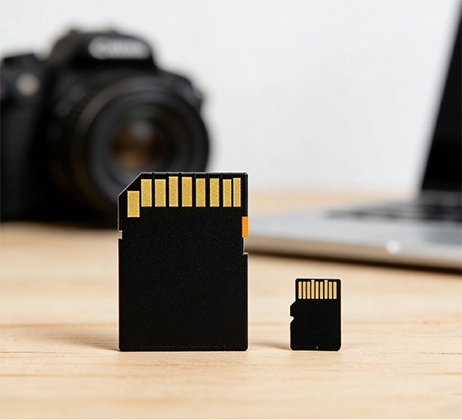
The topic of “TF card for camera” has long been a subject of clear debate online. Some users argue that using a TF card with an SD adapter is essentially no different from using a native SD card and works perfectly fine for everyday shooting. Others insist that this setup has clear disadvantages in speed and stability, especially during burst shooting or high-bitrate video recording, and advise against it. These conflicting conclusions stem from real-world experiences. The core issue is that discussions often miss a crucial point: different users have different camera levels, shooting demands, and expectations. Judgments made without considering the specific context lack reference value.
The Essential Connection Between TF Cards and SD Cards
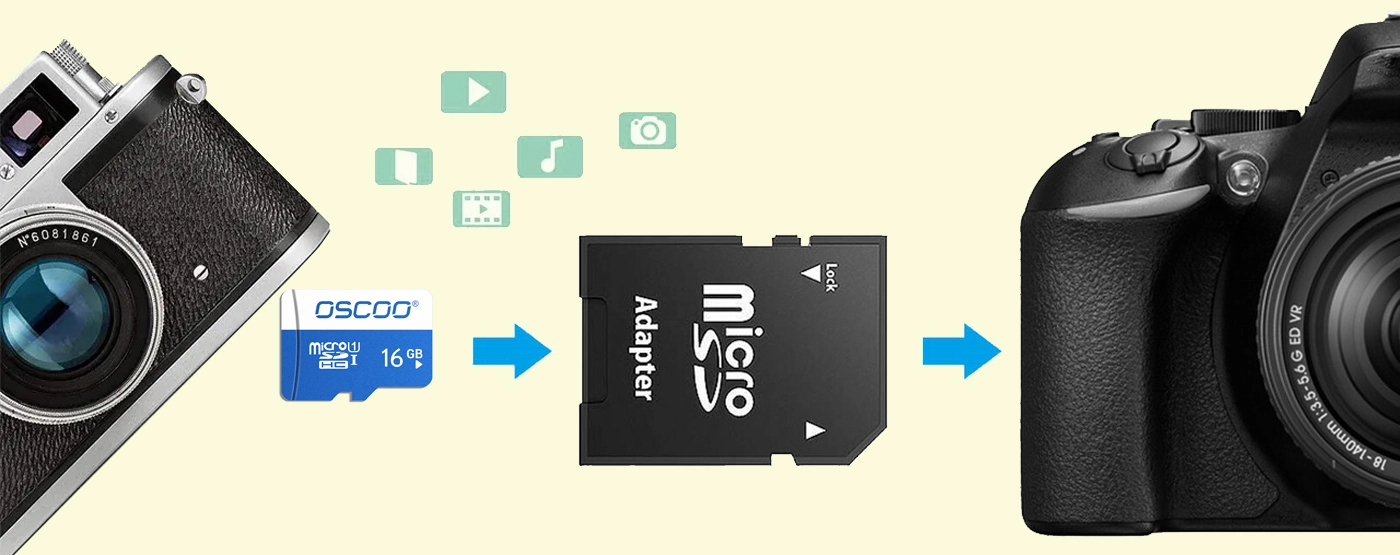
A TF card (also known as a microSD card) is fundamentally part of the SD card standard. In terms of electrical protocols and data transfer, there is no essential difference between a TF card and a full-size SD card. They use the same communication protocol and support the same speed class ratings like UHS-I, Speed Class, and Video Speed Class. The primary function of an SD card adapter is to convert the TF card’s physical size and contact points to the standard SD card form factor. This process does not involve protocol conversion or any active chips. For the camera, it simply recognizes a storage device that complies with the SD standard; it cannot tell whether the slot contains a native SD card or a TF card with an adapter. Therefore, from a standards perspective, this usage is not non-standard or irregular. This is why most cameras can recognize, format, and use a TF card with an adapter without issue, leading many users to feel “there’s no difference” in practice.
Usable Doesn't Mean Equally Suitable
The core question isn’t “Can the camera recognize the TF card?” but rather “Does it perform consistently under sustained high-write loads?” Structurally, using a TF card with an adapter introduces an extra layer of physical connection compared to a native SD card. Data must travel from the camera’s SD slot to the adapter, then through the adapter’s contacts to the TF card itself. This process doesn’t inherently slow things down, but it introduces more variables, such as contact quality, the adapter’s internal wiring, and connection stability.
These variables rarely cause problems in low-demand scenarios: during single photo capture, intermittent writes, or low-bitrate video recording, the storage system is under less pressure. The camera’s buffer can easily mask any performance differences between the TF card and SD card, so users naturally don’t notice any issues. However, in high-demand scenarios like high-speed burst shooting of RAW files or recording high-bitrate video, the storage medium must maintain stable write performance over extended periods. Here, any extra uncertainty can be amplified into noticeable performance fluctuations, such as slower buffer clearing, interrupted burst shooting, or even automatic video stoppage. This explains why some users have no problems with a TF card and adapter for years, while others quickly hit limitations—the divergence in experience stems from different usage loads, not from one group being right and the other wrong.
Are TF Cards Really "Slower"?
The common statement “TF cards are slower” is not entirely accurate. Looking at product specifications, high-end TF cards do not necessarily have lower sequential read/write speeds than comparable SD cards. In camera usage, sustained write performance and stability matter more than short-term peak speeds. Because TF cards are smaller, they have more limited heat dissipation capabilities. Furthermore, different manufacturers use varying controllers and NAND flash memory. When used in a camera via an adapter, these differences combine with the adapter’s quality and the camera’s controller characteristics, making overall performance harder to predict.
So, rather than saying “TF cards are definitely slower,” it’s more accurate to say “the TF card + adapter combination has a potentially lower performance floor and less predictable performance.” Under ideal conditions (good adapter, high-performance TF card, compatible camera), it can approach or even match the performance of a similar SD card. But in combinations with poor adapters, average TF cards, or less adaptable camera controllers, problems are more likely to appear.
Why Do Manufacturers Typically Recommend SD Cards?
An often-overlooked reality is that when camera manufacturers design and test their products, the default storage medium is almost always the standard-size SD card. Verification processes for buffer management, write scheduling, and error handling are based on mainstream SD card models and speed classes. The use of a TF card with an adapter is typically not part of most official testing routines. This doesn’t mean the TF card setup will definitely fail, but if abnormalities occur, manufacturers often won’t provide explicit support for this “non-recommended configuration.”
For users, this means that if a write error happens during an important shoot, getting an effective solution from the manufacturer might be difficult. Therefore, the TF card option is more of a “compatible” choice rather than a “recommended” one. This is particularly important for users who prioritize stability.
When is a TF Card Acceptable, and When is an SD Card Preferred?
The suitability of a TF card depends primarily on the camera’s capabilities and the shooting demands. Performance and risk vary significantly across different scenarios.
Light-Demand Scenarios: TF Card is a Practical Option
For entry-level or mid-range cameras, the storage system is often not the main performance bottleneck. These cameras typically have smaller buffers, more conservative burst speeds, and lower video specifications, placing less extreme demands on the card’s sustained write speed. During everyday photography (especially intermittent RAW file capture) or recording 1080p or low-bitrate 4K video, the camera’s buffer can handle the short bursts of data. If the TF card’s specs are genuine and the adapter is of good quality, the setup will suffice, and users are unlikely to notice any difference compared to an SD card.
In these cases, the advantages of the TF card solution are flexibility and cost: it can be shared with phones, action cameras, etc., avoiding extra expense. It’s a practical choice based on compromise. However, it’s important to note that even here, the TF card is rarely the “optimal” solution. A native SD card has structural advantages: fewer contact points, a clearer product positioning, and more mature camera compatibility, generally offering better stability and long-term reliability.
High-Demand Scenarios: SD Card is the Safer Choice
When shooting demands increase—such as high-speed burst shooting, writing large numbers of RAW files, or extended recording of high-bitrate video—the card’s sustained and stable write performance becomes critical. The camera’s buffer only provides a brief pause; the card itself ultimately determines whether the shoot proceeds smoothly.
During high-speed bursts, if the card’s sustained write speed is insufficient, the camera will quickly enter a “buffer wait” state, interrupting the sequence. High-bitrate video recording is extremely sensitive to write stability; even a momentary dip in speed can cause recording to stop. This risk is unacceptable in non-repeatable scenarios like commercial shoots or event coverage (e.g., weddings, sports). The uncertainties of the TF card + adapter combination are magnified under high load. Even if the TF card’s rated specs seem adequate, the adapter’s quality and connection stability can become weak links.
Furthermore, from a risk management perspective, if the footage is irreplaceable (like a wedding or unique event) or the shoot cost is high, any additional uncertainty carries a disproportionate potential for loss. Choosing a native SD card in these cases is essentially about reducing system complexity and potential failure points, not just about chasing higher performance. This is a more rational engineering choice.
结论
- If your shooting primarily involves light loads, the footage is replaceable, and you value sharing the card between devices or keeping costs down, the TF card option is a practical and viable choice.
- If your shooting frequently involves high-demand situations, the footage is irreplaceable, and you prioritize stable, controllable workflow, then a high-quality SD card that meets your camera’s specifications remains the lowest-risk and most worry-free option.